

























































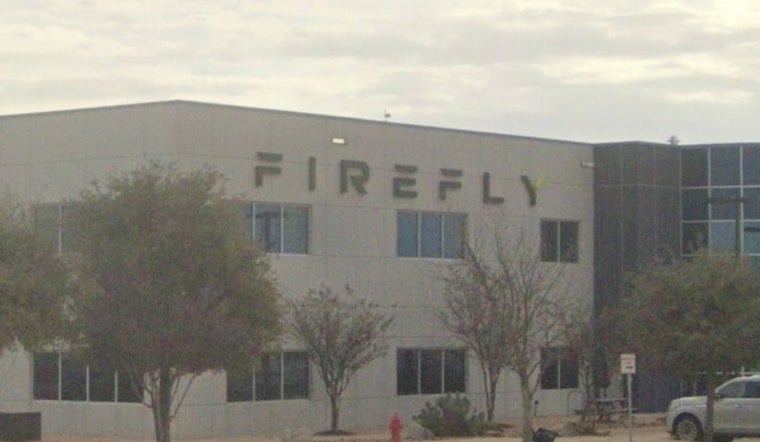
Central Texas just scored a front row seat in NASA’s return to the Moon. Firefly Aerospace, the Austin-area company headquartered near Cedar Park, has been tapped to help NASA scope out a future Moon base with a fleet of rocket-powered scouting drones.
Under a $75 million subcontract tied to the agency’s Moon Base effort, Firefly will deliver four small vehicles that will hop around the lunar south pole, diving into terrain that sunlight never reaches. Once there, the drones are designed to map potential landing zones in unprecedented detail and keep sending data even after temperatures crash during the long lunar night.
The mission is targeted to launch no earlier than 2028 and will ride to space on Firefly’s Elytra carrier spacecraft. From liftoff to lunar arrival, the journey is expected to take roughly 45 days.
According to Firefly Aerospace, the company received the subcontract from NASA’s Jet Propulsion Laboratory and will deploy the four drones from its Elytra orbital vehicle about 50 kilometers above the lunar south pole. The Elytra Dark configuration draws on systems proven through Firefly’s Blue Ghost program and is built to haul roughly 1,000 kilograms of drone hardware for the MoonFall mission.
Firefly is pitching the award as part of a larger strategy to back up Artemis-era surface operations with repeat robotic scouting and cargo runs, not just a one-off science flight.
What MoonFall’s drones will do
According to NASA’s Jet Propulsion Laboratory, each JPL-built drone will carry multiple high-definition cameras and science instruments, then make several propulsive flights during a single lunar day, which lasts up to 14 Earth days. At the end of their hopping campaigns, the vehicles will activate long-duration payloads at their final landing spots.
NASA officials told reporters that the drones are expected to generate terrain maps at roughly centimeter-scale resolution, a level of precision that could sharply reduce risk for future crewed landings, according to the Houston Chronicle.
With almost no atmosphere on the Moon, rotors are useless, so these are not the kind of drones you see buzzing over a neighborhood backyard. Instead they will fire rocket engines to reach steep slopes and permanently shadowed pockets where water ice may be preserved.
Why Cedar Park is in the middle of it
Locally, the MoonFall win lands at a moment when Firefly is rapidly scaling up. The company has more than doubled its Cedar Park-area campus and added a much larger cleanroom so it can build more spacecraft at once. That expansion, paired with the subcontract, has been framed as a boost for central Texas manufacturing and high-tech jobs, according to reporting from the Austin American-Statesman, and city leaders have been quick to point to a growing cluster of launch and spacecraft work around Austin as an economic bright spot.
In a statement via Firefly Aerospace, CEO Jason Kim called MoonFall “an incredible breakthrough mission” and said the award builds on the company’s recent lunar work. Firefly has highlighted its Blue Ghost lander, which completed successful surface operations in 2025, as a technical foundation for both Elytra and the MoonFall assignment.
The subcontract follows NASA’s late May Moon Base announcements that laid out an accelerated schedule of robotic missions to scout and prepare the south pole, according to NASA. Between Blue Ghost’s proof of concept and Firefly’s expanded Cedar Park production lines, the MoonFall selection reads as a bet on building up industrial capacity for sustained lunar operations as much as it does a single science mission.





