

























































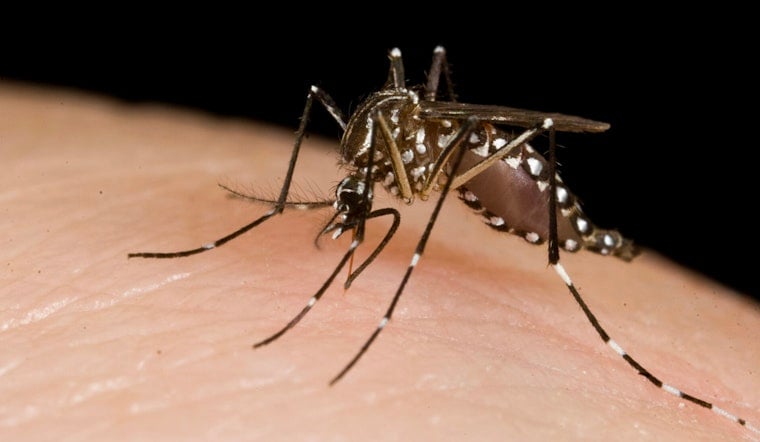
Low-flying helicopters are set to buzz over marshes and wetlands in the Bronx, Brooklyn, Queens and Staten Island next week, as the New York City Health Department rolls out its latest attack on mosquito season.
From next Monday through Wednesday (June 8–10), weather permitting, the agency plans to drop larvicide on nonresidential breeding grounds that ground crews cannot easily reach. The aerial work is slated between 6 a.m. and 7 p.m. each day and is aimed at tamping down mosquito activity early and cutting the risk of West Nile virus before it ramps up later in the summer.
As reported by PIX11, the operation will cover specific marsh and park areas, including Fresh Creek Basin and Marine Park in Brooklyn, Alley Pond Park, Rosedale and parts of College Point and Edgemere in Queens, Pelham Bay Park in the Bronx and multiple Staten Island sites such as Fresh Kills, Wolfe's Pond and South Beach. The outlet notes that the helicopters are scheduled to fly from 6 a.m. to 7 p.m. and that affected ZIP codes include Queens codes 11354, 11355, 11356, 11361, 11362, 11363, 11364, 11365, 11413, 11422, 11430, 11691 and 11692, along with Brooklyn codes 11207, 11229, 11234, 11236 and 11239. PIX11 also lists June 11, June 12 and June 15 as rain dates if weather scrubs the first round of flights.
How the drops work
The Health Department will use EPA-approved, biologically based larvicides that target mosquito larvae, commonly formulations containing Bacillus thuringiensis israelensis (Bti), which are designed to break down quickly and pose minimal risk to people, pets and most wildlife, according to the U.S. Environmental Protection Agency. The EPA notes that Bti needs to be eaten by mosquito larvae to be effective and that these manufactured products are short lived in water, which makes them a go-to tool for focused larval control instead of blanket spraying.
That targeted approach is why agencies favor larviciding in hard-to-reach marshes and wetlands in the first place. The idea is to hit the standing water where mosquitoes breed so the larvae never make it to winged adulthood.
Why the city is doing this
The aerial drops are one piece of the Health Department's seasonal surveillance and control strategy, which is designed to knock down mosquito numbers and lower the chance of West Nile virus. The helicopter work is limited to nonresidential marsh and wetland areas. Ground crews handle catch basins and neighborhood trouble spots, and the city reserves truck-based adult mosquito spraying for areas where testing actually finds infected mosquitoes.
According to the NYC Health Department, the agency posts maps and advance notices and alerts elected officials and community boards before spraying or larviciding operations move ahead.
What residents should know
People who live near the listed marshes and parks can expect low-flying helicopters during the scheduled hours. Health officials recommend steering clear of marsh edges while the aircraft are operating, securing loose outdoor items and keeping pets away from treated wetlands.
Residents are encouraged to report persistent standing water to 311 and to sign up for localized alerts through Notify NYC for 24-hour updates on pesticide activity and schedule changes. To cut down on bites, the Health Department also suggests using EPA-approved insect repellents and fixing or replacing window screens so mosquitoes have a harder time slipping indoors.
Background and timing
Aerial larviciding has become a routine, targeted tool in the city's mosquito-control playbook. The Health Department typically posts public notices with mapped boundaries and ZIP-code lists whenever drops are scheduled, similar to the current alert.
In recent years, helicopter larviciding has been coordinated with on-the-ground work, and the department's 2026 mosquito surveillance and control plan outlines how aerial and ground treatments are meant to fit together. For maps and technical details on that broader strategy, see the 2026 mosquito plan from the NYC Health Department.




.jpg)