

























































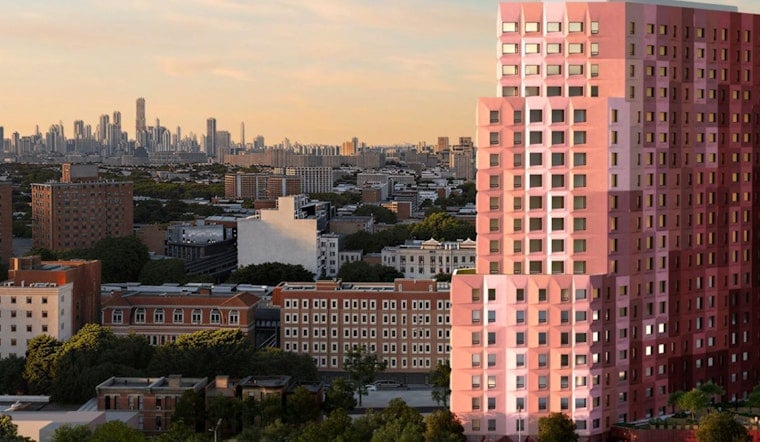
The fenced-off bus parking lot at 2031 Eastern Parkway, on a block cut in two by a wide freight rail tunnel and a short walk from the Broadway Junction transit hub, is on track to trade asphalt for apartments. The site is slated for a 20-story, 379-unit building made up of 100% affordable housing, with the developer and design team promising on-site supportive services and a slate of climate-forward systems, including a mass timber structure, geothermal wells and a Passive House level envelope. Studio Gang is listed as design architect, with The Doe Fund as the nonprofit operating partner. The team is currently aiming to break ground in 2027.
Developer Says Acquisition Unlocked Big Public Value
According to Coconut Properties, the site changed hands for about $19 million and, after entitlement, was appraised at roughly $27 million. The roughly $8 million uplift is framed by the developer as "public value" that will be steered back into affordability and sustainability measures. Coconut’s project page outlines plans for 379 homes with an average affordability around 50% of area median income, a 227-foot-tall, 20-story mass-timber-forward building and features that include a self-shading façade and a rooftop greenhouse.
BSA Variance Cleared the Way
The conversion from bus lot to housing is made possible through a Board of Standards and Appeals variance that allows residential use on what is currently an M1-1 manufacturing-zoned property, according to the BSA decision. The ruling cites unusual physical conditions on the site, most notably an approximately 80-foot-wide Long Island Rail Road tunnel running beneath much of the parcel, and describes a program of about 378 units, with a portion reserved for supportive housing and services. The BSA record notes that the application drew letters both in support of and in opposition to the plan, and that the Board attached specific conditions to its approval.
Design Aims to Be Both Green and Social
Studio Gang’s description of the project leans heavily on sustainability and shared spaces, highlighting a mass-timber community room, bird-friendly glazing, on-site geothermal wells and landscaped plazas that open directly to the street. As detailed by Studio Gang, the building takes its cues from the diagonal geometry created by the freight line, using that angle to shape a self-shading façade and a series of shared gardens. The idea is to tie high-performance building systems to affordable, service-rich housing that still feels welcoming at ground level.
The Legal Hinge: Cornell Doctrine
The development strategy leans on a Board of Standards and Appeals interpretation of the Cornell doctrine that in recent years has been extended to nonprofit developers proposing 100% permanently affordable housing. The doctrine, along with the Board’s 2018 application of it in a separate case, underpins the legal reasoning that allows the BSA to grant relief from otherwise prohibitive use restrictions for projects cast as providing substantial public benefit. The 2017–18 BSA decision that set that precedent is part of the case law this application cited.
Local Backing, Local Trade-Offs
Project coverage notes that Coconut Properties and its partners sought and received informal support from local elected officials and Community Board 4 before filing, framing the plan as a way to turn an underused bus lot into deeply affordable homes near a major transit hub. As reported by The Real Deal, advocates and officials have praised the project’s affordability targets and sustainability focus, while some neighbors have raised familiar worries about height, density and additional pressure on nearby transit.
What’s Next
The developer is still targeting a 2027 groundbreaking and says it is continuing design and funding work with partners including The Doe Fund and the architect-of-record team. The BSA decision and project filings indicate that, because of the rail tunnel below the site, the developer will need to coordinate final construction approvals with both rail and city agencies, and that the precise construction timeline will hinge on financing and city subsidy commitments. If the project moves ahead as planned, it would bring hundreds of deeply affordable apartments within walking distance of one of east Brooklyn’s major transit nodes.
Why This Matters
The Eastern Parkway proposal offers a compact case study in how zoning minutiae, legal precedent and design ambition can combine to unlock large amounts of affordable housing on parcels that would otherwise be off limits. Whether this playbook, using BSA precedent to turn industrially zoned lots above infrastructure into affordable housing, becomes a repeatable model will depend on whether financing, community buy-in and agency coordination all line up in the months and years ahead.



