

























































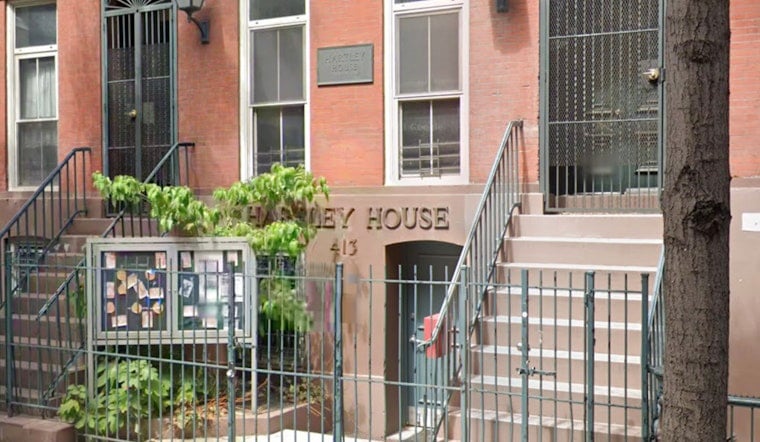
On Tuesday night in Hell’s Kitchen, four of the Democrats vying to represent New York’s 12th Congressional District found themselves on the hot seat. For 90 minutes at Hartley House, neighbors pressed them on a grab bag of very local headaches: Penn Station’s uncertain overhaul, the contentious Fulton and Elliott-Chelsea public-housing proposal, safety along Eighth Avenue, and gaps in nearby social services. With the June 23 primary fast approaching, the forum made it clear that block-by-block concerns could carry as much weight as big money and big-name backing.
The forum was organized by the Hell’s Kitchen Neighborhood Coalition and the West Side Neighborhood Alliance and held at Hartley House, 413 West 46th Street, according to the neighborhood group’s event listing. The Garment District Alliance noted the event was set for early June and capped at roughly 100 in-person seats. As W42ST reported, Nina Schwalbe, Alex Bores, Jack Schlossberg and Micah Lasher fielded questions directly from residents throughout the session.
Local Priorities Took Center Stage
Audience questions zeroed in on projects that shape daily life on the West Side. The Fulton and Elliott-Chelsea redevelopment plan, in which NYCHA and private partners propose tearing down aging buildings and replacing them with new construction, remains especially fraught for tenants and advocates, according to NYCHA. Meanwhile, coverage of the Penn Station renovation and the related Gateway program has repeatedly raised alarms over timelines and transparency, leaving commuters and small-business owners pressing for firmer commitments on schedules and oversight, as noted by ABC7NY.
Money And Momentum In The Primary
With Rep. Jerry Nadler stepping aside, NY-12 has become a magnet for attention, endorsements and outside cash in a district that stretches across the Upper West Side, Midtown and Chelsea. State of Politics reported that Micah Lasher is backed by millions in spending from Michael Bloomberg, while early polling covered by City & State showed Jack Schlossberg starting out with an advantage. The June 23 primary date appears on the official contest list from the Board of Elections.
Candidates Tried To Localize Policy
On stage, the four contenders worked to turn broad talking points into neighborhood-specific pitches. Lasher leaned on his government background and a roster of endorsements. Bores focused on technological fixes and housing policy. Schwalbe framed many issues through a public-health lens and the role of social services. Schlossberg highlighted his famous last name and his pledge to bring “new energy” to Congress. Those contrasts have been on display in earlier debates and community events, which have helped voters judge how each might deliver for Manhattan blocks, as reported in prior coverage by La Voce di New York.
What Comes Next
By the end of the night, residents had effectively handed the candidates a to-do list: credible timelines for major infrastructure projects, tighter protections for NYCHA tenants during redevelopment, and visible safety improvements along neighborhood corridors. Turning that pressure into clear, written plans may be crucial for anyone hoping to win over the older, civically active voters who tend to dominate Manhattan primaries. More community forums and targeted meet-and-greets are likely before June 23, with hyperlocal details poised to matter more than sweeping national rhetoric.





