

























































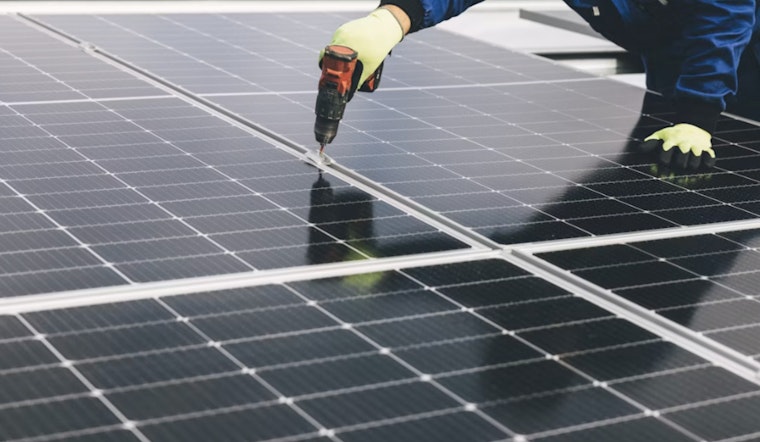
SEG Solar is cranking up the wattage in Greater Houston, unveiling plans for a third U.S. manufacturing plant that will add about 4.6 gigawatts of annual module capacity and lift the company’s planned domestic output to roughly 10.6 GW. The project is slated to wrap construction in March 2027, with commercial production expected to kick off in May 2027, further cementing the region’s growing solar manufacturing cluster.
The company laid out the expansion in a press release via PR Newswire, saying the new facility is being designed to support FEOC-compliant module production and a shift toward heterojunction (HJT) technology. The release also noted that by the end of 2025 SEG expects to have shipped more than 7.5 GW of modules worldwide and to have reached a module production capacity of roughly 6.5 GW.
Renewables Now reports the Houston-area site will combine factory and warehouse space across about 1.15 million square feet, and that SEG has signed an agreement with a local construction company to develop the build. Trade coverage from Solar Power World adds that the plant appears to sit adjacent to SEG’s recently announced second U.S. factory and will be configured to produce n-type HJT modules.
The latest project arrives as SEG readies a separate 4 GW Houston-area factory with a grand opening set for August 7, 2026. SEG previously described that earlier expansion as a roughly $200 million investment expected to create up to 800 jobs, according to a company release. Local officials and workforce groups say projects of this scale typically trigger additional technician, logistics and supplier hiring that can reshape nearby industrial corridors.
What This Means For Houston
Federal manufacturing incentives, notably the Section 45X advanced manufacturing production credit, have helped ignite a wave of U.S. module plant announcements. PV-Tech and other analysts say those credits are now a major factor in where factories land, especially for developers chasing domestic-content bonuses and more resilient supply chains.
For Houston, that policy backdrop translates into real-world jobs and a steady stream of related logistics work, even as upstream wafer and cell capacity increases at a slower pace. The clustering of SEG facilities in the region suggests a long-term bet on Houston as a hub for solar hardware, not just oil and gas.
Technology And Supply Chain
SEG says the new plant is being planned around a transition to heterojunction technology, a higher-efficiency n-type architecture that the National Renewable Energy Laboratory tracks as a promising pathway for advanced silicon cells. NREL notes that HJT cells can deliver strong conversion efficiency and favorable temperature performance compared with older designs.
Industry reporting also indicates SEG has begun planning for an ingot and wafer facility in Indonesia while evaluating U.S. locations for a dedicated HJT cell plant, a strategy the company says would help secure upstream inputs while keeping module assembly local. Solar Power World has detailed those upstream plans and technology goals.
What comes next bears watching: permits, which local contractor ultimately oversees site work, and how SEG sequences its hiring as it moves from announcement to shovels in the ground. If the current timetable holds, panels from the new line could be rolling off the assembly floor in May 2027, giving Houston an even firmer foothold on the U.S. solar manufacturing map.




