

























































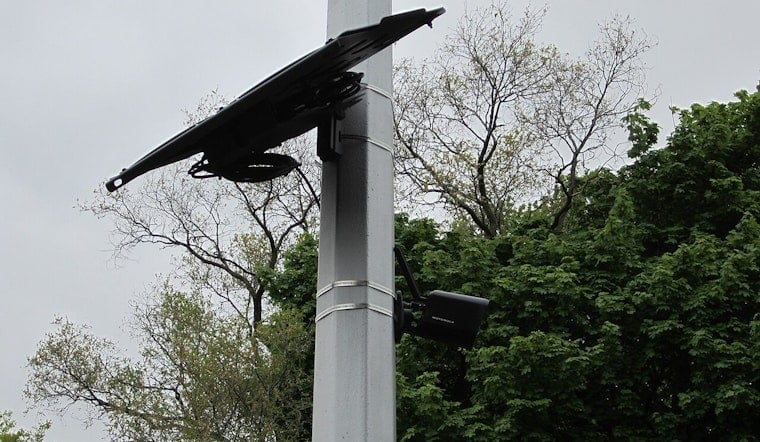
Imperial Beach’s City Council voted Wednesday to launch a two-month pilot that will roll out four automated license plate readers and two public safety cameras across the South Bay beach city, in partnership with the San Diego County Sheriff’s Office. The unanimous decision sets up a short trial meant to give deputies and city staff real-world data on whether plate readers and street cameras actually help solve crimes.
Plan, hardware and where the devices will be placed
Under the pilot, the city will deploy Flock Safety automated license plate readers at four intersections: Imperial Beach Boulevard and 13th Street, Palm Avenue and 13th Street, 13th Street and Elm, and 9th Street and Elm Avenue. Public safety cameras will be installed at medians on Palm Avenue and 8th Street, Palm Avenue and Seacoast Drive, and Imperial Beach Boulevard and Seacoast Drive.
City staff told the council that the San Diego County Sheriff’s Office had suggested eight readers, but the city chose to start smaller with four for the two-month test. Officials noted that plate reader hits have previously helped generate leads in cases such as retail thefts, gas station thefts, vehicle burglaries and an international hit-and-run homicide. As Times of San Diego reported, the move is intended to walk a line between investigative value and community concerns.
Council response and public comment
During public comment, speakers urged the council to be wary of expanded surveillance and the risk of misidentifications, while council members focused on the promise of quick investigative leads.
“This is a pilot program. We have to consider the trade-off of privacy for security,” public speaker Vivian Dunbar told officials. Mayor Pro-Tem Jack Fisher said he believed the benefits outweigh the privacy concerns, and the council ultimately voted unanimously to enter the agreement, according to Times of San Diego.
How the sheriff frames the technology
The San Diego County Sheriff’s Office describes automated license plate readers as a tool to locate wanted or stolen vehicles and to generate investigative leads. Plate reads feed into a system that can produce alerts deputies act on. The agency states that data is typically retained for only a short window unless it is preserved as part of an active investigation.
The sheriff’s SafeStreets program page also highlights training requirements and access controls for staff who query the system, according to the San Diego County Sheriff’s Office.
Privacy concerns and the regional debate
Imperial Beach’s move comes amid broader scrutiny of license plate surveillance along California’s border region. Reporting has documented a patchwork of deployments, including covert devices on rural highways that have drawn warnings from civil liberties groups.
Coverage by the Los Angeles Times and inewsource has helped fuel calls from organizations such as the Electronic Frontier Foundation to limit hidden readers and to tighten rules on how agencies share plate data with one another.
What’s next
The two-month trial is expected to give city staff and sheriff’s deputies a limited dataset to judge whether the technology is effective before any potential expansion. Staff are scheduled to return to the council with findings and recommendations once the pilot wraps up.
Other nearby cities are wrestling with similar choices. A longer pilot in Santee underscores how municipalities across the county are splitting between testing these tools and tightening safeguards around them.
Legal questions
State officials are already weighing in on how agencies use automated license plate readers. CalMatters and other outlets note that the attorney general has sent letters to multiple agencies over possible out-of-state data sharing and has sued one San Diego County city, while Gov. Gavin Newsom vetoed a bill last year that would have tightened statewide ALPR rules.
Those moves mean local contracts and policies will need clear limits on who can access the data, how long it is kept and how audits are conducted, according to CalMatters.




