

























































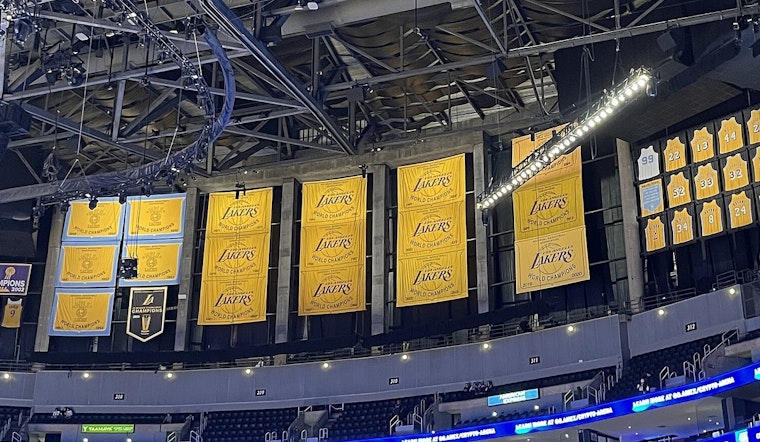
The Los Angeles Lakers head into the 2026 NBA Draft with a late first-round pick and a summer full of uncomfortable questions. Holding No. 25 and staring at a roster loaded with free agents and option years, the front office has to decide whether that pick becomes a plug-and-play rotation piece or a longer-term project. This guide breaks down which types of players realistically fit at that spot, how L.A.’s weaknesses make certain profiles more attractive, and the cap and roster math that will shape the decision. Expect the organization to walk a tightrope between immediate help and low-risk development over the coming days.
Where No. 25 Sits And What It Really Buys
The Lakers arrive at draft weekend holding the 25th overall selection as their lone first-round pick, a slot that usually produces upside role players or handy trade chips. NBA.com notes that L.A. controls only that single pick this year, which naturally narrows the strategy. The team can either draft and develop a frontcourt piece or flip the pick in a deal for an established rotation player. With an aging core and a relatively short contention window, both approaches are defensible, and neither can be treated casually.
Offseason Ledger: LeBron, Options And Who Is Actually Available
The roster picture is crowded and messy. Multiple veterans are on expiring deals, and several role players hold team or player options that will determine how aggressive the Lakers can be on draft night and beyond. Spotrac lists key expirations and option decisions, including LeBron James, Rui Hachimura, Luke Kennard, Maxi Kleber and Jaxson Hayes. It also shows Deandre Ayton with a player option figure that must be baked into any long-range planning. That level of uncertainty nudges L.A. toward prospects who can step into real minutes quickly or at least function as tradable contracts if the front office chases proven help.
What The Numbers Say About Need
Advanced metrics paint a fairly blunt picture of where the pick can help. As reported by The New York Times, the Lakers ranked near the bottom of the league in catch-and-shoot three-point volume and in rim protection, and they also lagged in offensive rebounding and average team speed. Put simply, they did not shoot enough, did not deter enough at the rim, did not grab enough extra possessions and did not fly around the floor the way elite teams do. Those issues point to two clear priority archetypes for the 25th pick: a switchable interior defender who can rebound and protect the rim, or a ready-made 3-and-D wing who punishes defenses when the ball collapses into the paint.
Fits At No. 25: Bigs And Switchable Frontcourt Pieces
One obvious route is a high-ceiling, switchable big. Houston’s Chris Cenac Jr. keeps surfacing as a potential target, a 6-foot-11 forward/center with mobility, rebounding instincts and obvious room to grow on offense. His draft profile lists his birthday as Feb. 1, 2007, which underscores how much youth a late-first team could be betting on at that spot. His scouting breakdown is available at NBA.com.
Another frontcourt name that appears in mock drafts is Cincinnati’s Baba Miller, a 6-foot-11 playmaking forward who produced roughly a 13.0-point and 10.3-rebound season and brings perimeter-switching length to the table. Draft coverage and team blogs have framed him as an immediate-impact rotation option rather than a pure long-term stash, with profile and stat context drawn from Bright Side Of The Sun.
Spacing Help And Cheaper Shooting
If the Lakers pivot toward floor spacing instead, there are wings and guards projected in the 20s who can drift to the corners and bury open looks. The Times’ draft guide highlights shooters who match L.A.’s catch-and-shoot needs, including prospects who showed both volume and efficiency from deep at the college level. A 3-and-D rookie at No. 25 would come at a rookie-scale price, slide more easily into rotation minutes and could materially improve Luka Doncic’s spacing by knocking down the open triples that currently go begging.
How The Front Office Is Likely To Play Pick No. 25
Given all the uncertainty around contracts, options and the cost of in-season upgrades, No. 25 will be judged on a simple scale: immediate floor value versus tradability. The pragmatic route for L.A. is to grab the best available player who clearly checks one of the team’s obvious boxes, whether that is rim protection, defensive switchability or trustworthy corner shooting, and to move the pick only if a trade target brings obvious, proven upside. For a franchise juggling a contention window against payroll flexibility, cautious and clear-eyed decision-making fits the moment.
Bottom line: No. 25 is modest in draft capital but huge in terms of optionality. Whether the Lakers turn it into a long-term center, a switchable forward or a trade chip for veteran help will depend as much on free-agency movement and pending contract calls as it will on which names are still glowing on the board when L.A. is finally on the clock.



