

























































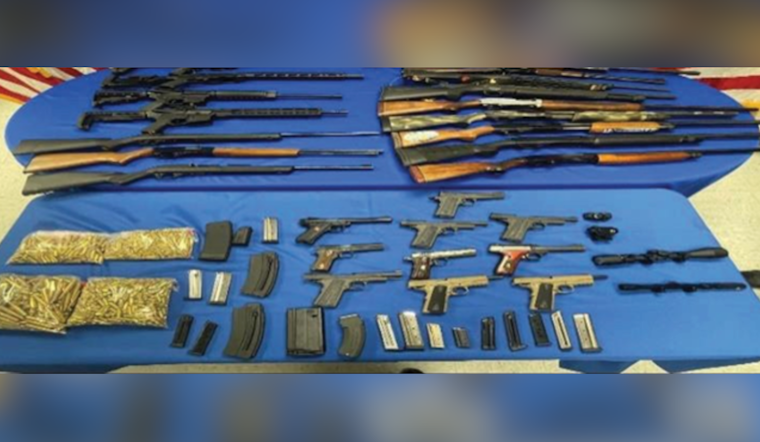
Fernando Munguia Jr., a 24-year-old Leesburg resident, has been sentenced to four years in federal prison after admitting he falsified firearms-purchase paperwork and caused a licensed gun dealer to keep bogus records. Prosecutors say Munguia spent much of 2023 buying guns on behalf of other people, then entered a guilty plea on January 26, 2026, according to West Orlando News.
Records Show 44 Guns, Thousands Spent
Federal records show Munguia purchased 44 firearms between January and November 2023, paying a total of $23,334.25 and often picking up several of the same model in a single visit. The paper trail turned into a border case when nine of those weapons were later intercepted on May 27, 2023, as U.S. Customs and Border Protection stopped someone trying to move them into Mexico, according to the U.S. Attorney’s Office for the Middle District of Florida.
How Investigators Closed In
The investigation was led by the Bureau of Alcohol, Tobacco, Firearms and Explosives, with help from Homeland Security Investigations and U.S. Customs and Border Protection. Assistant U.S. Attorney Hannah Nowalk Watson handled the prosecution, which federal officials say is part of a broader “Operation Take Back America” push to choke off weapons flowing to transnational criminal organizations, as reported by West Orlando News.
Why Straw Purchases Are a Big Deal
Authorities say Munguia’s behavior fits the classic “straw purchase” pattern: someone with a clean record buys guns for another person while falsely claiming to be the actual buyer on federal forms. The Bureau of Alcohol, Tobacco, Firearms and Explosives warns that this tactic undercuts background checks and makes crime-gun tracing harder, and that the agency routinely treats such cases as felonies. The Bureau of Alcohol, Tobacco, Firearms and Explosives runs its “Don’t Lie for the Other Guy” campaign to spell out how straw buying works and highlight the penalties that can follow.
The Long List of Charges, and the Actual Time
When Munguia was first indicted, federal prosecutors laid out a charging sheet that, on paper, could have locked him up for a very long time. Nine counts of making a materially false statement and nine counts of causing a federal firearms licensee to maintain false records added up to a theoretical maximum of more than a century behind bars. Each false-statement count carried up to 10 years, and each record-keeping count up to 5 years, according to an earlier release from the U.S. Attorney’s Office. In the end, the four-year sentence reflects the plea agreement and the judgment actually handed down in federal court.
What This Case Signals Going Forward
With Munguia headed to federal prison, prosecutors say they plan to keep leaning on traffickers who use straw buyers to move weapons across state lines and toward Mexico. The case highlights how investigators are zeroing in on the supply chains behind illegal firearms in Central Florida, not just the people caught holding the guns at the other end.



