

























































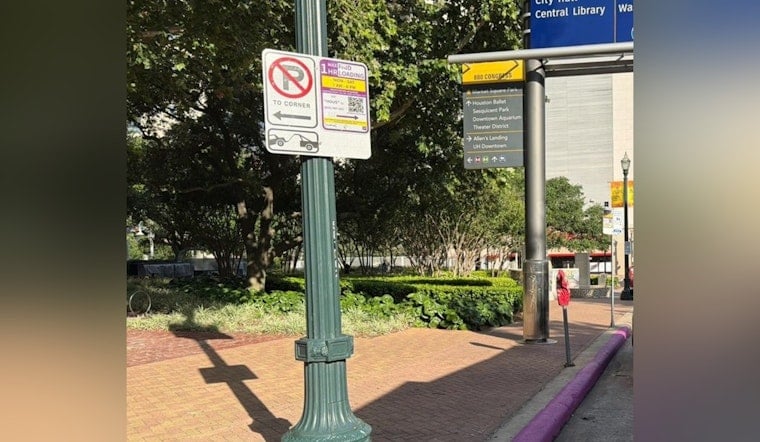
Downtown delivery drivers are getting a new kind of welcome in Houston: bright purple curbs and cameras that watch the clock. The city has launched an 18-month Smart Loading Zone pilot in select blocks of Downtown and Midtown, wiring up loading areas with sensors and automated billing in a bid to cut double parking, speed up drop-offs and open up curb space for everyone else.
The system tracks how long vehicles stay in these marked loading spots, then automatically bills registered drivers by license plate. As the pilot runs, Houston will also scoop up detailed curb-use data to help shape long-term parking and street policy.
According to ParkHouston, the purple zones use license-plate recognition to time each stay and apply tiered, per-minute fees after a short free-loading window. The posted rates are $0.06 per minute for 0–10 minutes (up to $0.60), $0.12 per minute for 11–20 minutes (up to $1.80), $0.15 per minute for 21–30 minutes (up to $3.30), and $0.19 per minute for 31–60 minutes (up to $9.00). Zones are enforced Monday through Saturday during the hours listed on each sign. Drivers and fleets can create a one-time CurbPass account so charges are tied to a card on file instead of showing up later as mailed invoices, the agency notes.
How the system works
The pilot runs on technology from curb-management company Automotus, which installs camera sensors on street poles. Using computer vision, the system identifies vehicles and bills by the minute, all off the license plate. Automotus says drivers only need to register once and do not have to fuss with apps, kiosks or meters, since payment is handled automatically in the background. City staff and the vendor say the resulting data will give planners a far clearer picture of how loading zones are used along busy corridors.
Administration & Regulatory Affairs Director Tina Paez said in a statement that the pilot will “improve curb access, reduce congestion, support public safety initiatives, and improve efficiency,” as reported by StateScoop. City officials say they plan to stay in close contact with nearby businesses, drivers and residents as the rollout continues, using feedback to evaluate how well the system is working and where it needs tweaks.
Precedents and early results
Houston is not the first city to let cameras babysit the curb. Similar automated loading-zone programs have popped up in dozens of municipalities, as transportation departments test sensor-based curb management to untangle traffic and delivery chaos. In some pilots elsewhere, vendor and city partners have reported large drops in double parking, with one media report noting that Automotus has claimed reductions of nearly 95 percent in certain locations. Results, though, can vary considerably depending on how clearly zones are signed, when they are enforced and how local delivery patterns work, according to NBC10 Philadelphia.
Privacy and data collection
ParkHouston emphasizes that the system is built to track plates, not people. The agency says it collects only license-plate information needed to process payments, along with de-identified curb-use metadata and a sample of images used to train the computer-vision models. It also says plate data will not be passed along for other purposes.
According to Automotus's privacy policy, license plates are the only form of personally identifiable information the company gathers. The document describes steps to strip out identifying details from other curb-use data that is used for planning and analysis.
What drivers need to do
Anyone planning to pull into a purple loading zone is expected to set up a CurbPass account and add a payment method so the system can bill automatically. Signs at each zone include QR codes that take drivers straight to the registration page.
Fleets can enroll multiple license plates under one account. Those vehicles still receive the built-in free loading period before per-minute charges start to accrue. Drivers and companies that want a closer look at how billing works can review the online portal at CurbPass.
With an 18-month pilot window, ParkHouston and Automotus will have time to pair hard curb-use numbers with on-the-ground feedback. City officials say those findings, along with input from businesses and residents, will guide any decisions about expanding the program and adjusting zone hours, prices or locations beyond the initial Downtown and Midtown footprint, per StateScoop.


