

























































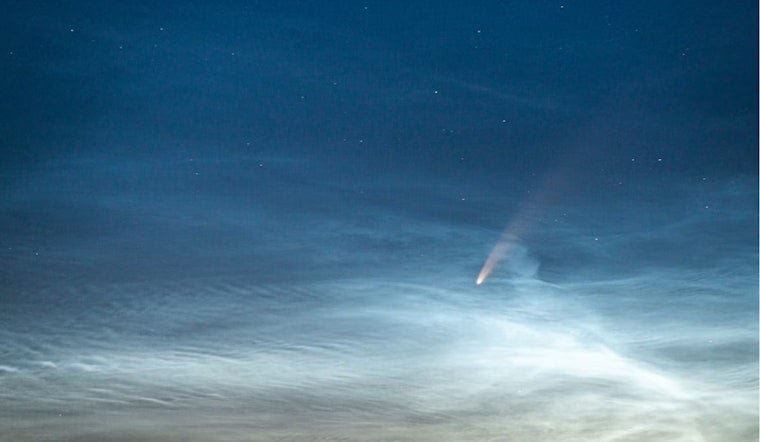
A bright fireball ripped across the sky over Sault Ste. Marie yesterday, cutting through the Queen Street Cruise and freezing onlookers in mid-cruise. The flash lasted only seconds but left behind a trail of stunned witnesses, cell phone videos and a quick burst of social media chatter. Several people who were indoors said they heard a loud boom shortly after the light slipped past the horizon.
Captured During Queen Street Cruise
Gerri Grenier was watching the cruise with family when she happened to be filming at exactly the right (or very lucky) moment. She told SooToday she "can't believe I panned my phone over in that same split second of the meteor hitting our atmosphere," after catching the flash from the sidewalk in front of GFL Memorial Gardens. The outlet reports that videos of the streak surfaced quickly and that some witnesses indoors described hearing a sonic boom like a slammed door.
Seen Across Northern Michigan And Ontario
The American Meteor Society logged 94 reports of a single fireball event around 00:12 UTC (about 8:12 p.m. EDT) on June 19. Observers submitted sightings from Sault Ste. Marie, Cedarville, Mackinac Island and other spots across northern Michigan and Ontario. Multiple photos and short videos were uploaded, with most witnesses saying the fireball was visible for only a few seconds.
Why Some People Heard A Boom
Bright meteors, often called fireballs or bolides, can produce sonic booms if they explode or travel low enough in the atmosphere. Any audible shock usually arrives minutes after the flash, since sound moves far slower than light. NASA's explainer on fireballs notes that both delayed sonic booms and rarer "electrophonic" sounds have been reported with very bright events, and that investigators use video, witness accounts and sensor data to reconstruct an object's path. That combination of eyewitness clips and scientific checks is what researchers will rely on to determine whether fragments reached the ground or the event was purely an atmospheric burst.
If You Filmed It
If you recorded the flash or heard a boom, the American Meteor Society asks observers to file a report so meteor networks can triangulate the path. Time-stamped clips, location details and a short description of any sounds help researchers confirm whether the fireball left a persistent train or produced debris.
For many on Queen Street, it was a sudden, unforgettable summer sky show. For scientists, it is another data point that helps improve tracking of incoming meteoroids. Updates may follow if tracking data or official recovery information becomes available.





