

























































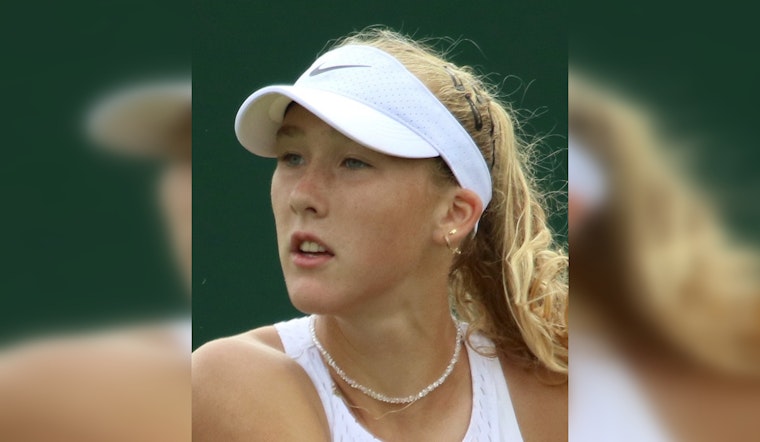
Mirra Andreeva, the 19-year-old Russian with the heavy artillery off both wings, claimed her first Grand Slam title on Saturday at Roland-Garros, taking down Poland’s Maja Chwalinska 6-3, 6-2 on Court Philippe-Chatrier. The straight-sets win made Andreeva the youngest women’s singles champion at the French Open since Monica Seles in 1992, and it capped a two-week run in which the 8th seed almost never looked like a newcomer to clay. When the final point landed, she dropped to her knees on the Paris clay, then later laughed that she needed to thank herself for surviving what she called a brutal fortnight.
The scoreline told only part of the story. Andreeva closed out the final 6-3, 6-2, and the numbers underlined the gap: she finished with 25 winners to Chwalinska’s 10 and committed 26 unforced errors to the Pole’s 29, with a stretch of nine straight games that flipped the match firmly in her favor, according to AP. During the trophy ceremony, Andreeva admitted, "Only I know how tough it was for me," while Chwalinska could only joke, "You're so young and talented. It's so annoying," neatly summing up just how different their two weeks in Paris had felt.
How Andreeva Got Here
Andreeva’s rise has been quick but hardly accidental. Born in Siberia, she relocated first to Sochi and then to France to sharpen her game, gradually building a base that would translate to the biggest stages. As part of that process, she has worked with coach Conchita Martínez to fine-tune her clay-court instincts, from constructing points to handling long rallies, as detailed by Roland-Garros. Across this French Open run, the 19-year-old kept holding her nerve on the biggest points and, once she found her rhythm, almost never let go of control.
Chwalinska’s Unlikely Run
Maja Chwalinska showed up in Paris as a qualifier ranked No. 114 and proceeded to rip up the script, knocking out higher-ranked players and piecing together one of the unlikeliest pushes to a maiden Grand Slam final in recent memory, according to Sky Sports. By the time she reached Andreeva, though, ten matches in under three weeks had clearly taken a toll on her legs and timing, and the Russian’s depth and pace proved the difference when it mattered.
What This Means For The Women's Tour
The final also said a lot about where the women’s game is right now. With several big names falling earlier in the fortnight, a surprise champion always felt possible, and Andreeva’s win delivers exactly that: a new name suddenly belongs at the top of the marquee, as noted in coverage by The Guardian. Her run in Paris adds fresh fuel to debates about who will steer the tour through the rest of 2026 and how quickly the younger generation can dominate across different surfaces.
Conchita Martínez, a 2000 Roland-Garros finalist, was among the coaches courtside as Andreeva hoisted the Suzanne Lenglen Cup, and the post-match celebrations in Paris almost immediately gave way to questions about how the teenager will live with the spotlight that comes with a major title, per Roland-Garros. The tour now pivots to the grass season, but this French Open final will linger as a touchstone for a while: a new Grand Slam champion has arrived in Paris, and everyone else will have to adjust.





.jpg)