

























































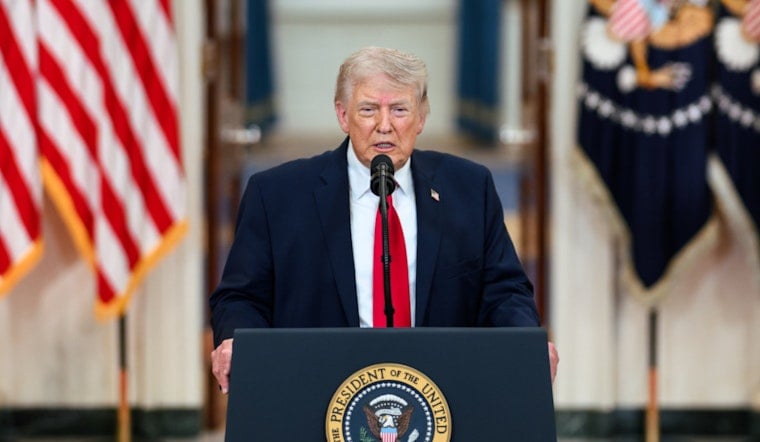
President Donald Trump has jolted an already tense Middle East by floating the idea that Syria should “take care” of Hezbollah, a suggestion that has unnerved regional leaders and rattled Israel’s security establishment. The trial balloon, raised during high-level diplomacy this month, has revived old fears of renewed Syrian involvement in Lebanon and triggered emergency consultations in Jerusalem.
What Trump said
On the sidelines of the G7 summit in Evian earlier this month, Trump criticized Israel’s military campaign against Hezbollah and told reporters, “I suggested to Israel to let Syria take care of Hezbollah,” adding that he believed Damascus might be “more precise” in targeting the group. The remark immediately set off alarm bells among diplomats and analysts who warned it could complicate an already fragile ceasefire, according to The Associated Press.
Damascus denies plans
Syria’s president, Ahmad al‑Sharaa, publicly pushed back, insisting his government has “no interest” in intervening militarily in Lebanon and arguing that Trump’s comments had been misunderstood. Al‑Sharaa told visitors in Damascus that “there are people spreading rumors that Syria will intervene in Lebanon” and later outlined a vision focused on mediation and economic cooperation rather than armed action, The Associated Press reported.
Israel’s reaction
Israeli officials did not treat the suggestion as idle talk. Jerusalem convened senior security leaders to game out potential repercussions, with analysts warning that inviting Damascus back into Lebanon could reopen the door to occupation and sectarian score‑settling. “This is like tossing a match into a powder keg,” an Israeli official told The Jerusalem Post, capturing widespread anxiety over any renewed Syrian footprint on Lebanese soil.
Background and scale
The dust‑up comes in the wake of Hezbollah’s March 2 attack on Israel, which widened the Iran‑linked front and triggered a sustained Israeli air and artillery campaign across Lebanon. The human cost has been severe: more than 4,000 people in Lebanon have been killed by Israeli strikes in the ensuing fighting, according to reporting by The Washington Post. Early in the conflict, Syria moved troops toward its border with Lebanon in an effort to prevent spillover, as reported by L'Orient Today.
Where this could go
Policy experts warn that trying to outsource the Hezbollah problem to Damascus would be a high‑risk gamble. Syria’s new government is still consolidating power, and any cross‑border operation could broaden the war and undercut fragile diplomatic efforts. For now, world leaders are watching closely as U.S. talks with Iran and wider regional diplomacy try to stabilize the situation and clarify whether Washington’s comments were tactical rhetoric or signal a real policy shift, a debate tracked in live coverage by The Guardian.





.jpg)