

























































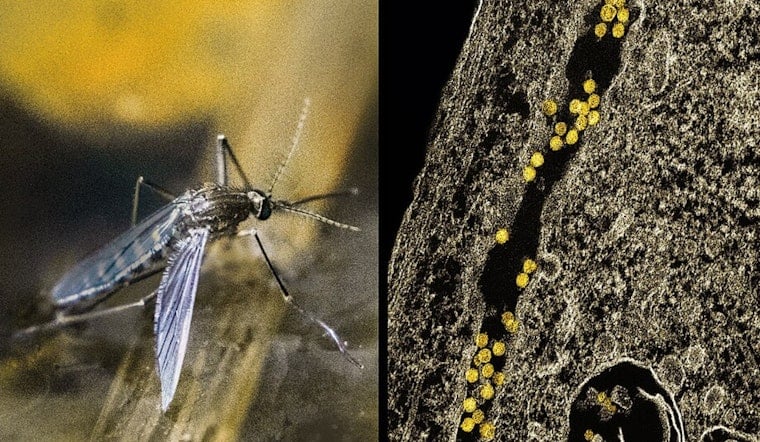
West Nile virus has shown up in Mesquite again, and this time it is in the 75181 ZIP code. City health officials said Tuesday that mosquitoes trapped in the Parkchase area tested positive, prompting a round of targeted nighttime spraying aimed at knocking back the infected population. Crews planned to start treatment after 10 p.m., focusing on streets the city describes as running from Clay Mathis and Faithon P. Lucas to Lawson Road between Berry and Daybreak Trail. Residents were urged to drain standing water, bring pets indoors during spraying, use EPA-approved repellents, and avoid being outside at dusk and dawn.
Where and when crews will spray
Crews are scheduled to treat parts of the Parkchase addition late Tuesday night, starting after 10 p.m. and continuing into the early morning hours if the weather cooperates. According to the City of Mesquite, the spray zone stretches from Clay Mathis and Faithon P. Lucas to Lawson Road between Berry and Daybreak Trail, and the advisory includes maps for neighbors who want to see exactly where trucks will roll. The city notes that high winds or rain could delay or cancel the operation.
Mesquite's Health Division relies on an Integrated Mosquito Management plan that combines routine trap surveillance with larvicide treatments and targ-eted adulticide spraying. Adult spraying happens after dark using ultra-low-volume equipment and EPA-approved products. The city’s online mosquito page explains that crews concentrate treatments around traps that test positive and aim to reduce mosquito numbers while limiting how much the public is exposed. Residents can check posted maps to see spray boundaries and any backup dates.
How to protect yourself and your pets
Officials repeated the familiar prevention checklist: drain standing water, wear long sleeves and long pants, use an EPA-registered repellent such as DEET, picaridin or oil of lemon eucalyptus, and cut back on outdoor time from dusk to dawn. That guidance tracks with federal recommendations. The CDC notes that most people infected with West Nile virus never feel sick or develop only mild symptoms, but older adults and people with weakened immune systems face a higher risk of severe illness. If you have to be outside while trucks are spraying, officials advise going indoors as sprayers pass and washing any skin that comes into direct contact with spray residue.
For questions about local spraying, spray-map details or to report problem spots with standing water, residents can contact the Mesquite Health Division. The city’s mosquito control page lists contact information, and the municipal site includes the Health Division phone number for anyone who wants assistance or a neighborhood inspection before treatments.
Why officials are acting now
Dallas County's mosquito lab alerts city health departments when traps test positive, and that notification is what triggered Mesquite's latest response. Dallas County Health and Human Services runs a West Nile Watch program that tracks positive mosquito pools across the county and shows Mesquite among the cities with confirmed positive traps this season, a countywide dataset that helps coordinate spray decisions. Local coverage earlier in June noted positive traps in other Mesquite ZIP codes, highlighting a broader uptick in detections across the Metroplex.
Nighttime ground spraying is a standard local tactic meant to bring adult mosquito numbers down quickly. Operations are usually limited to residential streets rather than divided highways and are postponed if wind speeds climb above safe limits. City and county notices emphasize that the insecticides used for adulticiding are EPA-registered and applied at very low volumes, but residents are still urged to bring pets inside, close windows and run air conditioning while trucks pass to cut down on direct exposure. Anyone who develops health concerns after possible contact with the spray is advised to call a healthcare provider and mention that they may have been exposed to mosquito-control products.
Where to get updates
Mesquite officials have posted spray maps and advisories on social media and on the city website, and residents who subscribe to the city’s alert system will get word if plans change. For a broader look at how West Nile is trending beyond one ZIP code, Dallas County Health and Human Services' West Nile Watch and the Texas Department of State Health Services arbovirus reports publish weekly surveillance snapshots for North Texas. If weather forces a delay, the city is expected to announce any postponed or follow-up spray dates once they are on the calendar.





