

























































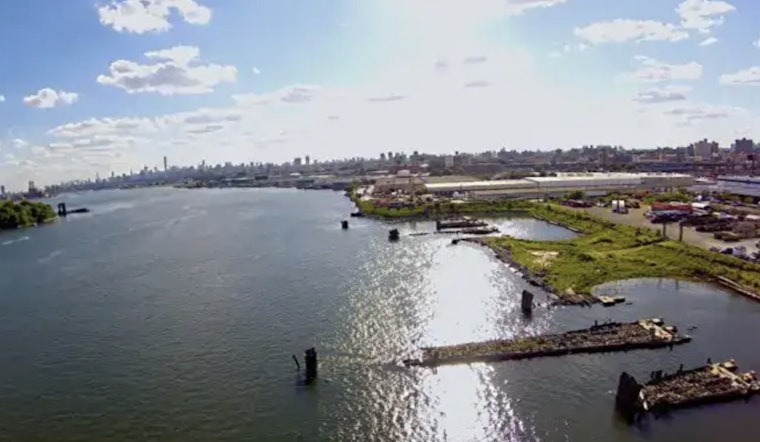
Bronx Community Board 1 has thrown cold water on a major Mott Haven waterfront proposal, voting on June 25 to oppose an early-stage rezoning that would clear the way for two affordable apartment towers and a new public shoreline walkway. The advisory "no" followed hours of at-times heated testimony from residents who argued that the project's income levels and mostly smaller apartments would leave out the large, long-rooted families that define much of the South Bronx.
Developers Phipps Houses and Douglaston Development pitched the plan as a two-phase project with 537 income-restricted apartments across two sites at 110 E. 138th Street and 63 Exterior Street. One shorter building was described as senior housing, paired with a taller family-oriented tower linked by a shared lobby. Opponents countered that the unit mix and income bands still did not line up with neighborhood realities, as reported by the Bronx Times. Community board votes carry only advisory weight, so the proposal now moves on to the Bronx borough president, the City Planning Commission and ultimately the City Council.
What the Plan Would Build
City Planning review materials describe a Uniform Land Use Review Procedure (ULURP) application that would allow two new mixed-use buildings of roughly 13 and 27 stories with about 537 income-restricted apartments, plus ground-floor retail, community facility space and a publicly accessible waterfront walkway, according to NYC Planning. The apartments are outlined at 30% to 80% of Area Median Income (AMI), and the project site is made up of two city-owned lots and one private parcel.
Local land-use watchers and real-estate outlets have been following the application since developers filed the land-use paperwork last year, coverage that has included CityRealty.
Neighbors Say It’s Not Affordable for Mott Haven
Residents at the June 25 hearing homed in on the project's affordability math, arguing that citywide AMI calculations - which blend in higher-income suburban counties - inflate what the typical local household actually earns and shut many Bronx families out of "affordable" housing. "The apartment sizes are catered to the single professional working class of Manhattan," said Matthew Shore of South Bronx Unite at the meeting, according to the Bronx Times.
The Association for Neighborhood & Housing Development's risk map underlines that tension by pegging Community District 1's median household income at roughly 23% of AMI, a stark gap between policy formulas and neighborhood wallets, according to ANHD.
What Happens Next
The application seeks several key approvals at once: an Urban Development Action Area (UDAA) designation, an Urban Development Action Area Project (UDAAP), disposition of city-owned parcels, and special permits to adjust waterfront bulk rules, according to the City's public notice. The City Record spells out the specific land-use actions requested.
If the City Council signs off on a UDAAP, projects in that category are commonly eligible for up to a 20-year property tax exemption administered by HPD, a benefit that land-use analysts routinely note in coverage of similar rezonings, as explained by CityLand.
Legal and Planning Implications
While the board's vote is not binding, it is a political shot across the bow that signals organized neighborhood resistance. That is something both developers and elected officials will have to contend with before any zoning changes move forward.
The City Planning Commission review packet includes an Environmental Assessment Statement with a Negative Declaration and a Racial Equity Report, indicating that the proposal has cleared initial environmental and equity screening stages, according to NYC Planning. From here, the development team can tweak the plan, step up community outreach, or press on through the process more or less as is. How they respond, and whether that satisfies local critics, will shape the tone of the ULURP debate at the borough president's office and later at City Hall.





