

























































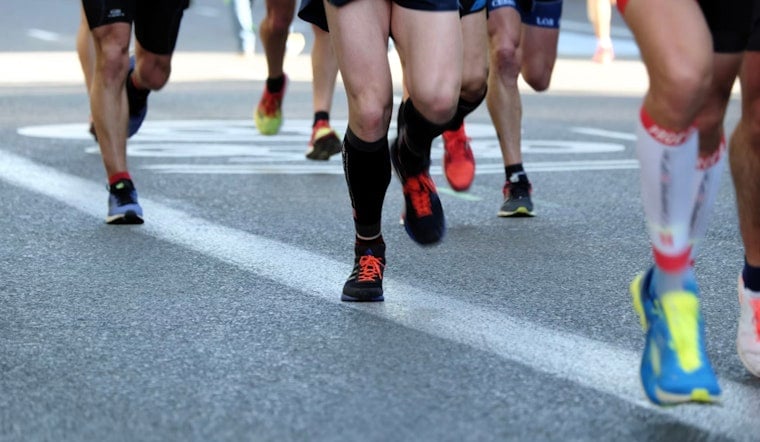
Runners gathered on the Manhattan side of the Williamsburg Bridge late Friday night with no idea how far they were about to run. By the time the last stragglers crossed the finish, they had covered 17 spans of the bridge — roughly 21.42 miles — a distance nobody in the crowd knew until a computer algorithm posted it online partway through the race.
That is the entire premise of the Williamsburg Bridge Marathon, an unofficial, permit-free event now in its fourth year. As the New York Post reported, runners simply cross back and forth over the bridge's 1.38-mile course until the event website spits out a random computer-generated number between 10 and 100, at which point that number of spans becomes the official distance. The Post's report, written by Rachel Sacks, forms the backbone of what happened this past weekend.
The race was the brainchild of Matt White, a 31-year-old software engineer who created the first Williamsburg Bridge Marathon in July 2023 after he failed to qualify for the New York City Marathon, per the Post's account. What began as an impulse project pulled in around 20 runners its first year. By this year's edition it had swelled into a crowd race volunteer James Cashen estimated at 300 to 400 people, according to the Post.
A Distance Nobody Could Plan For
There is no entry fee, no fixed course length, and no predetermined finish line — just an algorithm. This year's number landed on 17 spans, which White himself said was disappointingly short compared to prior years, the Post reported. Not everyone who started managed to finish; the 2026 race also had its share of DNFs, or runners who did not complete the distance once it was revealed.
At the front of the pack, Joe Cady won the men's race in 2:30:13, while Maya Geller took the women's title in 3:15:04, according to the Post's reporting. Runners tracked and logged their own bridge spans on Strava rather than relying on official timing chips, underscoring just how DIY the whole operation remains.
Runners Describe a Chaotic, Communal Scene
Kaeli T., a 28-year-old running the event for the first time, told the Post that people brought lawn chairs and yoga mats onto the bridge to cheer on friends, and that a cake was shared at the race's midway point. She said a woman shouted “get it, girl!” around 12:15 a.m. as runners passed, and that despite her disappointment the race wasn't a full marathon or ultramarathon, the people who showed up were her favorite part of the night. She added she was grateful to get a good night's sleep afterward.
Nathan Yan, who moved to New York City from Colorado and first ran the event in 2025, returned this year and completed seven bridge spans — about 9.06 miles — while carrying a 45-pound DJ rig to provide music for other runners along the route, the Post reported. Yan said the back-and-forth format lets runners and their support crews interact with each other repeatedly throughout the night, rather than seeing each other only once as in a traditional point-to-point race.
Built on a Legal Gray Area
The Williamsburg Bridge Marathon has no permit. Under New York Police Department regulations, formal permits are required for public parades, processions, or athletic events, with specific parade permit mandates kicking in for group roadway processions of 50 or more participants, per NYPD rules. Staging an official race or street closure in the city typically requires sign-off from the NYPD, the city's Department of Transportation, and NYC Parks if city parkland is involved — a process that can take weeks or months, according to IDEKO. By sticking to pedestrian walkways rather than closing roadways outright, the Williamsburg Bridge Marathon has so far operated in that gray zone.
The bridge itself is no small stage for an unsanctioned event. Completed in 1903 as the world's longest suspension bridge at 7,308 feet, it rises 135 feet above the water with pedestrian climbs averaging 2 to 3 percent grades, according to the NYC Department of Transportation. The same agency's 2024 data shows the span handles an average of 4,440 pedestrians and 8,645 cyclists daily, alongside nearly 88,000 motor vehicles, meaning hundreds of late-night runners are sharing infrastructure that a huge number of commuters also depend on.
A Backlash to Marathon Gatekeeping
The race's growth tracks closely with the shrinking odds of getting into the official TCS New York City Marathon through normal channels. The 2026 lottery received more than 240,000 applications from over 160 countries, resulting in a general acceptance rate of roughly 1%, according to Running Magazine. That rate has cratered in recent years, falling from 12% in 2022 to 4% in 2024 and 2 to 3% in 2025 as applicant volume more than doubled, according to a Substack analysis of the race's business. White's own rejection from that lottery, as reported by the Post, is what pushed him to start his own version on the bridge in the first place.
James Cashen, the volunteer who helped estimate this year's turnout, described the event as capturing the best parts of New York and its running community, telling the Post the race continues to build around fun-loving city runners. He said running should involve both fun and overcoming difficult challenges, calling the event gritty and difficult. Past participants have described not finishing as still counting as a kind of win, framing the whole night as a shared experience in mutual pain, per the Post's account.
The Williamsburg Bridge Marathon also fits into a longer local tradition of unsanctioned nighttime street races, including the Midnight Half launched in 2011 and Take the Bridge, founded on the Queensboro Bridge in 2015, according to Six Minute Mile. Those events, like this one, tend to prioritize spontaneity and low barriers to entry over official timing chips and aid stations — a stark contrast to the corporate infrastructure behind New York Road Runners' marquee race. Hoodline has previously reported on the city's push to smooth out the Williamsburg Bridge's bike lane bump, part of the same span where hundreds of runners now gather each August night without a permit in hand.





