

























































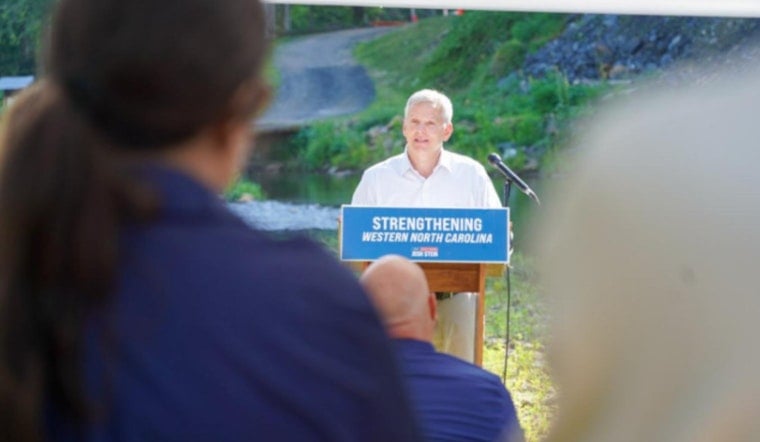
Western North Carolina’s storm-battered water and wastewater systems are getting more than $1 billion in help after Hurricane Helene, state officials announced this week. Gov. Josh Stein traveled to Burnsville with Department of Environmental Quality Secretary Reid Wilson to mark the funding milestone and to remind residents that, despite the big number, recovery work is very much still in progress.
Burnsville’s Cut Of The Cash
Out of the billion-plus pot, Burnsville is set to receive $13 million from the Drinking Water State Revolving Fund and the Clean Water State Revolving Fund to shore up the town’s drinking-water supply, distribution system and sewer lines. That money stacks on top of roughly $4.5 million in emergency bridge loans and technical help already used to replace the town’s raw-water intake, bringing total State Water Infrastructure Authority support for Burnsville to more than $17 million, according to the Office of the Governor.
‘Washed Away’ Intake, Lingering Headaches
Burnsville Mayor Russell Fox and Yancey County officials say the town’s raw-water intake was literally washed away during Helene, forcing crews, the NC National Guard and local volunteers to scramble just to get basic service back on. As Carolina Journal reported, residents and local leaders say the community is still a long way from fully recovered even as new projects start to roll out.
Big Money, Bigger Need Across The Region
By mid April, DEQ’s State Water Infrastructure Authority had already awarded about $861 million in federal and state funding to repair and rebuild systems damaged by Helene, but communities hit by the storm submitted more than $1.3 billion in applications, leaving hundreds of millions in unmet requests, according to NC DEQ. The state has been using SRF Helene dollars, Infrastructure Investment and Jobs Act allocations and other funding streams over several rounds to cover the most urgent projects first.
Why The Job Is Nowhere Near Done
State officials say most of the cash so far has gone to stop the bleeding rather than to future-proof systems. More than 90% of the more than $1 billion has paid for immediate repairs, and those investments have backed 222 projects in 28 counties, according to WUNC. Local leaders and state officials warn that tens or even hundreds of millions of additional dollars will likely be needed to finish resilience upgrades and replace aging pipes and plants that are still vulnerable to the next major storm.
What Happens Next For Towns Like Burnsville
The State Water Infrastructure Authority signed off on another $44 million in state Helene funding on July 15, and DEQ says it will keep combining grant and loan money with technical assistance and planning support so communities can move projects from paper to construction, according to NC DEQ. “It’s an important milestone that DEQ has awarded over $1 billion for Helene recovery, but in some ways it’s just the beginning,” Wilson told the crowd in Burnsville. Officials say they plan to keep working with towns, nonprofits and federal partners until projects are finished and communities are better protected when the next Helene-sized storm shows up.




