

























































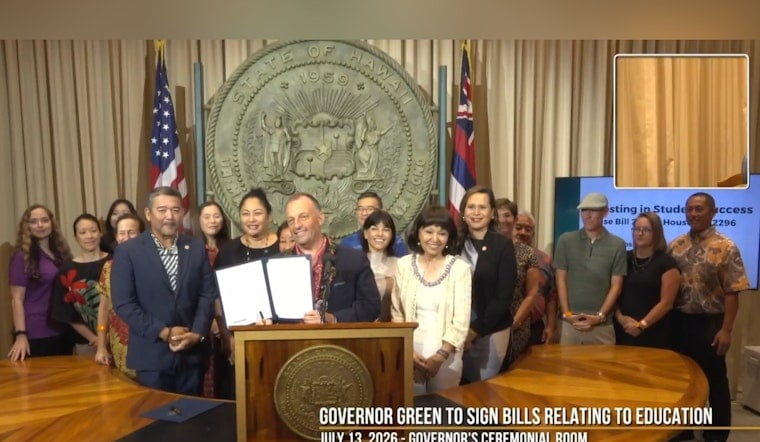
Gov. Josh Green just gave community college students a little more breathing room in their budgets, signing a bill that rewires how the Hawaiʻi Promise program works. The change scraps the program’s last-dollar rule so that Pell grants and private scholarships can go toward housing, food and other basic needs while the state continues to pick up as much as 95% of tuition. Supporters say the move is aimed squarely at the cash crunch that pushes students to cut classes or walk away, and they are pitching it as a way to keep more community college students on track through graduation.
What the law does
House Bill 2338 revises the Hawaii Community College Promise Program so that grants, scholarships and other nonrepayable aid no longer get subtracted when the state calculates a student’s award. Instead, the program will provide scholarships equal to 95% of a student’s unmet direct cost need.
In practical terms, the measure turns Hawaiʻi Promise from a last-dollar program into one that is designed to work in tandem with federal student aid, maximizing the total support students receive. Lawmakers and university officials framed the update as a way to sync up with recent federal Pell Grant policy changes and to let students put outside aid toward day to day expenses rather than just tuition.
According to LegiScan, the bill also directs administrators to protect students’ federal aid eligibility whenever state and federal rules might clash.
Numbers behind the program
The University of Hawaiʻi reports that in the 2024–25 academic year, Hawaiʻi Promise distributed about $5.69 million to 1,941 recipients, with an average award of roughly $2,933. Program participants posted stronger academic indicators than nonrecipients, including higher GPAs (2.89 vs. 2.73) and more credits earned (17.9 vs. 13.0). Since 2017, the program has served 11,921 students with an overall success rate of about 70%.
UH also notes that about 22% of 2024–25 recipients showed financial need but did not qualify for federal Pell Grants, and that Hawaiʻi Promise students have a stop out rate of 30%, compared with a reported national average of roughly 45%. These figures are summarized by University of Hawaiʻi News.
How and when it takes effect
The bill allows the Hawaiʻi Promise program to coordinate with federal student aid systems starting July 1, 2026, and it tightens up the program’s definition of “direct cost” so it lines up more closely with federal rules. The idea is that Pell Grants and private scholarships can be steered toward indirect costs like rent, groceries and bus fare, while the state scholarship continues to shoulder most of the tuition bill.
The statutory language spells out both the 95% scholarship target and the coordination requirement. For the full text, see LegiScan.
Students and advocates respond
Students already using Hawaiʻi Promise describe the change as a near instant pressure release on monthly bills. "The Hawaiʻi Promise program has lifted the majority of the financial burden associated with my education, allowing me the opportunity to explore my career goals and further my education," said student Kanako Horner in a statement to University of Hawaiʻi News.
Another student leader, Lui Hokoana, called the bill "a vital change that will directly support more residents across our islands," according to the same UH release.
Why covering non tuition costs matters
Research on basic needs in higher education has repeatedly found that unpaid living expenses like food, housing, childcare and emergency costs are a top reason students drop or pause their studies. Studies of emergency grants and more flexible use of aid show that helping students cover those everyday bills can improve their chances of staying enrolled and completing a credential.
For an overview of the broader evidence and the federal policy backdrop, see The Hope Center for College, Community, and Justice.
What comes next
Universities now have to retool their awarding practices and financial aid systems before the new rules kick in. Students are being urged to check in with campus financial aid offices to see how their Pell Grants and outside scholarships will be applied under the updated setup.
The UH system says it will roll out implementation details to campuses and students in the coming weeks, while lawmakers keep an eye on whether the revamped program really closes the gap between financial aid and everyday costs that can knock a student off course.



