

























































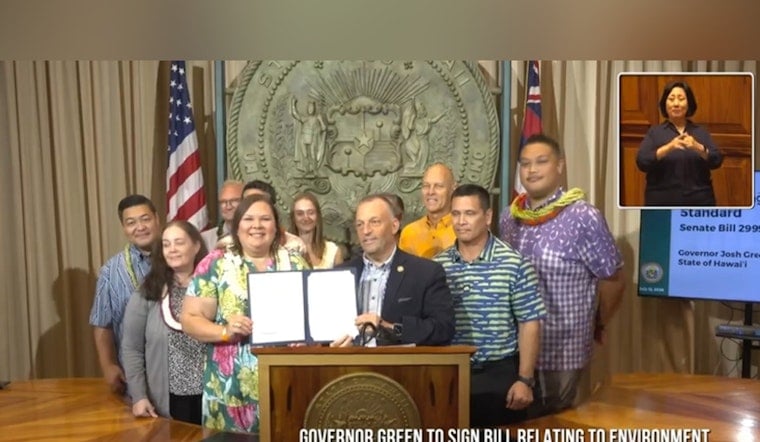
Hawaii is turning up the heat on tailpipe pollution. On Wednesday, Governor Josh Green signed a bill that orders the Hawaii Department of Transportation to build a statewide clean fuel standard aimed squarely at cutting emissions from cars and trucks. The new law tells HDOT to create a credit-and-deficit market that rewards cleaner fuels and penalizes dirtier ones, with backers arguing it will boost local renewable-fuel production and keep the state on track to hit its greenhouse-gas limits.
What is in the law
Senate Bill 2999 requires the Department of Transportation to adopt rules for alternative fuels by Jan. 1, 2028, and to start applying the clean fuel standard to gasoline and diesel no later than Jan. 1, 2029, according to the Hawaii State Legislature. The statute sets phased carbon-intensity targets of at least 10% below 2019 levels by 2035 and at least 50% below 2019 levels by 2045, and it calls for regular reporting on how the program is working and how it affects the market. HDOT must also build lifecycle-emissions benchmarks and lay out a phased plan to keep lowering fuel carbon intensity over time.
How emissions will be measured
Lawmakers point out that transportation is the state’s largest source of lifecycle greenhouse gas emissions, a finding used to justify the broad scope of the policy. SB2999 directs HDOT to rely on Argonne National Laboratory’s GREET model to calculate lifecycle carbon intensity and to set up the credit-and-deficit system. It also allows opt-in pathways and exemptions for aviation, rail and military uses. In a bit of legislative fine print, the measure sets an administrative effective date of July 1, 3000, a drafting tactic that leaves the real operational timing to the department’s rulemaking process, according to the Hawaii State Legislature.
HDOT’s role and public engagement
HDOT’s Energy Security and Waste Reduction Plan casts a clean fuel standard as a key tool to shrink emissions while trying to keep transportation both affordable and resilient, according to the Hawaii Department of Transportation. “HDOT can take immediate actions by expanding EV public charging and having incentives for cleaner fuels,” Transportation Director Ed Sniffen said in the department’s release. The agency says it will share public-engagement materials on its Energy Security, Community and Culture portal and will hold county-level informational sessions as it works through the rulemaking.
What officials and advocates are saying
Gov. Green called the bill signing part of a push toward “a cleaner, low-carbon future,” while Sen. Chris Lee, who introduced SB2999, described it as “a huge opportunity” to reinvest in lower-cost, cleaner transportation options for residents, according to Hawaii News Now. Industry and clean-energy groups have welcomed the policy as a way to expand markets for renewable natural gas and other homegrown fuels, observers noted in post-vote coverage. HDOT plans to publish rulemaking materials and stakeholder notices on its portal as the process moves ahead.
Next steps and what to watch
With SB2999 now law, HDOT is on the clock to finish alternative-fuels rules by Jan. 1, 2028, and to phase in the program for gasoline and diesel by Jan. 1, 2029. In the meantime, stakeholders will be watching closely for draft rules, pathway approvals and public meeting dates. The statute requires HDOT to report back to the Legislature on implementation and market impacts, and legal and industry analysts note that Hawaii has effectively joined the club of states with low-carbon fuel programs, a shift that could widen markets for domestic renewable fuels, as described by Holland & Knight. Drivers, fuel suppliers and clean-energy developers alike will be eyeing how HDOT designs cost-containment tools and credit-banking rules over the next 18 months.



