

























































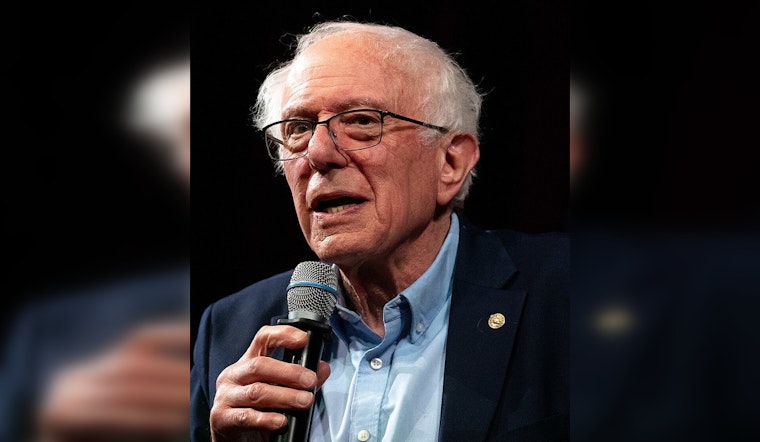
Sen. Bernie Sanders has dropped sweeping legislation that would force the largest U.S. artificial-intelligence firms to hand over half their stock to a federally managed sovereign wealth fund, a move his office says could generate roughly $7 trillion in public assets and, under the bill's payout rules, finance annual distributions of about $1,000 per person.
What Sanders is proposing
The measure, called the American A.I. Sovereign Wealth Fund Act, would impose a one-time equity remittance so the public owns a direct stake in qualifying AI businesses, according to a release from Sen. Sanders' office. Sanders frames the idea as a way for the public to share in wealth built on what he describes as humanity’s collective knowledge.
How the tax would work
The bill text directs an excise tax that would leave the Treasury holding 50% of all outstanding equity interests in applicable AI companies, and it spells out which activities qualify, from AI data centers and computing infrastructure to advanced robotics, as well as a $200 million annual-revenue threshold for coverage, per the formal legislative filing. The measure is listed in Congress as S.4825 and was read and referred for committee consideration, according to the official bill entry on GovInfo.
The math: fund size and payments
Sanders' one-page summary says that, at current valuations, the equity transfers would seed a sovereign fund worth an estimated $7 trillion and that the statute would authorize annual distributions equal to 5% of the fund’s average market value. That 5% payout, Sanders' office argues, could translate into a direct payment of more than $1,000 for every person in the United States in a starting year. Those figures come from the senator’s summary of the proposal and its planning assumptions.
Industry moves and the public-wealth conversation
The idea of putting public money or public equity into AI firms is not new. OpenAI's policy blueprint earlier this year floated a “Public Wealth Fund” as one way to share AI gains, and outlets have reported that OpenAI executives even discussed offering a smaller, voluntary stake to Washington to seed such a vehicle. OpenAI’s April policy paper lays out public-wealth mechanisms, and reporting in outlets including The Guardian has described early talks about a roughly 5% government stake as part of that broader conversation.
Critics and legal questions
Policy analysts and lawmakers from both parties have raised alarms about the legal and market consequences of the plan, from questions about constitutional takings and shareholder rights to concerns that government ownership could create conflicts when regulators consider rules affecting the very firms the fund would hold. Observers have also noted the political uphill climb: Roll Call and other outlets say the measure faces steep resistance in a divided Congress, and opinion pieces in outlets such as Reuters' Breakingviews have flagged tradeoffs between redistribution and market stability.
Local reaction and coverage
National coverage has migrated into local debates. Cleveland.com has summarized the proposal's headline numbers and potential payments to residents, while local officials in other states have publicly pushed back. For example, Illinois' governor paused new data-center incentives while warning the state will not welcome a federal equity grab, as detailed in Pritzker slams D.C. AI stock grab.
Where the bill goes from here
Formally introduced in June, the measure has been routed into committee and would need a series of hearings, votes and legal reviews before it could become law, and several analysts say those steps look difficult in the near term. Supporters argue the statute builds in guardrails, including restrictions on using fund assets to bail out firms, while opponents say the policy raises novel governance and market-structure questions that would almost certainly land in the courts if enacted.
Whether the American A.I. Sovereign Wealth Fund Act ultimately becomes law or remains a high-profile policy provocation, it has already shifted the national conversation about who should capture the gains from the next wave of technological growth and how ordinary Americans might see that value flow back to them.





.jpg)