

























































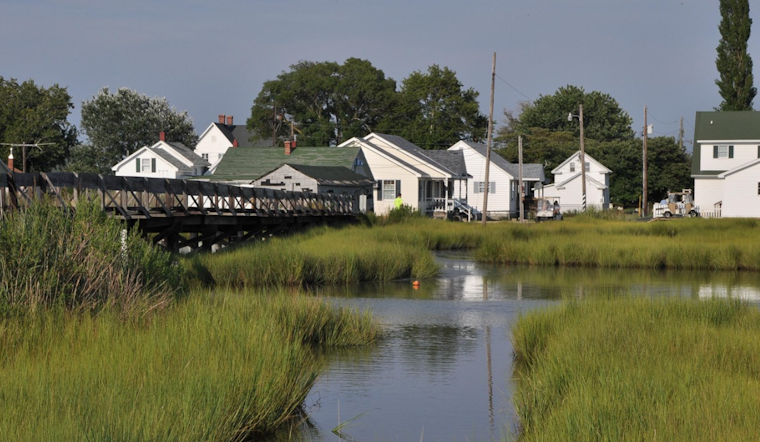
Tangier Island is running out of room to retreat. The tiny 1.2-square-mile community in the middle of the Chesapeake Bay has watched its marshes and beaches disappear for generations, leaving seawalls, temporary sand berms and a stack of planning grants as the last line of defense. Town leaders say they are grateful for a new federal planning grant, but warn that without real construction funding and clearer rules for reusing dredged sediment, a plan on paper will not keep the water out.
Small grant funds a roadmap
The National Fish and Wildlife Foundation has awarded a $356,500 National Coastal Resilience Fund grant to develop a Tangier Island Shoreline Adaptation Plan, according to the Chesapeake Bay Foundation. CBF is administering the award and has brought in coastal engineers to examine more than seven miles of shoreline and marsh and rank which nature-based projects should come first. The group expects the adaptation plan to be finished by December 2026 and says the document will be used to chase much larger state and federal construction grants.
Design money and reapplication
The consulting and design firm Bayland was counting on a follow-up award this year to fund detailed engineering work. Instead, Bayland missed out on an additional $1.2 million for design-phase work and now plans to reapply in February, as reported by The Baltimore Sun. Residents and local officials worry that each missed round of funding pushes real construction further into the future, while the shoreline keeps slipping away in the present.
Corps' fix at Tom's Gut fell short
Federal engineers have already tried quick fixes with mixed results. The U.S. Army Corps of Engineers used dredged material in an attempt to plug a breach at Tom’s Gut, but much of the fill washed out, highlighting how temporary measures can fail under tough bay conditions, according to reporting by Inside Climate News. A 2015 scientific study found that Tangier and its surrounding archipelago have already lost about two-thirds of their landmass since 1850, a trend documented in Scientific Reports. With that kind of loss, one-off emergency projects tend to be expensive and fragile rather than a true long-term fix.
New law could unlock dredged material
This year, the Virginia General Assembly passed House Bill 52, which tells state agencies to prioritize using dredged material for resiliency projects starting in 2027, according to Virginia Mercury. Supporters often point to Maryland’s Poplar Island project, where dredged sediment has been turned into new marsh and upland habitat, an example highlighted by the U.S. Army Corps of Engineers. Using similar material to reinforce or rebuild inhabited islands like Tangier, however, brings a tangle of extra permits, higher costs, and tough questions about who gets protected first.
Why the fishing community is at stake
Tangier’s working waterfront is still the backbone of the local economy. Crabbing and oyster harvests support many of the island’s households and small businesses, and researchers and regional conservation groups estimate Tangier watermen bring in about 13 percent of the Chesapeake Bay’s blue crab harvest despite the town’s tiny footprint, a disproportionate share noted by Chesapeake Bay and earlier scientific work. Restored oyster reefs and marshes are valued not just for the seafood they support but because they can function as living breakwaters - a nature-based tool planners want to feature prominently in the new adaptation plan.
Population, culture and the mayor's plea
As the shoreline shrinks, so does the community. The 2020 U.S. Census counted roughly 430-436 residents, but more recent community data puts the island’s population closer to about 252, underscoring an older and steadily shrinking town, per Data USA. Mayor James “Ooker” Eskridge has been pressing state and federal officials for faster action and more investment, repeating that “there is no place like home” as he argues that Tangier should not be written off while there is still time to act. Many residents fear that without major construction funding, the next generation will keep leaving for the mainland.
The adaptation roadmap expected next year is supposed to give Tangier a short list of concrete options, from berms and marsh fill to reef construction. Turning those designs into real equipment on the ground will require sustained federal and state money, the Chesapeake Bay Foundation warns. Town leaders say they intend to keep pushing, including backing Bayland’s reapplication next February, but they also acknowledge the clock is ticking and that one strong storm could alter the island’s fate. For now, Tangier is racing to turn planning documents into bulldozers, barges, and breakwaters before the bay makes the final call.



