

























































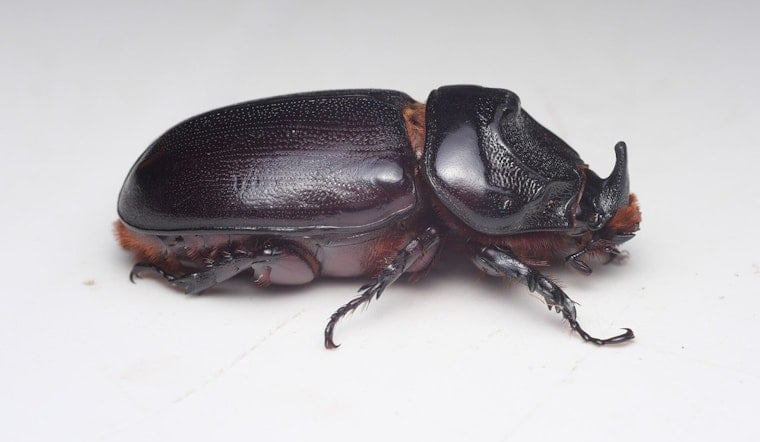
State agriculture officials are turning up the pressure on West Hawaiʻi businesses and landscapers, reminding anyone who hauls, sells or handles materials that can shelter coconut rhinoceros beetles that they must hold a Department of Agriculture and Biosecurity compliance agreement and complete mandatory training. The reminder is aimed squarely at nurseries, composters, landscapers and other operators moving mulch, potted plants or green waste inside the designated West Hawaiʻi infested zone, in an effort to slow human-assisted spread of the pest that bores into palms and can damage culturally important and food crops.
What the rule covers
On March 24 the Board of Agriculture and Biosecurity approved Interim Rule 26-1, authorizing the Hawaiʻi Department of Agriculture and Biosecurity to restrict movement of coconut rhinoceros beetle host materials from and within a defined North Kona management zone. The mapped area is generally bounded by Waikōloa Road from Highway 190 to the coast, continuing south to Laʻaloa Avenue and east to Highway 11, with covered and exempted items spelled out in the rule.
As outlined by the Hawaiʻi Department of Agriculture and Biosecurity, the restrictions focus on bare-root palms, potted plants with organic root material, mulch, wood chips, compost and commercially bagged propagation media.
How to comply
The Big Island Invasive Species Committee is running the required training and processing compliance agreements. The group says its one-hour sessions walk operators through detection, inspection and management steps that must be in place before a compliance agreement can be issued. BIISC keeps materials, checklists and a sign-up form on its website and will collect and forward completed compliance agreement applications to DAB after training.
Businesses that routinely move host material, from retail nurseries to composting facilities, are among those required to participate, according to the Big Island Invasive Species Committee.
Fines and contact
The department’s July reminder notes that failing to sign up for and finish the training "in a timely fashion" could trigger penalties that include fines of up to $10,000, according to the statewide news release. The release names Plant Quarantine Branch Acting Plant Specialist Techie Lancaster as the contact and provides a phone number and email for questions about Interim Rule 26-1. For the full breakdown, see the Department of Agriculture and Biosecurity news release.
Where this came from
The state reminder follows a county voluntary compliance order first issued last summer and later extended while the state finalized the interim rule. Officials previously said the county order initially ran from July 1 through Sept. 30, 2025, and was later pushed out through April 30, 2026, as work on statewide interim rules continued. The voluntary pause asked property owners to avoid moving potential breeding material off-site and to use designated disposal sites.
Spectrum News coverage and county notices include maps and specific guidance for residents inside the compliance area.
Practical steps for residents
Officials are urging residents and businesses to check mulch and potted media regularly, avoid moving suspicious material outside the compliance zone, and use county compost sites that heat piles to temperatures lethal to coconut rhinoceros beetle larvae. Hawaii County and state agencies have highlighted heated facilities and outreach resources for anyone who needs information on safe disposal or treatment.
For local guidance and details on heated compost operations, see reporting from Hawaii News Now.
Legal implications
Beyond administrative fines, local reporting has noted that the interim rule framework could allow misdemeanor charges for violations, with potential fines ranging from about $100 to $10,000 for a first offense under proposed enforcement language. At the same time, the department’s public notices stress that outreach and training are the primary focus while the rules are rolled out.
Aloha State Daily has summarized the possible legal consequences tied to the interim rule process.
For any business or organization that moves green waste or other host material, the most straightforward move right now is to sign up for a BIISC compliance training and complete the coconut rhinoceros beetle detection course. BIISC staff will then help submit the application to DAB and verify training completion. Questions about the rule and compliance agreements can also be directed to DAB’s Plant Quarantine Branch using the phone and email listed in the department’s notice. The Big Island Invasive Species Committee is also posting resources and downloadable checklists for operators.



