

























































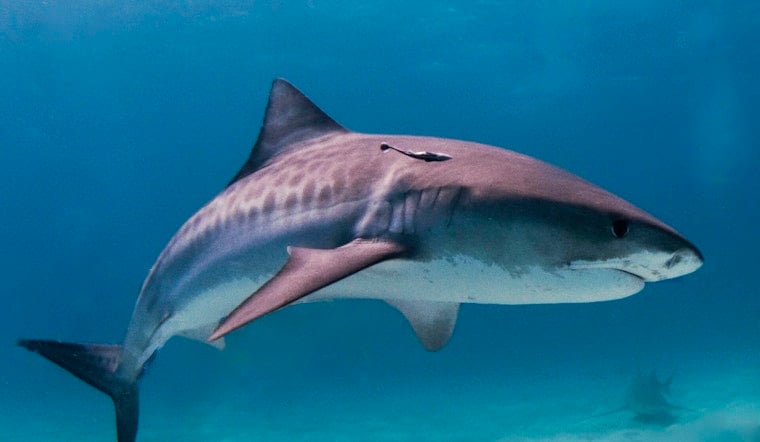
An aggressive 10-foot tiger shark surfaced Wednesday afternoon at Ala Moana Beach Park, prompting Honolulu Ocean Safety to post warning signs along one of Oahu's busiest stretches of shoreline. The shark was seen between the concessions and tennis courts at the park, and officials issued the warning at 2:05 p.m. on Wednesday.
The sighting was first reported by KHON2, which described the shark as aggressive and said Honolulu Ocean Safety posted warning signs at the beach following the confirmed sighting. Under standard agency protocol, lifeguards post yellow shark-sighted signs for at least two hours after a confirmed sighting while patrolling on watercraft and ATVs, according to a Honolulu Star-Advertiser Facebook post outlining the response procedure, with lifeguards reassessing conditions if no further sharks are spotted.
Ala Moana Beach Park is no small patch of sand. The 100-acre park features a half-mile artificial gold-sand beach and a 25-foot-deep dredged ocean swimming channel protected by an outer reef, drawing an estimated 4 million visitors a year, per GPSmyCity. That dredged channel drops off quickly just offshore, a topographical quirk that makes it easier for large marine predators to approach nearshore areas where crowds of swimmers gather.
A Pattern Along Honolulu's South Shore
Wednesday's sighting is not an isolated event for this stretch of coastline. On May 30, Honolulu Ocean Safety issued a shark advisory at Ala Moana Bowls, the surf break at the park's east end near Magic Island, after lifeguards spotted two aggressive eight-foot sharks shortly following a non-fatal shark attack at nearby Cromwell's Beach, according to The Inertia. Hoodline previously reported on that Kahala Cove attack and the advisories it triggered.
Just two months later, on July 20, officials confirmed an aggressive eight-foot tiger shark near the Flies surf zone off Kakaako Waterfront Park, less than two miles down the South Shore from Ala Moana, as Hoodline reported in its piece on the Kakaako surf scare. It was also not the first time Ala Moana itself had drawn a shark warning: Honolulu Ocean Safety posted signs there on September 30, 2024, after hammerhead sharks were spotted swimming near the shoreline.
Why Late Summer Brings More Sharks Close to Shore
The timing lines up with a well-documented seasonal shift. A seven-year tracking study by the University of Hawaii and University of Florida found that up to 25 percent of mature female tiger sharks migrate roughly 1,500 miles from the Northwestern Hawaiian Islands to the main islands in late summer and fall for birthing season, according to the University of Hawaii System.
A 30-year study of Hawaiian shark incidents from 1995 to 2024, published in 2026, found that 20 percent of all unprovoked shark bites statewide occur in October, a rate two to four times higher than any other month, with tiger sharks accounting for at least 63 percent of those October incidents, per research published in Frontiers. The phenomenon is locally known as “Sharktober.” Native Hawaiian oral tradition captured the same seasonal pattern long before modern tracking studies: the proverb “Pua ka wiliwili, nanahu ka manō,” or “When the wiliwili tree blooms, the shark bites,” warned of rising shark activity as the trees bloom in late summer, coinciding with tiger shark pupping season.
Risk Remains Low, Officials Say
Despite the string of advisories, state records show actual bites remain rare. Hawaii averages roughly three to six unprovoked shark bite incidents per year statewide, keeping individual risk under one in a million even with millions of ocean visitors, according to statistics maintained by the Hawaii Department of Land and Natural Resources. That context also explains why the state no longer attempts shark culling: programs run between 1959 and 1976 killed 4,668 sharks, including 554 tiger sharks, without producing any measurable drop in bite rates, according to the Hawaiʻi Institute of Marine Biology, which notes that modern tagging shows tiger sharks roam widely between islands rather than staying in small territories.
The Hawaii Department of Land and Natural Resources is recommending that beachgoers stay near lifeguards and other people, swim, surf or dive in groups, and choose beaches with lifeguards on duty. The agency also advises avoiding the ocean at dawn, dusk and night, since some sharks move closer to shore during those hours to feed, and steering clear of murky water, harbor entrances, stream mouths, channels and steep drop-offs. People with bleeding or open wounds should stay out of the water entirely, and tiger sharks have been known to bite people at any time of day.
What to Do if You See a Shark
Anyone who sees a shark should leave the water quickly and calmly, following any posted warnings, and should never touch, chase or harass the animal. People who see or encounter a shark need to notify ocean safety personnel or call 911 immediately. Officials stress that beachgoers should check with a lifeguard for the latest ocean and beach conditions before entering the water, since Hawaii's waters are, and always will be, home to sharks.





