

























































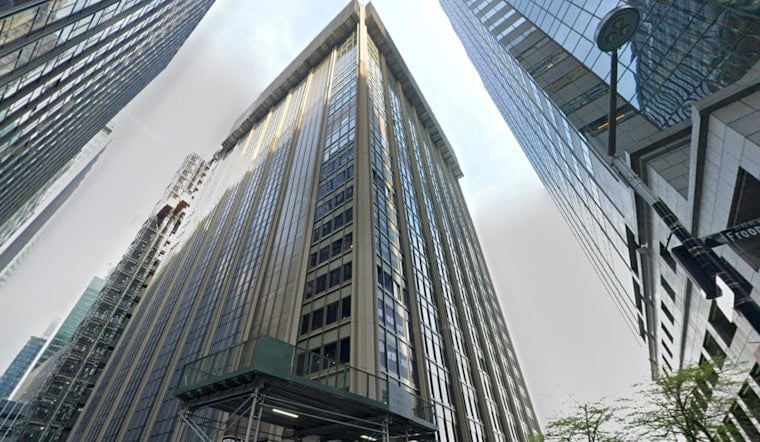
A 24-story tower that once housed Citigroup's entire downtown workforce is now getting a five-story addition and a total residential makeover, with construction underway to convert 111 Wall Street into 1,568 rental apartments. The Financial District project will reserve a quarter of its units as affordable housing while packing in amenities that include a bowling alley, a golf simulator, and what developers are calling the city's only rooftop NBA regulation court.
The scope of the conversion is detailed in a report from New York YIMBY, which notes the redevelopment will span more than 899,000 square feet and add a five-story overbuild atop the existing 1968 structure. The building, located between South and Front streets in Manhattan's Financial District, served for decades as the headquarters of First National City Bank, later Citigroup, which occupied the full 1.2 million-square-foot tower before vacating in 2019 upon its lease expiration, according to CommercialSearch. Gensler designed the residential conversion, per the same report from New York YIMBY, while Studios Architecture had designed an earlier $100 million office renovation in 2023.
A Deal That Nearly Collapsed in Foreclosure
The path to today's construction site was anything but smooth. Intervest Capital Partners, successor to Wafra Capital Partners, and Nightingale Properties originally bought the leasehold for $175 million in January 2020, then purchased the underlying land for $220 million in June 2021 to take full ownership, as reported by The Real Deal. The partners initially poured money into a $100 million office renovation, but lender Oaktree Capital Management moved to foreclose on a $500 million loan in 2023 after Nightingale exited the venture amid financial scandals, per the seed report's account.
The foreclosure threat lifted in September 2024, when Oaktree agreed to let the funds originally earmarked for the office upgrade be repurposed for a residential conversion instead. Intervest Capital Partners then signed an agreement with Metroloft Development that same month to convert the tower, according to New York YIMBY. Metro Loft, led by developer Nathan Berman, is simultaneously converting other large Manhattan office towers into housing, including a 1,300-unit project at 25 Water Street in the Financial District and a 1,500-unit conversion at Pfizer's former Midtown headquarters, The Real Deal reports.
An $867 Million Bet, the Largest of Its Kind
The financial engineering behind the project is as outsized as the building itself. The 111 Wall Street team closed an $867 million financing package, consisting of a $778.6 million construction loan from Apollo Global Management, J.P. Morgan Chase & Co., and TYKO Capital, alongside an existing $88.4 million C-PACE loan from Petros PACE Finance, according to Multi-Housing News. Walker & Dunlop, which arranged the package, says it represents the largest single-building office-to-residential conversion loan in the country's history as of late 2025.
The building's C-PACE financing has a pioneering history of its own. In June 2021, 111 Wall Street became the first property in New York City to secure Commercial Property Assessed Clean Energy financing, landing $89 million from Petros PACE Finance for infrastructure and sustainability upgrades, per Petros PACE Finance. That existing loan was folded into the larger 2025 package rather than replaced.
Affordable Units and a Long List of Amenities
The conversion qualifies for New York City's affordable housing conversion program, and the project will reserve 25 percent of its residential inventory for affordable housing, with those units expected to serve residents earning an average of 80 percent of area median income, per New York YIMBY. That set-aside falls under Section 467-m of the state's Real Property Tax Law, which was enacted in May 2024 to offer 25- to 35-year property tax exemptions to commercial conversions that reserve at least a quarter of their units as affordable housing, according to the Office of the New York City Comptroller.
Residents will have plenty to do without leaving the building. Plans call for more than 100,000 square feet of amenities, including a fitness center, café, and coworking spaces, a full lobby redesign, and 7,000 square feet of ground-floor retail. A wellness and recreation suite will include a spa, golf simulator, bowling alley, and social lounges, while the rooftop will feature climate-controlled basketball and padel courts, a pool, jogging track, and outdoor fitness area. Walker & Dunlop promises the building will house the city's only rooftop NBA regulation court.
Part of a Wider Downtown Shift
111 Wall Street is one of dozens of similar bets being placed across Lower Manhattan. A May 2026 report by the Alliance for Downtown New York identified 18 active or planned office-to-residential conversions south of Chambers Street set to add 7,557 new apartments, expanding the neighborhood's housing stock by nearly 20 percent, according to The Broadsheet. Hoodline previously reported the neighborhood surpassing 70,000 residents, a milestone tied to the same wave of conversions now reshaping former office towers like 222 Broadway and 17 Battery Place. Metro Loft's broader acquisition activity in the district was also detailed in Hoodline's coverage of a FiDi tower purchase days after a Midtown building collapse scare.
Whether the 25 percent affordable set-aside meaningfully addresses the city's housing crunch, or simply greases the wheels for developers to unlock lucrative conversions, remains an open question as more of these 1960s-era towers empty out and get reimagined for a residential Financial District.





