

























































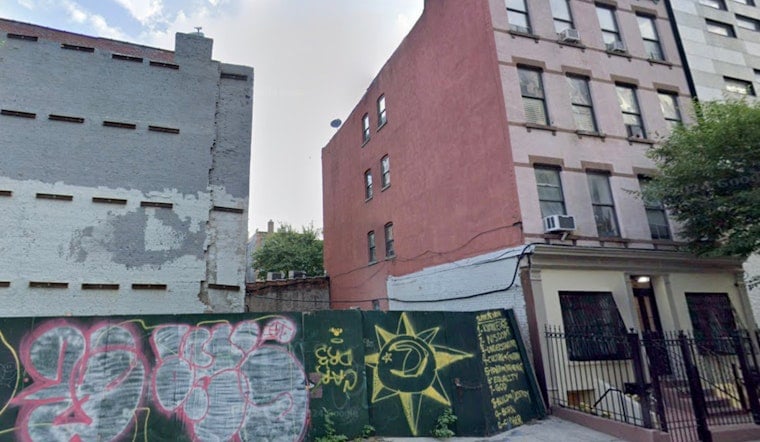
A six-story residential building with 17 units has been proposed for the northeast corner of Second Avenue and East 103rd Street in East Harlem, on a site currently occupied by a four-story building dating to 1910. The new construction would rise 64 feet and add 10,448 square feet of residential space to a stretch of Second Avenue that sits just blocks from a future subway stop tied to one of the city's largest transit projects.
The permit filing, first reported by New York YIMBY, lists the address as 299 East 103rd Street, which carries an alternate address of 2000 Second Avenue. The site sits on a 1,896-square-foot lot at the corner, and the existing structure it would replace contained six residential units and three commercial spaces before full demolition permits were filed for the property in December 2018, according to a separate New York YIMBY report at the time. Demolition permits for the new project have not yet been filed, and the developer has not announced an estimated completion date, per the outlet's account.
The building would include a cellar and a penthouse, with a concrete-based structural system. Average unit scope is projected at 614 square feet, a size the report indicates points toward rental apartments rather than condos. Aviv Ben Avi, affiliated with AB+R Construction Corporation, is listed as the owner behind the applications.
An Architect With a Regulatory Record
The architect of record is Naresh Mahangu, affiliated with NKM Engineering PLLC. Mahangu's history carries some baggage worth flagging for East Harlem residents watching this corner: in May 2019, he voluntarily surrendered his Professional Certification and Directive 14 self-certification privileges with the NYC Department of Buildings, except for solar applications, after a DOB audit cited code non-compliances tied to accessibility, egress, and zoning. Losing that self-certification status means all of his plans now require full review by a DOB plan examiner rather than sign-off by the architect himself.
Mahangu's name also surfaced in a February 2023 federal lawsuit. The Fair Housing Justice Center filed a disability discrimination complaint against Mahangu and a developer, alleging that a newly constructed 60-unit rental building in Queens failed to comply with federal accessibility standards, according to the Fair Housing Justice Center. That complaint reportedly noted his prior disciplinary history with the city buildings department.
Transit Access and Zoning Backdrop
The 103rd Street subway station, served by the 6 train, is within walking distance of the site. Beyond that existing line, the corner also sits three blocks south of the planned 106th Street station for Phase 2 of the Second Avenue Subway extension, a project Hoodline has previously reported will eventually bring the Q train north with new stops at 106th, 116th, and 125th Streets.
The 2017 East Harlem Rezoning covered a 96-block area of Manhattan Community District 11, permitting increased residential density while layering on Mandatory Inclusionary Housing requirements meant to encourage affordable unit creation, according to the Municipal Art Society of New York. That rezoning effort was coordinated with a broader citywide housing plan targeting thousands of new affordable homes.
Why Small-Scale Buildings Keep Coming
Projects sized like this one fit neatly into current tax incentive structures shaping East Harlem's development pipeline. Under Real Property Tax Law Section 485-x, enacted in April 2024, the state offers a 35-year property tax exemption for rental developments of 6 to 99 units, provided at least 20 percent of units are designated affordable, per Nixon Peabody LLP. That law replaced the former 421-a program and requires rent stabilization for participating units.
Staying under 100 units also carries a labor advantage. Hoodline has reported that developers in East Harlem have increasingly structured residential projects below that threshold specifically to avoid the higher construction wage mandates that 485-x imposes once a building reaches 100 or more units. That dynamic has shaped projects across the neighborhood this year, including one developer's decision to split a mega site into seven separate 99-unit towers rather than build one larger structure.
The market rationale lines up with East Harlem's demographics. Census data compiled by Data USA shows Community District 11 has an 8.6 percent homeownership rate, far below the national average of 65.2 percent, even as the median property value in the district reached $751,600 in 2024. That overwhelmingly rental-driven market helps explain why a 17-unit building averaging 614-square-foot apartments makes sense on this corner.
A Developer's Track Record in Low-Rise Infill
Aviv Ben Avi and AB+R Construction Corporation have a pattern of filing similar low-rise residential projects around the city. The developer filed permits for four-story residential buildings at 702 Hancock Street and 762 Macon Street in Brooklyn in March 2023, according to New York YIMBY's broader coverage of the firm's Bed-Stuy area filings, and the company frequently operates in Brooklyn and Manhattan's residential infill markets.
The East Harlem project arrives as the neighborhood juggles both small private infill and much larger, city-backed affordable housing pushes. In February, city officials broke ground on Timbale Terrace at Park Avenue and East 118th Street, a $255 million, 341-unit fully affordable development featuring an Afro-Latin cultural venue, built on former NYPD parking land, as Hoodline has reported. That project stands in sharp contrast to the scale of the 299 East 103rd Street filing, underscoring how differently market-rate infill and city-subsidized housing are being built just blocks apart.



