

























































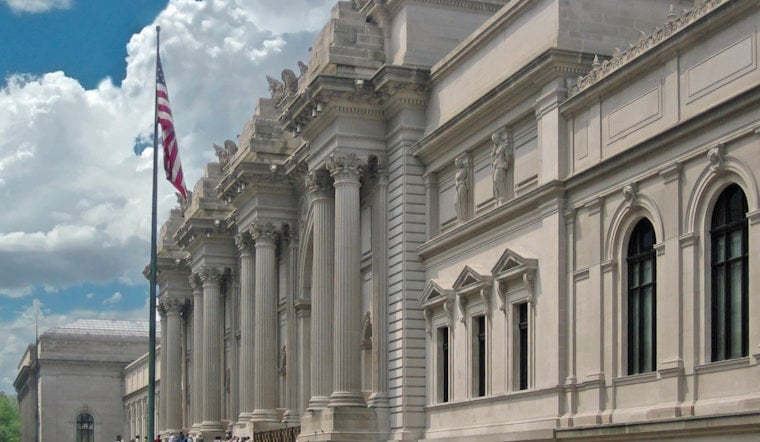
A scrap of papyrus small enough to hold in two hands has become one of the most talked-about objects in New York City this month. The Metropolitan Museum of Art returned its 2,300-year-old fragment of Homer's Odyssey to public display in Gallery 162, and it preserves three lines of the epic that appear nowhere in the standard text readers know today.
The papyrus went back on view on August 5, according to Hyperallergic, after having been kept out of public view for an extended period, per Time Out New York. The Met paired the reopening with a departmental video feature on Homeric art, and the timing lines up with a cultural moment: Christopher Nolan's film adaptation of The Odyssey has renewed public interest in Homer, as Time Out notes, turning a museum case in Manhattan into an unlikely pilgrimage site for moviegoers.
Dug From an Egyptian Necropolis in 1902
The fragment has a long paper trail. Papyrologists Bernard P. Grenfell and Arthur S. Hunt excavated it in 1902 from the necropolis of El Hibeh, Egypt, recovered from debris outside the ancient town's northern walls, according to the Metropolitan Museum of Art. The Egypt Exploration Fund formally gifted it to the museum in 1909 under accession number 09.182.50. Time Out reports the piece was written with charcoal and water on papyrus, and dates to roughly 285 to 250 BCE, making it the first early Ptolemaic fragment of the Odyssey ever discovered.
The Odyssey itself was composed around the eighth century BCE, originating as an oral tradition passed down and performed by bards long before anyone wrote it on papyrus, per Time Out. The Met's fragment was produced in early Ptolemaic Egypt during the third century BCE, a period when Ptolemaic kings established the Great Library of Alexandria specifically to collect regional copies of Homeric epics from Mediterranean city-states and compile standardized texts, the museum's collection notes explain. Alexandrian scholars systematically edited variations from cities like Chios and Argos to establish canonical versions of the poem.
Three Lines No Modern Reader Has Seen
Measuring just over 7 inches (7.5 inches, or 19.1 cm) in height, the fragment preserves lines 41 through 68 of Book 20 of the Odyssey, including three so-called plus verses entirely absent from modern standard editions, according to the Center for Hellenic Studies. It's cataloged in Homeric studies as Papyrus 19 in M. L. West's critical edition of the epic. The Met displays both the front and back of the fragment, per Time Out.
Those missing lines aren't errors. Surviving Homeric papyri show that written versions of the epic stayed fluid during oral performances until roughly 150 BCE, when manuscripts began stabilizing into the uniform texts we recognize now, the Center for Hellenic Studies notes. Early fragments like this one frequently carry extra or omitted lines compared with the medieval vulgate manuscripts that came later — evidence of bards adapting the tale on the fly rather than reciting from a fixed script. Sean Hemingway said bards occasionally embellished stories and had different versions of the same episodes, according to Time Out.
Seven Objects, One Hero's Journey
The papyrus isn't on view alone. The Met is highlighting a Melian terracotta plaque from around 460 to 450 BCE in Gallery 157, depicting the goddess Athena disguising Odysseus as a beggar so he can slip past the suitors into his own palace, according to the Met's own account. Curators pulled together seven objects across the galleries tracing key episodes of Odysseus's journey, including a Roman fresco featuring the Cyclops Polyphemus, a fifth-century BCE bowl showing Odysseus pursuing Circe, and a carnelian scarab depicting the Trojan Horse, per Time Out.
Those pieces sit within a much larger collection. The Met's Department of Greek and Roman Art houses more than 30,000 ancient works spanning from the Aegean Neolithic period around 4500 BCE to the conversion of Roman Emperor Constantine in 312 CE, according to 6sqft. Its galleries were reinstalled as part of a multi-phase master plan completed in 2007.
A Blockbuster Fuels the Foot Traffic
The renewed interest didn't come out of nowhere. Nolan's The Odyssey hit theaters on July 17 and had earned nearly $640 million worldwide, including $140 million from IMAX screens, within two weeks, making it the highest-grossing movie of 2026 after just two weekends, according to ComingSoon. The production spanned 91 days across six countries and used two million feet of 15/70mm IMAX film, becoming the first feature-length film shot entirely on IMAX cameras, per CBS 60 Minutes.
Demand for 70mm IMAX screenings at AMC Lincoln Square was so intense that tickets reportedly sold out more than a year before the premiere, pushing some moviegoers who couldn't get seats toward the Met's exhibit instead, per 6sqft. AMC Lincoln Square houses one of the few active 15/70mm IMAX screens in the country. A similar pattern played out far from Manhattan — Hoodline previously reported on Fort Lauderdale's IMAX pull, where fans traveled statewide for a rare 70mm screening during the film's record-breaking run.
For now, the fragment remains on view in Gallery 162, a physical link between Homer's oral tradition and the version of the story now filling IMAX screens nationwide. The three verses it preserves won't be found in any modern printed edition, but they're a reminder that the Odyssey was never one fixed text — just the version that happened to survive.




