

























































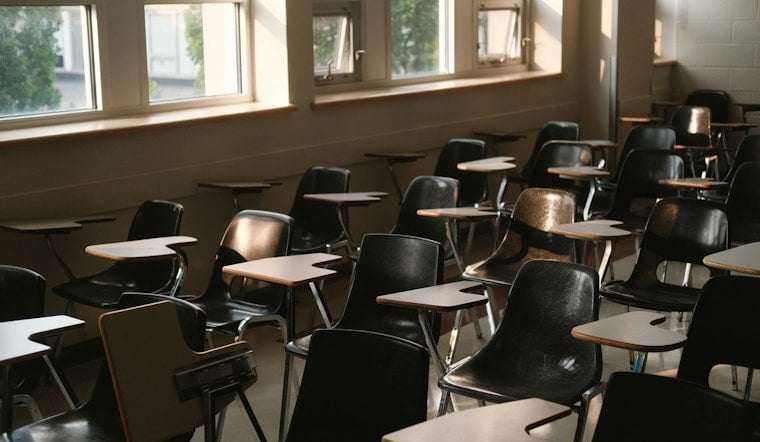
Fifty-two Philadelphia public schools will dismiss students early on Tuesday, September 1, because their buildings still lack adequate air conditioning to handle the late-summer heat. The School District of Philadelphia announced the early dismissals, along with the cancellation of all in-person after-school activities at those campuses, as forecasts pushed temperatures into territory that triggers the district's heat protocol.
Affected schools include Joseph Catharine, Bache-Martin, James Blaine, Amy Northwest, and Building 21, among others, according to 6abc Philadelphia. Early childhood programs at the impacted buildings, including the on-site PreK and Head Start programs at Catharine and Bache-Martin, will also let out ahead of schedule. The district encouraged students to wear lightweight clothing and carry a water bottle to stay hydrated through the day.
The dismissals follow a precise operational threshold: under the district's official weather protocol, schools without sufficient cooling must dismiss early when outdoor temperatures are forecast to reach 85°F by noon, and shift to remote learning entirely if that mark is expected by 9 a.m., according to the School District of Philadelphia.
A Shrinking But Still Sizable List
The number of Philadelphia schools without adequate cooling has dropped steadily in recent years — from roughly 100 buildings in 2022 to 86 by late 2023, 63 in 2024, and 52 by mid-2026, per district facilities data cited by WHYY. That progress reflects what the district has called significant headway toward cooling every campus, but the remaining 52 buildings still represent nearly a quarter of all district facilities.
Officials set a target back in 2022 to fully air-condition every school by 2027. As of August 2026, that goal appears unlikely to be met on schedule, the Philadelphia Inquirer reported. The newspaper's reporting points to a bottleneck that has little to do with the price of window units: the real obstacle is the complex electrical system upgrades required inside aging school buildings before modern HVAC can even be installed.
Electrical Upgrades, Asbestos, and a Budget Squeeze
That infrastructure challenge became starkly visible earlier this month. HVAC renovation work at Kensington High School uncovered asbestos hazards, forcing more than 400 students to relocate for the remainder of the calendar year, CBS News Philadelphia reported. The episode illustrates the physical and logistical risks the district faces when it tries to retrofit century-old buildings with modern cooling systems.
Money remains the other constraint. In April, the Board of Education approved a $3 billion, 10-year Facilities Master Plan called Accelerating Opportunity, aimed at modernizing 169 school campuses with updated HVAC systems while closing 17 underutilized buildings, according to FOX 29 Philadelphia. But the district can only cover about $1 billion of that plan from its own budget, leaving the remaining $1.8 billion dependent on public and philanthropic funding, K-12 Dive reported in January. Those capital needs come on top of an operating budget already under strain: the Board approved a $4.6 billion spending plan for the 2026-2027 school year in May while managing a $300 million structural deficit that forced $50 million in classroom cuts and $169 million in central office reductions, per WHYY.
Heat's Toll on Learning, and a Calendar Debate
The stakes go beyond discomfort. Research by environmental economists cited in WHYY reporting found that a 1°F rise in average school-year temperature can reduce annual learning by roughly 1% in classrooms without air conditioning. That research underscores why the district treats its 85-degree threshold as a health and academic protection measure rather than a mere scheduling inconvenience.
The recurring disruptions have also reignited debate over when the school year should begin. A district survey published in February 2025 found that while 55% of overall respondents favored starting the school year before Labor Day, a majority of parents actually preferred starting classes afterward, citing late-summer heat concerns, the Inquirer reported. For families at the 52 schools still waiting on adequate cooling, Tuesday's early dismissal is the latest reminder of why that debate hasn't gone away.





