

























































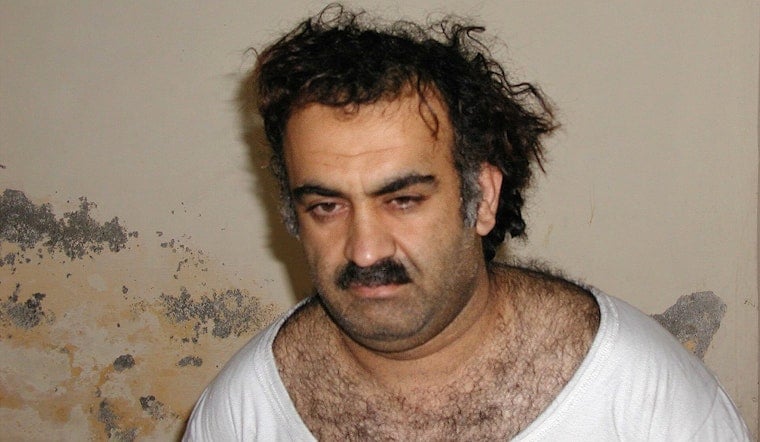
Khalid Sheikh Mohammed, the accused mastermind of the September 11 attacks, will finally stand trial at Guantanamo Bay — but not until June 5, 2028, according to a ruling issued this week by military judge Lt. Col. Michael Schrama. The decision, which lands just two weeks before the 25th anniversary of the attacks that killed nearly 3,000 people, rejected a request from government prosecutors to begin trial proceedings sooner, in January 2027. Mohammed and three alleged co-conspirators have been held at the Guantanamo Bay military base in Cuba since 2003.
As reported by the New York Post, Schrama's ruling sets a firm date for a case that has dragged through the military commission system for well over a decade with no trial in sight. The judge, an Air Force lieutenant colonel who became the fifth military judge assigned to the case in late 2025, was a 19-year-old Georgetown University undergraduate on September 11, 2001, when hijacked American Airlines Flight 77 crashed into the Pentagon four miles from his campus, according to Lawdragon. The three alleged co-conspirators set to stand trial alongside Mohammed are Walid bin Attash, Ammar al-Baluchi — also known as Ali Abdul Aziz Ali — and Mustafa Ahmed al-Hawsawi, per the Military Commissions Trial Judiciary.
A Collapsed Plea Deal Reopened the Door to the Death Penalty
The case took a dramatic turn in 2024, when military commission convening authority Susan Escallier formally signed a plea agreement with Mohammed and two co-defendants on July 31 of that year, ending years of negotiation and taking the death penalty off the table in exchange for life sentences. Just two days later, on August 2, 2024, then-Defense Secretary Lloyd Austin issued a memo revoking the deal outright, as detailed by The Guardian.
That reversal was later upheld in court. On July 11, 2025, a panel of the U.S. Court of Appeals for the D.C. Circuit ruled 2-1 that Austin acted within his legal authority when he revoked the pre-trial agreements, according to CBS News. The ruling restored the possibility of capital punishment for Mohammed and his co-defendants and effectively forced the case back toward a full trial rather than a negotiated resolution.
Torture Allegations Still Complicate the Evidence
Much of the delay in the case traces back to how Mohammed was captured and interrogated. He was seized during a joint CIA-Pakistani operation in Rawalpindi, Pakistan, on March 1, 2003, then held in secret CIA black sites, where he was waterboarded 183 times that same month before being transferred to Guantanamo Bay in September 2006, according to reporting cited by The Washington Post. He was later held at Guantanamo Bay in 2009, and a photograph purporting to show him in detention there that July was released under a policy allowing the International Committee of the Red Cross to photograph Guantanamo inmates — though the Red Cross released the image only to the detainee's family, per the seed reporting.
Those interrogation methods have continued to haunt the prosecution's case. A central legal fight has centered on so-called clean team FBI confessions obtained from defendants in 2007 and 2008, which prosecutors want to use at trial. Defense attorneys argue those later statements remain irreconcilably tainted by the earlier CIA torture — an argument that succeeded in April 2025, when a military judge granted a motion suppressing statements by co-defendant Ammar al-Baluchi on exactly those grounds, according to Lawfare.
Not every original co-defendant remains part of the case. In September 2023, military judge Col. Matthew McCall severed co-defendant Ramzi bin al-Shibh from the trial after a Defense Health Agency medical panel found him mentally incompetent to stand trial, citing post-traumatic stress disorder and psychosis caused by CIA torture, as reported by PBS.
A Legal Framework Born From a Supreme Court Rebuke
The Guantanamo military commissions themselves exist because of a 2006 U.S. Supreme Court ruling. In Hamdan v. Rumsfeld, the court held that President George W. Bush's original military tribunals violated both the Uniform Code of Military Justice and the Geneva Conventions, prompting Congress to pass the Military Commissions Act that now governs the case, according to the Center for Constitutional Rights.
Formal pre-trial proceedings began with the arraignment of the defendants at Guantanamo Bay on May 5, 2012 — meaning that by the time the trial finally opens in June 2028, the case will have spent more than 16 years in pre-trial hearings alone, per Lawdragon's reporting. That extraordinary timeline reflects a tangle of military commission procedures, ongoing interlocutory appeals, and the lasting legal fallout of the post-9/11 detention and interrogation program.
With the trial date now set for June 5, 2028, prosecutors and defense teams are expected to continue litigating evidentiary questions — including the admissibility of the FBI confessions — both before and during the proceedings. This remains a developing story.



