

























































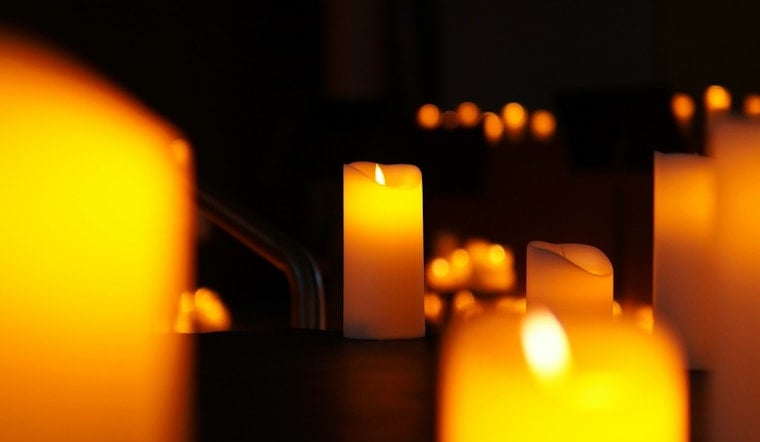
Six ways that light shapes a movie scene are about to take over two full floors of the Academy Museum of Motion Pictures. Starting August 29, the double-height Hurd Gallery in the Miracle Mile will house Glow: A Cinematic Moodscape, an immersive installation exploring the cinematic uses of candlelight, moonlight, dawn, dusk, fireworks, campfires, neon and other radiant light sources, and it will remain on view through May 21, 2027.
The exhibit is organized around six aesthetic light themes — Sunrise and Sunset, Moon, Neon, Candlelight, Fireworks and Campfire — and weaves together multi-story synchronized projections, dynamic gallery lighting and an original musical score, according to the Academy Museum of Motion Pictures. As reported by NBC Los Angeles, the installation is included with general admission and occupies parts of the museum's second and third floors.
Glow is staged inside the Saban Building's Hurd Gallery, a specialized 34-foot-tall double-height space that has previously hosted large-scale exhibits, including the 30-foot Mt. Rushmore backdrop from Alfred Hitchcock's North by Northwest, per the museum. The gallery also housed the 2023–2024 exhibition Shifting Perspectives: Vertical Cinema, which showcased vertical-format films by Southern California filmmakers exploring non-traditional screen orientations — a reminder that this room has become the museum's go-to lab for experimental visual formats.
A Film Series Built Around Candlelight
Pairing with the installation is In the Glow of Candlelight, a complementary film series running September 3 through 14 that requires a separate ticket. The lineup includes films such as Amadeus and The Beguiled, and per the museum, screenings also include Stanley Kubrick's Barry Lyndon in 35mm, Céline Sciamma's Portrait of a Lady on Fire in 4K DCP, and Ingmar Bergman's Fanny and Alexander.
The museum notes that candlelight can provide warmth to a cinematic image whether it contributes to the mise-en-scene or serves as the only light source — a line that points directly at Barry Lyndon's reputation as a landmark of low-light cinematography. To shoot the film's candlelight-only interior scenes without artificial boost lighting, Kubrick used three rare Carl Zeiss 50mm f/0.7 lenses originally built in 1966 for NASA's Apollo program, paired with custom three-wick candles, according to ZEISS.
The Technology Behind the Glow
Projection and display technology for the exhibit, and across the museum more broadly, comes from digital display partner Christie, whose cinema technologies won an Academy Award in 2024 for its Dolby Vision projection system. That hardware is what allows the Hurd Gallery's synchronized, multi-story projections to sync with the gallery's dynamic lighting and original score across all six light themes.
Part of a Star-Studded Fall Calendar
Glow arrives as part of a broader autumn 2026 rollout at the museum, which also includes a fall film series devoted to filmmaker John Carpenter and a planned Monster Mash party in October. As MyNewsLA reports, the season's public programs include in-person appearances from Sofia Coppola, Guillermo del Toro, Denis Villeneuve, Taika Waititi, Isabella Rossellini, and Sissy Spacek for a 50th anniversary screening of Carrie. Public tickets for the full autumn lineup — Glow, the Carpenter retrospective and the Monster Mash programming — went on sale Thursday.
The expanded season comes under Director and President Amy Homma, who took the museum's helm in 2024 and was elevated in January to also oversee the Academy's broader 52-million-item collection, uniting the museum's exhibitions with the Academy Film Archive and the Margaret Herrick Library, per the Academy Press Office. That consolidation gives the museum deeper archival resources to draw on for exhibits like Glow, which sits at the intersection of gallery technology and traditional repertory cinema.
The Academy Museum sits at Wilshire Boulevard and Fairfax Avenue in the Miracle Mile, occupying the historic 1939 Streamline Moderne Saban Building connected to a glass-and-concrete sphere designed by architect Renzo Piano. The museum opened in September 2021 as the largest museum in the United States dedicated to the art and science of movies, and Glow now joins its list of major installations exploring how filmmakers manipulate light to shape mood and memory on screen.



