

























































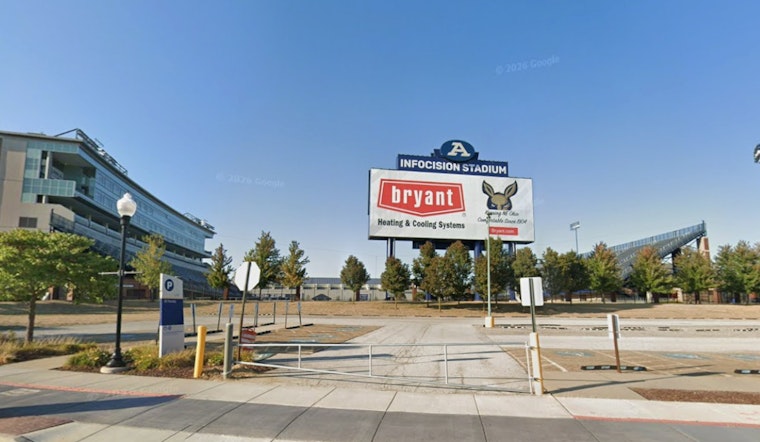
Akron will mark 25 years since the September 11 attacks next month with a 110-story climb up the stands of InfoCision Stadium, a physical tribute to the emergency responders who died that day and a fundraiser for the mental health care of the ones still on duty today. The Safety Forces Support Center will host the event on Sept. 11 starting at 6 p.m., inviting individuals, families and community teams to take part.
The climb, organized alongside the University of Akron, honors the 343 firefighters, 72 police officers and 10 EMS personnel who died in the World Trade Center attacks on September 11, 2001, according to the center. As Cleveland.com reports, the event is also organized in partnership with the Summit County Executive's Office, Akron Fire Local 330 and FOP Lodge No. 7. Participants will climb 110 stories at the stadium, located at 375 E. Exchange St., replicating the ascent attempted by emergency personnel inside the twin towers a quarter-century ago.
That 110-story, roughly 2,200-step benchmark is standard for 9/11 memorial climbs held across the country, according to the National Fallen Firefighters Foundation, which sets the format nationally to honor surviving families. Registration costs $25 for students and $40 for adults, and those unable to climb can still make a donation or become an event sponsor. All proceeds benefit the Safety Forces Support Center, per the same account.
From a 2021 Anniversary Event to a Regional Lifeline
Akron's stair climb began in 2021, when the inaugural event commemorated the 20th anniversary of the attacks and raised $21,413.78 for the Safety Forces Support Center, according to a Metis Construction newsletter from that period. The center itself traces back further still — it was founded in 2012 by Rev. Dr. Allen Robert “Bob” Denton as the Safety Forces Chaplaincy Center, offering free mental health counseling and crisis support to local emergency personnel, according to Billow Funeral Homes, which noted Denton was a longtime chaplain and adjunct professor at the University of Akron.
Today the organization provides mental health support and training for first responders, and it trains the chaplains and mental health professionals who work with them. While it primarily serves first responders in Summit County, the center also extends its reach into Cuyahoga, Medina, Wayne, Portage and Stark counties, addressing occupational stress among fire, law enforcement, EMS and dispatch personnel that can create physical, mental and emotional effects.
Deploying After the Worst Calls
The center's work goes beyond routine counseling. It deploys specialized crisis management teams to safety departments following traumatic events, including active shooter incidents, pediatric fatalities, officer use-of-force incidents and natural disasters, according to the Safety Forces Support Center, which provides these services at no out-of-pocket cost to first responders and their families. Executive Director Cameron Mosley also leads Bluecoats, Inc. of Summit County, a nonprofit chartered in 1959 to assist families of fallen safety officers that has since expanded to support all actively serving local emergency workers, according to the Rotary Club of Akron.
The center draws on local public and philanthropic backing to sustain that work, including a $2,500 “4-Alarm” sponsorship from the Summit County ADM Board, which oversees public addiction and mental health services in the county, along with competitive grants from the Akron Community Foundation, according to the center's Facebook page.
A Legal Shift and a National Reckoning
Ohio's legal landscape for first responder mental health changed in January 2021, when House Bill 308 made state compensation and medical benefits available to first responders diagnosed with work-related PTSD without requiring an accompanying physical injury, according to the Ohio House of Representatives. Before that, the state required a physical injury before a job-related PTSD claim could be compensated.
The stakes behind that policy shift are stark. First responders are five times more likely to experience PTSD and depression than the general public, and more firefighters die by suicide each year than in the line of duty, according to research from the Ruderman Family Foundation cited by Counseling@Northwestern. Separate long-term tracking by the Firefighter Behavioral Health Alliance documented more than 2,200 firefighter suicides nationwide between 2000 and mid-2025, with researchers estimating that only about 40% of cases are formally reported due to lingering stigma within departments.
Against that backdrop, Akron's stair climb functions as more than a remembrance of a single catastrophic day. It's a recurring funding mechanism for the kind of free, immediate crisis intervention the Safety Forces Support Center offers first responders across five Northeast Ohio counties, long after the anniversary events on the calendar have passed.





