

























































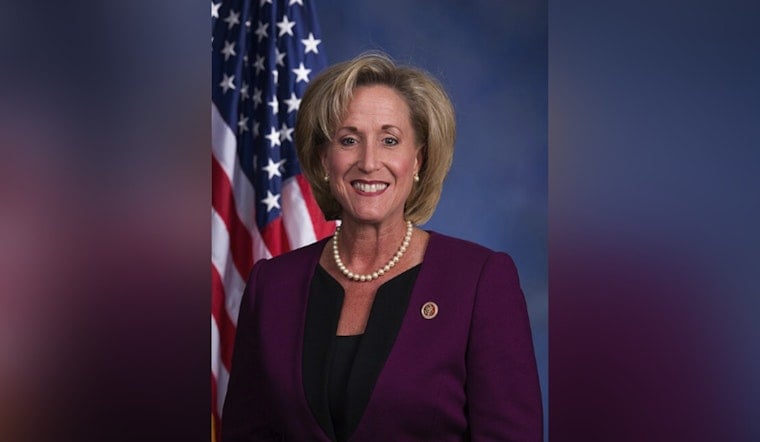
Rep. Ann Wagner's net worth has climbed to an estimated $26 million, up from just over $6 million when she started her first term 13 years ago, while her Democratic challenger in Missouri's 2nd Congressional District, Fred Wellman, has filed for personal bankruptcy twice. The financial contrast between the two candidates has become a flashpoint in the suburban St. Louis race, with each side hoping to turn the other's money story into a liability.
Wagner, the U.S. representative from Ballwin, has increased her net worth by an estimated $22 million since entering Congress, according to figures per Quiver Quantitative cited by St. Louis Magazine. That growth amounts to nearly quadrupling her wealth during her time in office. Wagner chairs the House Financial Services Subcommittee on Capital Markets, a post from which she directly oversees equity markets, private investment funds, investment advisers, and the Securities and Exchange Commission, according to the U.S. House Committee on Financial Services, which notes she has held the gavel since January 2023.
Wagner's spokesman, Arthur Bryant, said the congresswoman does not trade individual stocks and instead has invested in private equity funds, which put money into private companies rather than publicly traded ones. Bryant said Wagner avoids individual stocks specifically to prevent any appearance of a conflict of interest, and that she cannot use privileged information to direct investments. Wagner herself put it directly: “I have neither owned nor traded individual stocks since long before I was elected to Congress, and neither has my husband.”
A Family Built on Two Careers
Bryant said Wagner and her husband, Ray Wagner, worked hard, saved their money, and succeeded in their respective fields. Ray Wagner, married to the congresswoman for 39 years, spent 27 years as a longtime executive at Enterprise Mobility before retiring in 2022. The couple's finances have become a talking point not just for their scale, but for how they were built — through salaried corporate work and fund investments rather than stock picking.
Wellman, however, sees semantics in Wagner's framing. He said her statement about not trading individual stocks relies heavily on semantics, and separately argued that almost half of Wagner's fundraising comes from corporate PACs tied to the financial services industry. Wellman put the contrast bluntly: Wagner has had more than a decade in Congress and a $26 million net worth to show for it, he said.
Wellman's Two Bankruptcies
Wellman, a military veteran who served 22 years as an Army aviator and public affairs officer — deploying four times, including leading a scout platoon during Operation Desert Storm and flying UH-60 helicopters in Operation Iraqi Freedom — has filed for bankruptcy twice. The first came in Tennessee in 2003, with liabilities of $303,000 according to figures from the campaign of Joan Vondras, who defeated Wellman in the Democratic primary by fewer than 2,500 votes. Wellman has said that bankruptcy resulted from his wife's job loss at Delta Airlines after 9/11, and separately said he was deployed after the attacks and that the Army mishandled his pay.
The second bankruptcy came in Virginia in July 2020, with liabilities exceeding $715,000, including roughly $116,000 in outstanding taxes. That filing followed the collapse of ScoutComms, Wellman's advocacy firm that worked with nonprofits and other companies serving veterans returning from service. Wellman said the pandemic hurt ScoutComms after the firm became over-leveraged with nonprofit clients and had taken on expansion loans, and the company went under shortly before he filed. Bankruptcy records reviewed by the Washington Free Beacon put the 2020 total liabilities at $715,129, including $477,904 across three unpaid business loans from ScoutComms and $116,575 in unpaid tax debts, against $53,418 in declared assets. Wellman filed for bankruptcy the same month he began working as Senior Advisor for Veterans Affairs at the Lincoln Project, before being named the anti-Trump PAC's executive director in January 2021.
Does It Matter to Voters?
Political scientists interviewed for the original report were split on how much any of this will sway the race. Anita Manion, a political science professor at the University of Missouri-St. Louis, said Wagner's wealth could make her appear out of touch to voters, but also said Wellman's bankruptcies are less damaging politically because he is not running as a fiscal conservative. Ken Warren, a Saint Louis University political science professor, offered a more skeptical view, saying the candidates' financial histories are largely peripheral to the race's main dynamic.
That dynamic includes redistricting: GOP lawmakers redrew Wagner's congressional district to favor her more, according to the report. Warren also noted that incumbents win at a very high rate except when districts are redrawn or scandals occur — a dynamic that cuts against Wellman regardless of how voters weigh the candidates' finances. Missouri's 2nd Congressional District is the wealthiest in the state, with a median household income of $101,494 according to 2024 Census Bureau data cited by Forbes, covering portions of St. Louis, St. Charles, Franklin, and Warren counties. Wagner won reelection in 2024 with 54.5% of the vote against Democratic challenger Ray Hartmann, according to the Missouri Secretary of State.
Stock-Trading Ban Looms Over the Race
The financial contrast plays out against a broader congressional push to restrict lawmakers from trading individual stocks. The House passed a congressional stock-trading ban, and Wagner voted in favor of it. The measure, the Stop Insider Trading Act, passed the House 232-198 in July and would bar lawmakers and their immediate families from purchasing individual stocks while requiring public notice seven to 14 days before selling existing holdings, according to a video posted by the U.S. House Administration Committee. The bill, introduced by Rep. Bryan Steil, has since stalled in the Senate.
A December 2024 analysis by the Campaign Legal Center found that 61% of incoming freshman members of the 119th Congress held individual stocks, while 32% invested exclusively in widely held funds like mutual funds and ETFs, and 7% owned no stocks or funds at all — context that underscores how Wagner's fund-heavy portfolio diverges from many of her colleagues. Voters in Missouri's 2nd Congressional District will choose between Wagner and Wellman in November.




