

























































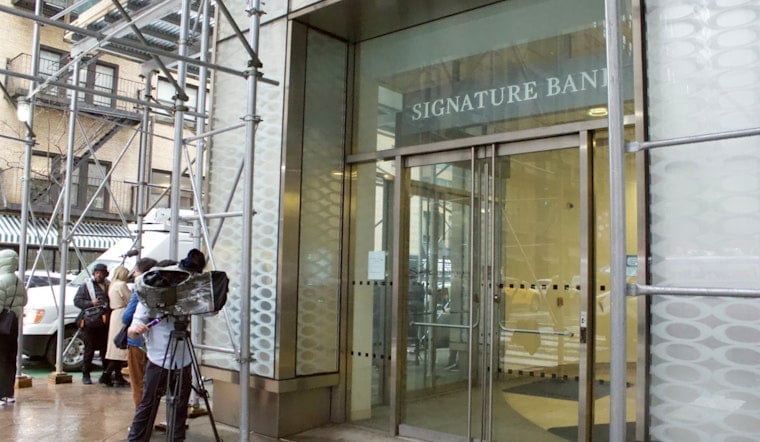
A federal appeals court in Manhattan has revived a shareholder lawsuit accusing former Signature Bank executives and auditor KPMG of hiding liquidity risks before the New York lender's sudden collapse in March 2023, rejecting the FDIC's argument that only the regulator could bring such claims. The 2nd U.S. Circuit Court of Appeals voted 3-0 to send the case back to U.S. District Judge Frederic Block in Brooklyn, who had dismissed it in March 2025.
The ruling, reported by Reuters, centers on the Financial Institutions Reform, Recovery, and Enforcement Act of 1989, a law adopted in the wake of the savings-and-loan crisis. Circuit Judge Richard Wesley wrote that the law's Succession Clause gave the FDIC many powers to oversee failed banks but did not include ownership of the right to sue on shareholders' behalf, according to Reuters. The appeals court said the FDIC's seizure of Signature Bank did not strip shareholders of their right to pursue the claims themselves, though the panel did not address the lawsuit's underlying merits.
The case, formally known as Sjunde AP-Fonden v. DePaolo, is led by Sjunde AP-Fonden, a Swedish state pension fund known as AP7 that manages more than $90 billion in assets, alongside co-lead counsel Bernstein Litowitz Berger & Grossmann LLP and Kessler Topaz Meltzer & Check, LLP. Shareholders accuse seven former Signature Bank executives and directors — including former CEO Joseph DePaolo, Chairman Scott Shay and COO Eric Howell — along with KPMG, of misrepresenting the bank's liquidity risks and risk-management practices, inflating its share price in the process. KPMG served as Signature Bank's independent auditor from 2001 until the bank's seizure, per Kessler Topaz.
A Circuit Split Over Who Gets to Sue
Judge Block's March 2025 dismissal had rested on a broader disagreement among federal appeals courts over the FIRREA Succession Clause. He adopted the First Circuit's position in Zucker v. Rodriguez, which holds that the FDIC succeeds to all claims tied to a failed bank's assets, whether brought directly by shareholders or derivatively, as detailed by Justia Law. The 2nd Circuit's rejection of that broad reading now sets a competing precedent in New York federal courts, according to the same analysis. The FDIC declined to comment on the ruling, Reuters reported.
Signature Bank was closed by regulators on March 12, 2023, just two days after Silicon Valley Bank's collapse, with both institutions carrying growing exposure to cryptocurrency clients, per Reuters. At the time of its seizure, Signature held roughly $110.36 billion in total assets and $88.59 billion in deposits, making it the third-largest bank failure in U.S. history at that point, according to the Federal Reserve Bank of Richmond. Roughly 92% of the bank's deposits were uninsured by 2021, and about 40% of its deposit base belonged to just 60 clients that year, Reuters reported, citing figures from the case record.
A Run Fueled by Crypto and a 24/7 Payment Network
On the day regulators moved in, customers withdrew several billion dollars, representing about 20% of the bank's total deposits, according to Reuters. Signature had built Signet, a proprietary blockchain payment network launched in 2018 and approved by New York regulators, that let cryptocurrency clients settle dollar transactions around the clock — a system that accelerated digital deposit withdrawals once the run began, per FinanceFeeds. A post-collapse review ordered by New York Department of Financial Services Superintendent Adrienne A. Harris found the bank suffered a rapid deposit run driven by market contagion and executive risk-management failures rather than balance-sheet insolvency before regulators stepped in, according to the department's internal report.
Separately, an internal FDIC oversight report disclosed that the agency faced severe staffing shortages from 2017 to 2023, leaving its examination team unable to complete timely supervisory reviews as Signature grew from $45 billion to $110 billion in assets, CBS News reported. The FDIC has publicly blamed Signature's demise on inadequate risk management, per Reuters. The FDIC provides deposit insurance to about 4,250 banks and savings associations nationwide.
Deposits Guaranteed, Shareholders Left With Nothing
Hours after the closure, the Federal Reserve, FDIC and Treasury jointly invoked a systemic risk exception to fully protect all depositors, including uninsured balances above the standard $250,000 threshold, funded through special assessments on commercial banks rather than taxpayer money, according to the FDIC. Flagstar Bank later acquired substantially all of Signature's deposits. While depositors were made whole, equity shareholders lost their entire investments, leaving this class action as one of the few remaining avenues to hold former leadership and KPMG financially accountable, per the case background compiled by King & Spalding.
The banking turmoil that swept up Signature also claimed First Republic, which failed in May 2023, months after Silicon Valley Bank's collapse. Reuters noted that a 2021 Supreme Court decision addressing the rights of Fannie Mae and Freddie Mac shareholders after the 2008 government takeover has also shaped legal thinking around how far federal receivership authority extends over private shareholder claims.
Locally, the fallout from Signature's failure has rippled through New York real estate, as loan portfolios that originated with the bank were reshuffled under FDIC receivership. Hoodline has previously reported on how those shifting loans pressured Bronx tenants and pushed a Manhattan office tower toward foreclosure. The revived lawsuit now returns to Judge Block, who must decide whether the shareholders' fraud allegations have merit — a question the appeals court explicitly left untouched.





_camera_setup.png)