

























































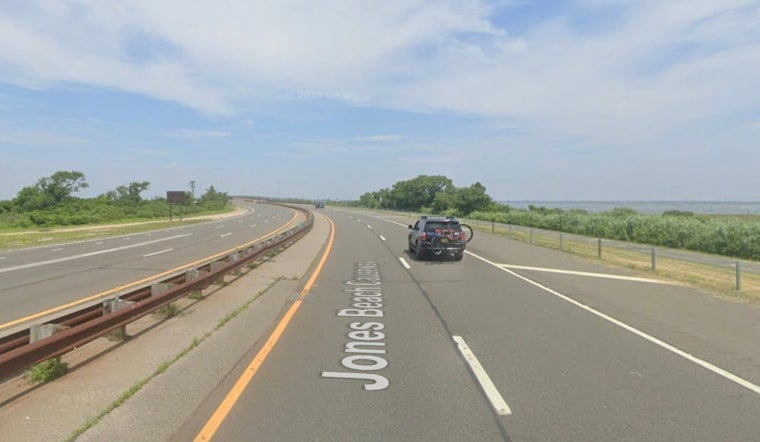
A 19-year-old Astoria man died Sunday evening after losing control of his motorcycle on the Wantagh State Parkway and crashing into a guardrail just before the Goose Neck Bridge, throwing him and his passenger from the bike. Dario Marsalek could not be saved after the crash, which also left his passenger in critical condition, according to New York State Police.
The crash happened around 5 p.m. Sunday as Marsalek and his passenger were traveling northbound from Jones Beach toward the Goose Neck Bridge on a 2014 black Suzuki, according to Newsday. Marsalek was thrown into the roadway, while his passenger landed in the grassy area on the right side of the highway. Both were taken to a hospital, where Marsalek died and his passenger was listed in critical condition, police said.
The crash occurred approximately one mile north of the Jones Beach water tower near Goose Neck Bridge, prompting state troopers to close all northbound lanes of the Wantagh State Parkway for nearly four hours, according to News 12 Long Island. The lanes reopened just before 9 p.m. New York State Police are investigating the fatal crash.
A Familiar Stretch of Roadway
This is not the first serious crash to draw attention to the northbound Wantagh State Parkway this year. In April, a 23-year-old driver was critically injured in a single-vehicle crash near Exit 5 after crossing the center median and striking a tree, a case Hoodline covered in its report on the Farmingdale family's brain-death clash. The parkway corridor near Jones Beach has also been the focus of state infrastructure work, with New York announcing $9.5 million in flood resiliency funding in August 2025 for drainage upgrades and pump stations along the route, work that was scheduled for completion this year.
Long Island's roads see frequent serious wrecks. The region experiences an average of one traffic crash causing death, injury or significant property damage every 7 minutes, and crashes seriously injured more than 16,000 people and killed more than 2,100 people on Long Island between 2014 and 2023, per Newsday's reporting.
Young Riders Face Outsized Risk
Statewide, the trend in motorcyclist deaths had been moving in a more encouraging direction before Sunday's crash. Preliminary figures released in December 2025 showed statewide motorcyclist fatalities fell from 157 during the first ten months of 2024 to 134 during the same period in 2025, according to the New York State DMV. Even so, single-vehicle collisions like Sunday's accounted for 30% of all fatal and personal injury motorcycle crashes reported by police statewide in 2024, according to the Institute for Traffic Safety Management and Research.
Marsalek's age places him within a group that state data shows bears a disproportionate share of the risk. Regional crash data published in 2026 found that 56% of motorcycle rider fatalities involved operators under the age of 35. New York law requires all motorcycle operators and passengers to wear DOT-compliant protective helmets at all times under Vehicle and Traffic Law § 381(6), a mandate that traces back to 1967, when New York became the first state in the nation to pass a universal helmet law.
Legal and Financial Hurdles Ahead
Motorcycle passengers carry additional regulatory requirements beyond helmet use. State Department of Motor Vehicles rules require motorcycles carrying a passenger to have a permanent seat designed for multiple riders along with dedicated footpegs, and mandate that passengers sit facing forward with one leg on each side. It remains unknown whether roadway conditions near the Goose Neck Bridge played any role in Sunday's crash, and State Police have not released findings on whether speed or mechanical failure contributed to Marsalek losing control of the motorcycle.
Beyond the immediate medical toll, families of motorcycle crash victims in New York often face steep financial obstacles. Under New York Insurance Law § 5103(a), motorcycle operators and passengers are excluded from standard auto no-fault insurance benefits, meaning crash victims or their families must pursue medical and liability coverage directly through fault claims or private policies rather than the no-fault system available to most car accident victims.



