

























































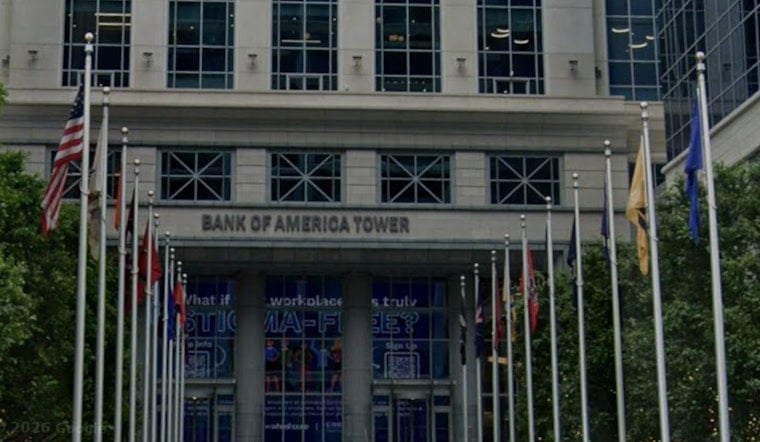
Bank of America is putting $250 billion behind a sweeping push into data centers, power grids, and the raw materials that feed them, the bank announced yesterday. The plan, dubbed the Critical Infrastructure Finance Initiative, will run for 18 months and touch everything from solar farms to computer chip factories, according to the bank.
The initiative targets what the bank calls digital, energy and core infrastructure sectors, and it will be led by the bank's Global Capital Solutions and Global Infrastructure & Sustainable Finance teams. As reported by the Charlotte Observer, Bank of America aims to connect investors with the people actually building these projects, spanning solar and wind power plants, battery storage, data storage centers, phone and internet lines, roads, transit, electric and energy transmission, grids, water systems, and technology-metal mining. The bank says it will track spending and environmental and social investment targets from January 1, 2026, through July 4, 2027 — a window that, per the Critical Infrastructure Finance Initiative's own accounting rules described by FStech, backdates eligible transactions to the start of the year and closes out on the final day of the nation's Semiquincentennial celebrations.
A Bet Backed by Charlotte's Balance Sheet
Bank of America is the second-largest bank in the United States, with roughly 213,000 employees companywide and more than 19,000 workers in the Charlotte region, the Observer reports. That scale matters because the $250 billion figure is not a single pot of direct investment; the same FStech account notes the total spans primary market lending, direct investments, capital markets underwriting, and advisory work across all of the bank's business lines, meaning much of the money reflects deals the bank helps arrange rather than cash it puts up itself.
The bank is coming off a strong earnings run that gives it room to back these commitments. Bank of America posted $9.1 billion in net income for the second quarter of 2026, a 27% jump from a year earlier driven by strong equities trading and investment banking fees, according to The American Bazaar. Hoodline previously reported on that Q2 earnings rebound and on the bank's $520 million credit line to OpenAI, part of a growing technology financing portfolio that now includes this larger infrastructure push.
Executives Frame the Push as Jobs and Security
Karen Fang said the bank is focused on accelerating infrastructure investment that drives economic growth and creates lasting value for communities, according to the Observer's reporting. Jim DeMare added that infrastructure powering the economy, strengthening energy security, and securing technological leadership will drive growth and create jobs. Bank of America said its financing will create thousands of jobs, and the Observer notes the bank gave about $40 million to partners for worker training last year.
The White House also weighed in after Bank of America's announcement, issuing a statement that the initiative will help create thousands of jobs and support long-term economic growth across domestic energy and technology sectors, per NTD News.
Why the Money Chases Data Centers and Metal
The push builds on work the bank has already been doing. In the 18 months leading up to August, Bank of America helped finance and enable construction of more than 5 gigawatts of data center projects globally, according to research from BloombergNEF. In April, the bank served as structuring agent and financial advisor on a $16 billion project financing package, selling $14 billion in long-term bonds to back a gigawatt-scale Oracle data center in Saline Township, Michigan, that serves OpenAI, as reported by Quartz.
That kind of buildout demands enormous quantities of raw material. Bank of America Institute research from earlier this year found that each incremental megawatt of data center capacity requires roughly 60 to 75 tons of metals, primarily copper, which helps explain why the initiative explicitly folds in critical mineral mining and natural gas supply alongside renewable power, according to Kitco News. Goldman Sachs Research has projected that U.S. data center power demand will more than double from 31 gigawatts in 2025 to 66 gigawatts in 2027, driven by AI compute workloads — a surge that is straining regional utility grids across the country.
Part of a Wider Wall Street Race
Bank of America is not alone in chasing this money. Morgan Stanley announced a 10-year initiative in August to facilitate roughly $1.5 trillion for U.S. technology and infrastructure, following a similar $1.5 trillion plan JPMorgan Chase launched in 2025 targeting critical national security and energy sectors. Unlike those decade-long commitments, Bank of America's 18-month target is built for faster execution across a tightly interconnected set of sectors — renewable energy, natural gas, data centers, grid transmission, and raw material mining.
The new push sits on top of, rather than replacing, a goal Bank of America set back in 2021 to deploy and mobilize $1.5 trillion in sustainable finance by 2030, including $1 trillion earmarked for the low-carbon energy transition. Whether regional power grids can be upgraded fast enough to absorb the coming data center demand — and how the industry balances that green-energy commitment against expanded natural gas and mining investment — remains an open question hanging over the entire effort.




