

























































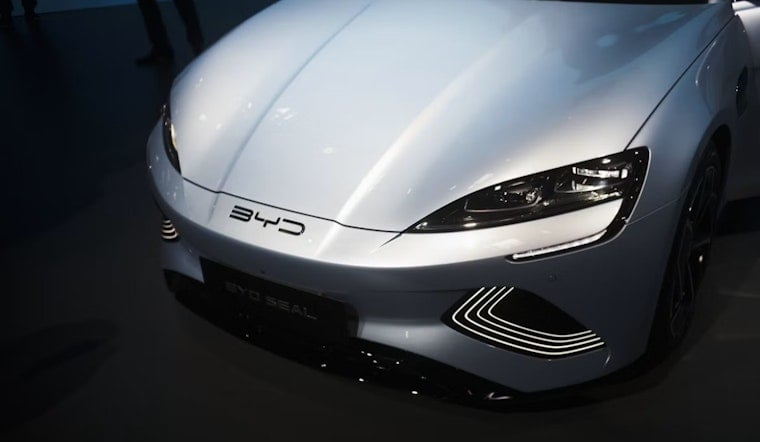
Chinese-made electric vehicles are showing up on San Diego roads even though they cannot legally be sold at a single American dealership. The cars are not being smuggled in or illegally registered — they are driven across the San Ysidro Port of Entry by Mexican residents who bought them a few miles away in Tijuana, taking advantage of a federal rule meant for tourists rather than a permanent workaround for automakers.
The trend was detailed in reporting by Supercar Blondie, which found that a BYD dealership in Tijuana's Zona Río confirmed Mexican residents are buying vehicles there and driving them into San Diego. Chinese-made cars cannot be sold to American buyers or placed on sale at U.S. dealerships, but under U.S. Customs and Border Protection rules, non-residents may temporarily import a foreign-registered personal vehicle duty-free for personal use for up to one year, without meeting U.S. EPA emissions or DOT safety standards, as long as the car is exported within that timeframe and never sold in the country. That tourist-vehicle exemption, built for cross-border travel rather than commercial entry, is what allows a Tijuana-registered BYD to legally cruise San Diego streets.
Why the Cars Can Cross But Can't Be Sold
The barrier keeping Chinese vehicles out of American showrooms is steep. The Office of the U.S. Trade Representative finalized Section 301 tariff increases on Chinese imports on September 13, 2024, raising duties on Chinese-made electric vehicles from 25% to 100%, effective two weeks later. On top of that, the U.S. Department of Commerce's Bureau of Industry and Security finalized a national security rule on January 16, 2025, banning the import or sale of connected vehicles running software linked to China or Russia starting with model year 2027, with hardware prohibitions following for model year 2030. Federal officials have warned that connected-vehicle software from foreign adversaries poses risks of unauthorized data collection and remote vehicle manipulation.
Those rules are strict about corporate ownership, not just assembly location. In June, the Commerce Department denied Swedish brand Polestar an authorization under the Connected Vehicle Rule for model year 2027 onward because of its majority ownership by China's Geely Group, according to Electrek — blocking U.S. sales even for a Polestar SUV built in South Carolina. Meanwhile, California drivers cannot buy the latest BYD, Geely or other Chinese-market models at any dealership in the state, per the Supercar Blondie report.
A Border Crossing Built for This Volume
The loophole is only as significant as the traffic flowing through it, and San Ysidro carries an enormous amount. The U.S. Bureau of Transportation Statistics recorded more than 15.2 million incoming personal vehicles at the San Ysidro Port of Entry in 2025, making it the busiest land border crossing in the Western Hemisphere. Tens of thousands of cross-border commuters live in Tijuana because of housing costs while working or attending school in San Diego County, giving the loophole a built-in commuter population that regularly moves foreign-plated cars into California.
Vehicle buyers reportedly need Mexican residency or a Mexican driver's license to purchase from these border-city dealerships, according to Supercar Blondie's reporting, which distinguishes legitimate cross-border commuters from any improper registration attempts by California residents. California Vehicle Code requires any vehicle based in the state or operated by a California resident to register with the DMV within 20 days, but non-residents holding valid foreign registration and driving licenses may operate foreign-plated vehicles temporarily without local registration — the same provision that lets a Tijuana commuter's BYD stay street-legal in San Diego without ever touching California's DMV system.
Tijuana Showrooms Selling What San Diego Can't
Mexican border-city dealerships are selling Chinese-made EVs, hybrids and gas-powered SUVs loaded with features rarely found on comparably priced American-market cars, including advanced driver assistance, large infotainment systems and even built-in karaoke functions, per Supercar Blondie. Chinese-made models reportedly start around $20,000, undercutting the average U.S. EV price by a wide margin. BYD's Dolphin Mini launched in Mexico in March 2024 at 358,800 Mexican pesos, about $21,000, making it the lowest-priced battery-electric vehicle in the Mexican market, according to WardsAuto.
BYD's presence in Mexico has grown fast enough to reshape the market. The brand reportedly controlled around 70% of Mexico's EV and plug-in hybrid market after nearly doubling its sales volume in 2025, according to CleanTechnica, with plug-in vehicles making up about 9% of total new car sales by early 2026. Chinese brands overall accounted for roughly a quarter of vehicle sales in Mexico, per the same Supercar Blondie report, even as Mexico's Congress approved tariffs of up to 50% on goods from countries without free trade agreements, including automobiles from China, effective January 1, 2026 — a move CleanTechnica notes BYD has largely absorbed through discounts rather than passing on to Mexican buyers.
Why Chinese Automakers Can't Just Build in Mexico
One obvious workaround — building Chinese-brand plants in Mexico to ship cars tariff-free into the U.S. — runs into its own wall. The United States-Mexico-Canada Agreement requires passenger vehicles to contain 75% North American regional value content and 40% to 45% high-wage labor content to qualify for tariff-free trade, a threshold raised from NAFTA's former 62.5% standard specifically to discourage Asian sourcing. That leaves the tourist-vehicle exemption as the primary legal channel through which Chinese-made cars reach California streets at all.
Lawmakers have already pushed back on adjacent workarounds. Hoodline previously reported that Michigan lawmakers urged Trump to shut Chinese car loopholes tied to Mexican and Canadian import routes, pressing federal trade officials for tougher restrictions on Chinese and Russian connected-vehicle technology. For now, the Tijuana-to-San Diego pipeline remains in place, still legal, still growing alongside California's own zero-emission vehicle demand, and still governed by the same federal rules written for tourists rather than the wave of commuter EVs now driving through them.





