

























































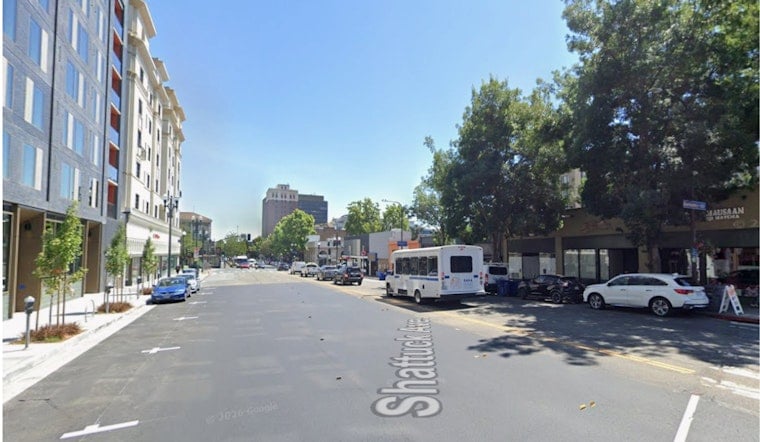
A loan default has hit the downtown Berkeley property where developer NX Ventures hopes to build a 28-story tower that would become the city's tallest building, according to county records cited by The Mercury News. NX Ventures, an affiliate of which owns the site through a McDonald's-anchored parcel at 1974 Shattuck Avenue, defaulted on the property's loan as of Monday, throwing a fully entitled 599-unit project into fresh uncertainty even though it has yet to break ground.
The loan traces back to 2018, when First Republic Bank provided a $2.2 million loan to an NX Ventures affiliate, as reported by The Mercury News. The delinquent loan matured in February 2025, and First Republic has threatened to seize the property through foreclosure if the $2.2 million debt is not repaid in full. The NX Ventures affiliate originally paid just under $2.1 million for the parcel back in 2014.
First Republic itself no longer exists as an independent institution. Regulators seized the bank and sold it to JPMorgan Chase in May 2023, a collapse that, according to The Real Deal, left mid-size Bay Area developers facing a far tighter credit environment and fewer refinancing options. First Republic had been a dominant financier of Northern California multi-family real estate before it failed.
A Tower Designed to Beat the Campanile
The development site stretches along Shattuck Avenue from Berkeley Way to University Avenue, with addresses at 1950, 1974, 1984 and 1998 Shattuck. Spats Bar currently operates at the 1974 Shattuck property, alongside the McDonald's tenant on the broader site. As proposed, the high-rise would rise 312 to 317 feet — tall enough to surpass UC Berkeley's 307-foot Sather Tower, known as the Campanile, though the Campanile itself sits on higher ground elevation, per the report's context.
Berkeley's current tallest completed building is the 54-year-old, 186-foot Chase Building, followed by UC Berkeley's 180-foot Anchor House student residence. A tower at 312 to 317 feet would represent a dramatic leap over anything now standing in the city, part of a wave of high-density tower proposals that has swept downtown Berkeley since 2022.
Architectural plans call for a 411,610-square-foot building containing 489 studio apartments and 110 two-bedroom units, plus 154 auto parking spaces and more than 16,000 square feet of commercial space topped by a rooftop restaurant. The proposed high-rise would set aside an estimated 58 units for low-income residents. The project was designed by Berkeley-based Stackhouse De La Peña Trachtenberg Architects in partnership with Rhoades Planning Group, led by former Berkeley planning director Mark Rhoades, who ran the city's planning department from 1997 to 2007.
City Approval Came Despite Fierce Local Debate
NX Ventures filed the project under California's Senate Bill 330 and the State Density Bonus Law, legal tools that let the developer bypass standard city height limits and streamline permitting. Berkeley officials approved the development in 2025, with the city council unanimously backing the 599-unit project and overruling a formal appeal from a resident who argued the tower threatened the city's character.
Even with that approval secured, NX Ventures has yet to buy all the parcels it needs for the tower as currently designed — other groups still own the remaining three parcels required for the project. Real estate advisers on the project publicly acknowledged in 2025 that high-rise construction had become nearly impossible to finance, citing high labor costs, elevated interest rates, and federal steel tariffs, according to CoStar News.
Part of a Broader Berkeley Debt Crunch
Nathan George heads NX Ventures, a firm that has proposed several housing development projects in Berkeley — at least nine separate residential projects representing a combined pipeline of nearly 1,900 planned units, according to San Francisco YIMBY. The default at 1974 Shattuck is not an isolated case. Hoodline previously reported that the 97-unit University Park Apartments at 1709 Shattuck Avenue was taken back by its lender for $25 million in January following default and bankruptcy.
Together, the two cases point to a wider tension playing out across the East Bay: state law and local councils have granted entitlements for record-breaking housing density, but private developers are running into an aggressive credit squeeze that can stall groundbreakings and put land ownership itself at risk. For now, the parcel that could someday hold Berkeley's tallest building remains exactly what it has been for years — a McDonald's, a bar, and a stalled set of blueprints.





