

























































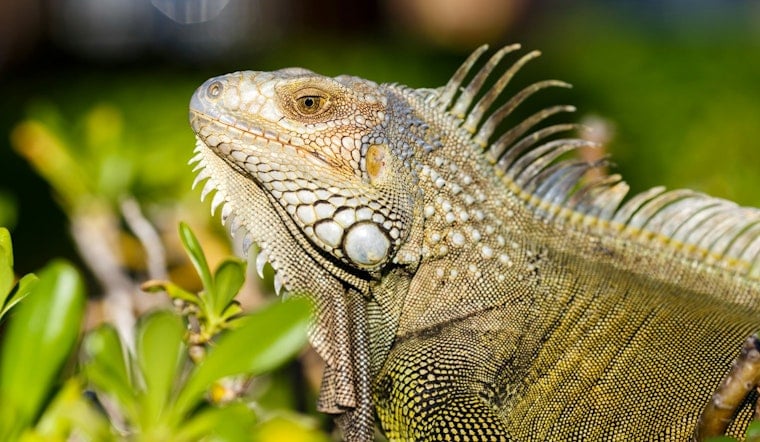
Boca Raton has made it illegal to leave out food that draws iguanas, rats, mice or pigeons, after the city council approved a new feeding ban this week. The measure, passed on a 3-2 vote, took effect immediately and carries a minimum $100 fine for anyone caught violating it.
The council approved Ordinance No. 5792 and Resolution No. 79-2026, which together ban distributing, placing, depositing or leaving food in a quantity or manner likely to attract or sustain iguanas, rats, mice or pigeons, according to WPBF 25. Mayor Andy Thomson, Stacy Sipple and Jon Pearlman voted in favor, while Deputy Mayor Michelle Grau and Yvette Drucker voted against it, the station reported. City officials say the city does not need to prove that a specific animal ate a specific meal or caused a specific instance of waste or property damage for the ordinance to apply — the focus is on the quantity of food and how it is provided, not the outcome.
What the Ordinance Actually Targets
Brandon Schaad, Boca Raton's development services director, is listed as the city official who clarified how the rule will work in practice. Per the same report, Schaad said cats and birds eating from a bird feeder do not violate the ordinance, an attempt to head off concerns that backyard birdwatchers or outdoor cat feeders could be swept up in enforcement.
The ordinance formally created Section 5-4 of Chapter 5 of the city code, titled Feeding of Certain Nuisance Animals Prohibited, while also amending Section 9-60 to let code enforcement officers issue direct civil citations rather than routing violations through a preliminary board hearing, according to City of Boca Raton records. A companion measure, Resolution No. 79-2026, updated the city's civil penalty schedule to set that $100 baseline fine per violation, as detailed by the Boca Post.
No Added Cost to Businesses, City Says
An official business impact estimate released the same day by City Manager Mark Sohaney concluded the feeding ban imposes no direct compliance costs on local businesses and will not require the city to hire additional code enforcement staff. Florida law requires cities to produce that kind of estimate under Section 166.041 of the state statutes before passing local ordinances of this type, per the city's own filing.
A Statewide Problem With Local Consequences
The vote fits into a broader pattern of South Florida cities grappling with invasive and nuisance wildlife. The Florida Fish and Wildlife Conservation Commission added green iguanas to the state's Prohibited Species list back in April 2021, barring anyone from possessing, breeding or transporting them without a specialized state permit. More recently, the FWC approved rule changes effective in August 2025 and January 2026 that let permitted trappers capture wild-caught iguanas for out-of-state commercial sale and eased outdoor caging requirements, aiming to speed up removal of the reptiles from the wild.
The scale of the problem became especially visible earlier this year. Following an emergency order issued on January 30, Florida residents helped capture and remove more than 5,000 invasive green iguanas from ecosystems statewide after a winter freeze left the cold-blooded reptiles stunned and comatose, according to WUSF.
Green iguanas were first documented in South Florida in the 1960s in Hialeah, Coral Gables and Key Biscayne after escaping from homes or being released by pet owners, and they have since spread across Palm Beach, Broward and Miami-Dade counties using connected drainage canals as aquatic highways, per The Times of India. The same report notes the animals carry Salmonella bacteria that can contaminate decks, seawalls and swimming pools through their droppings, and that they consume nickerbean plants the endangered Miami Blue butterfly depends on to survive.
Seawalls and Insurance Gaps Raise the Stakes
Beyond sanitation concerns, burrowing iguanas pose a direct financial threat to waterfront property owners. Most Florida homeowners insurance policies exclude coverage for iguana damage because insurers classify the animals as vermin alongside rats and mice, according to IggyTrap, leaving owners on the hook for seawall repairs that can run into the tens of thousands of dollars.
That kind of damage has already forced the closure of public infrastructure elsewhere in the region. Severe iguana burrowing compromised seawalls and pool infrastructure in Palm Beach County badly enough to force the indefinite closure of the historic Lake Worth Beach pool in December 2024, roughly 20 miles north of Boca Raton.
A Divided Council, A Familiar Debate
The 3-2 split on the council reflects an ongoing debate playing out in cities across South Florida over how far feeding bans should go. Supporters argue the rules curb pest attraction and protect public infrastructure, while opponents and some residents have raised concerns about how practical the bans are to enforce and whether they could have unintended effects on bird feeders or outdoor cat management, according to coverage from the Boca Post. For now, Boca Raton's version of the ordinance is already in effect, with Schaad's office positioned as the point of contact for how it plays out on the ground.





