

























































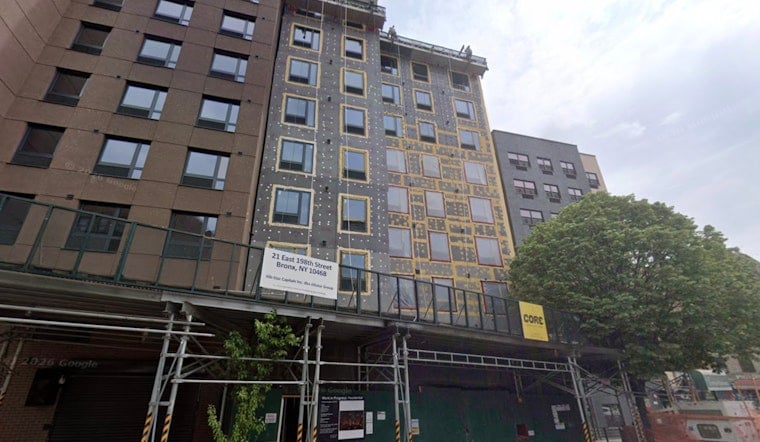
In the Fordham section of the Bronx, a 28-year-old developer just opened twin apartment buildings that together hold 166 units — but on paper, they're two separate 83-unit projects. That distinction isn't an accident. It's how Andrea Gjini avoided triggering a state wage law that would have forced him to pay construction workers starting at $40 an hour instead of standard market rates.
Gjini, who arrived in the United States from Albania eight years before publication, split the 166-unit development at 19 and 21 East 198th Street into two buildings specifically to avoid the wage scale under New York's 485-x tax incentive program, which kicks in once a project hits 100 units, according to The Real Deal. The wage floor starts at $40 per hour and can climb as high as $72 per hour once a project reaches 150 units, per the same report. Under the city Comptroller's own published schedule, the minimum reaches $41.00 per hour as of July 2025 with an annual 2.5% escalator, and tops out at $74.26 per hour for 150-plus-unit projects in designated Zone A areas, according to the Office of the New York City Comptroller.
Gjini was 25 when he bought the East 198th Street property in 2023, per The Real Deal's account, after 421-a — the prior tax abatement program — had already expired in June 2022 with no comparable wage floor. Market-rate multifamily development in the Bronx had no viable path forward once that abatement lapsed, the outlet reports, and 485-x, also known as Affordable Neighborhoods for New Yorkers, was approved by state lawmakers in April 2024 as its replacement.
A Deal Built On Vacant Buildings and Relocated Families
The East 198th Street site had been owned by five small buildings' worth of sellers — three Bangladeshi brothers, a Costa Rican owner and an Albanian owner — and Gjini agreed to pay $9.3 million for the five buildings, the report states. He required the buildings to be vacant before closing, and the relocated tenants included young families and senior citizens; Gjini says he helped relocate them and co-signed some of their new leases.
Gjini had been approached by one of the owners while building on Crescent Avenue back in 2022, according to the same account. The finished project sits near a supermarket, Fordham University and the Bronx Zoo, and includes a fully automated laundromat on the ground floor. Twenty percent of the apartments were made affordable at 80% of Area Median Income, Gjini told the outlet, and he expects rental vouchers to contribute substantially to the building's income, with plans to lease the remaining market-rate units and refinance.
Bronx Borough President Vanessa L. Gibson joined AG Holdings Group for a ribbon-cutting ceremony to open the development, which set aside 34 permanently affordable units for households earning up to 80% of Area Median Income, according to Norwood News. The project wasn't without hiccups: the city Department of Buildings issued a stop-work order in February 2026 after a 311 complaint about unpermitted work, briefly delaying progress before completion in July, per the outlet. Separately, a utility connection delay cost $200,000 and lasted one month, The Real Deal reports, and the project received financing from Kearny Bank and Northeast Community Bank. Renter demand has been good so far, according to Gjini.
The In-House Model Behind the Math
Founded around 2021, Gjini's AG Holdings Group is a vertically integrated Bronx-based firm that handles architecture, general contracting and property management entirely in-house, according to the Bronx Times. That in-house structure saves an estimated 10% to 12% of overall costs, The Real Deal reports, and Gjini says he comes from a family of builders. He says paying 485-x wages could put a deal at risk, and that the wage scale causes inefficient, duplicative design as developers restructure projects to dodge it. He adds that noncompliance with 485-x can trigger a penalty capable of bankrupting a project.
By his own account, Gjini developed the first 99-unit project built specifically to sidestep the wage scale. In a June 2026 interview, he said he intentionally eliminated 21 planned units from a separate development to keep it at 99 units, because projected construction expenses ran 25% to 30% higher above the 100-unit threshold, according to Commercial Observer. He's repeating the formula elsewhere in the Bronx: in May 2026, AG Holdings Group acquired a parking lot at 1917 Morris Avenue in Mount Hope for roughly $3.1 million and filed plans for a 12-story, 99-unit building spanning nearly 60,000 square feet, per The Real Deal's permit reporting. A year earlier, in May 2025, he acquired a commercial site at 205 West 230th Street in Kingsbridge for $11.5 million under North Bx Associates LLC and secured a $27.5 million construction loan from North East Community Bank for another 99-unit project, according to PincusCo.
A Citywide Pattern, Not Just One Developer's Playbook
Gjini is far from alone. A REBNY report documented 28 buildings capped at 99 units filed in the four quarters preceding July 2025 — more than double the prior 16-year combined total — with 19 additional 99-unit projects filed in the second quarter and just nine projects larger than 99 units filed citywide in that same quarter, per The Real Deal. Separate Department of Housing Preservation and Development data analyzed between April 2024 and April 2026 found developers filed at least 154 building permits capped at exactly 99 units citywide, while only 1% of filed projects exceeded 100 units, Commercial Observer reports. Under the former 421-a program, more than half of newly built multifamily developments in the city topped 100 units; under 485-x, that figure has fallen below 1%, according to industry estimates cited by the outlet.
The broader market has cooled alongside the shift. NYC developers proposed 8,000 apartment units in the second quarter of 2026 — a 52% drop from the first quarter — with only nine of 172 proposed residential projects citywide containing 100 or more units, according to a Real Estate Board of New York analysis reported by The Real Deal. Projects with 100 or more units now tend to be subsidized affordable housing developments rather than market-rate ones, the outlet notes, since city housing targets call for 17,500 new units per quarter to meet production goals.
New York state lawmakers included the 100-unit wage-scale provision in 485-x at construction unions' request, and union leaders are now pushing to extend the wage floor to side-by-side projects like Gjini's twin Bedford Park buildings — a change that would close the workaround he and other Bronx developers have relied on. For now, Gjini says he's confident in his approach as he moves forward with his next 99-unit filings in Mount Hope and Kingsbridge.





