

























































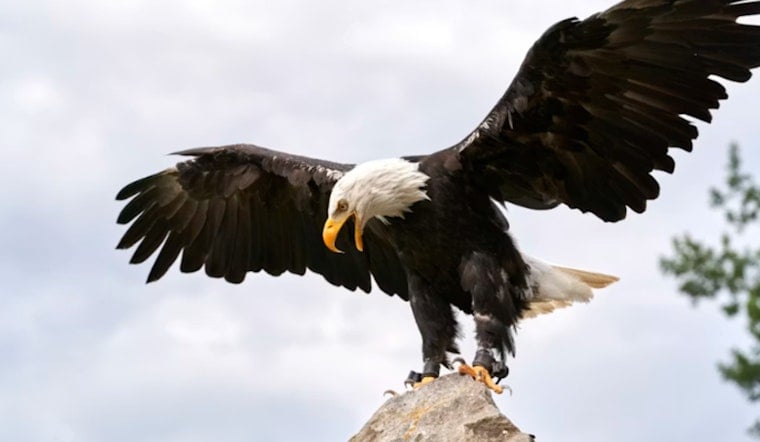
A 66-year-old Brush Prairie man is facing federal charges after a bald eagle was found dead with pellets lodged in its skull, in what prosecutors allege was a shotgun killing on February 5, 2026. Benjamin G. Allen kept chickens near the Clark County property where the eagle turned up, and investigators say the shooting violated federal law protecting the nation's symbol.
Allen was charged with a Class A misdemeanor under the Bald and Golden Eagle Protection Act, along with a Class B misdemeanor for unlawfully killing a migratory bird, according to KOMO. He has been summoned to appear in U.S. District Court in Tacoma on September 8.
Gunshot Report Led Wildlife Officers to Brush Prairie Property
Washington Department of Fish and Wildlife officers went to the Brush Prairie property after a report of a dead bald eagle, and a witness reported hearing a gunshot earlier that day. Court records describe the eagle as having been found with blood around its head. Brush Prairie is an unincorporated community in Clark County north of Vancouver, where low-density properties and hobby farms often border raptor habitat near local watersheds, as MyNorthwest.com reports.
A veterinarian's examination confirmed two shotgun pellets lodged in the eagle's brain, which investigators say caused its death. Special agents with the U.S. Fish and Wildlife Service interviewed Allen about the dead eagle and his actions, according to court records.
Prosecutors Detail How Charges Were Filed
First Assistant U.S. Attorney Charles Neil Floyd announced the charges Tuesday, saying they were filed by criminal information in the Western District of Washington, according to the U.S. Department of Justice. Assistant U.S. Attorney Sean H. Waite has been assigned to prosecute the case, which is being investigated jointly by the U.S. Fish and Wildlife Service and the Washington Department of Fish and Wildlife.
A conviction on the Class A misdemeanor carries a maximum sentence of one year in prison, and KOMO reports the fine can reach up to $500,000. Federal guidance from the U.S. Fish and Wildlife Service, however, describes the statutory fine cap for individuals as up to $100,000, with repeat violations escalating to felony status. The Class B misdemeanor Allen also faces carries a maximum of six months in prison and a $5,000 fine.
No Automatic Exception for Protecting Backyard Chickens
Federal regulations enforced by the U.S. Fish and Wildlife Service provide no general exception allowing property owners to kill protected raptors to protect poultry or livestock without a specific federal permit. The agency instead advises using non-lethal deterrents such as coops, netting, and scare devices.
In April 2024, the agency implemented updated eagle take permit rules under 50 CFR Part 22, creating streamlined general permits for low-risk industrial and disturbance activities such as wind energy and utility infrastructure, while maintaining zero tolerance for unauthorized intentional killings.
Comparable Federal Cases Show Zero Tolerance for Killings
In a comparable 2017 case in Virginia, a property owner who shot a bald eagle with a rifle and then drove over it with an ATV — because it was catching fish in his private pond — pleaded guilty under the Bald and Golden Eagle Protection Act, according to the U.S. Department of Justice. He was sentenced under federal misdemeanor guidelines after initially denying the shooting.
According to Justice Department records from a similar 2008 case in the same federal district, timber consultant James Allen — unrelated to Benjamin Allen — pleaded guilty to violating federal eagle protection law after ordering a contractor to cut down a bald eagle nesting tree in Clallam County to avoid land-use restrictions. He was later sentenced to federal prison time after misleading investigators.
Bald Eagles' Rebound Raises the Stakes for Enforcement
Washington's breeding bald eagle population has rebounded dramatically, growing from about 105 nesting pairs in 1980 to more than 1,500 pairs today, which led the Washington Department of Fish and Wildlife to remove the species from the state's sensitive species list in 2016. The agency also runs a Turn In a Poacher program, offering cash rewards up to $500 or hunting bonus points for public tips that lead to convictions in cases like this one, a tool officials lean on to help monitor rural areas with a limited number of field officers.
Nationally, a 2021 U.S. Fish and Wildlife Service assessment found the bald eagle population had quadrupled since 2009 to more than 316,000 birds, including roughly 71,400 nesting pairs. The case against Allen remains pending in federal court, and no plea has yet been entered, court records show.



