

























































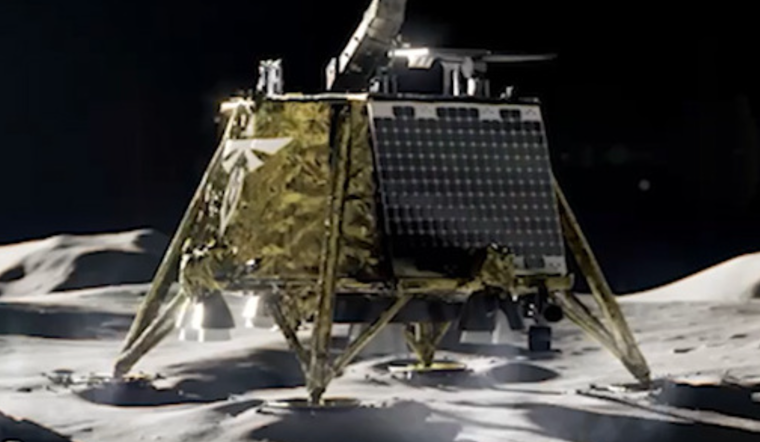
The lunar night drops below minus 280 degrees Fahrenheit and lasts about two Earth weeks, a stretch of cold and darkness that has ended the working life of nearly every solar-powered spacecraft that has tried to outlast it. Firefly Aerospace and Zeno Power think they have found a way around that problem, and they plan to test it on a future Blue Ghost mission to the moon's near side targeted for no earlier than 2028.
Firefly's first Blue Ghost lander touched down on the moon in 2025 and measured lunar daytime temperatures exceeding 230 degrees Fahrenheit before nighttime readings plunged below minus 275 degrees, according to GeekWire. That lander, like most solar-powered spacecraft, stopped functioning shortly after sunset, illustrating why engineers now say thermal survival hardware is essential for any mission that hopes to operate for more than a single lunar day. As WESH reports, the compact power source Zeno Power is building could help future missions survive long periods without sunlight and eventually support sustaining people and equipment on the moon.
How the Heater Works Without the Sun
Zeno Power's system includes a 5-watt radioisotope heater unit that produces energy from heat generated by the natural decay of radioactive material, per WESH's reporting. Rather than conventional plutonium-238, the unit uses americium-241, an isotope with a 432-year half-life recovered from recycled nuclear waste, according to the American Nuclear Society. That long half-life allows the compact device to generate passive warmth for years without sunlight, without needing electric power from resistive solar heaters, the trade publication notes.
Under NASA's Commercial Lunar Payload Services CS-8 task order, the Blue Ghost lander will run three NASA science instruments on solar power during the 14-day lunar day, and Zeno's payload will activate at sunset to sustain power, thermal control, and communications so the lander can keep transmitting data to Earth, according to Payload Space. Firefly Aerospace has partnered with Zeno Power to carry the so-called survive-the-night package aboard the mission, per WESH.
From Federal Research Contract to Commercial Hardware
Zeno's lunar payload builds on a $15 million NASA Tipping Point contract awarded to mature universal radioisotope power supplies for the Artemis program, SatNews reports. The arrangement reflects a broader pattern in which commercial startups are drawing on Department of Energy laboratory expertise and NASA research funding to commercialize nuclear hardware that had spent decades stalled in government pipelines, per the same outlet's account.
Zeno announced plans in June 2026 to establish a nuclear battery manufacturing facility at the Vallecitos Nuclear Center in Sunol, California, while keeping its primary engineering hub in Seattle, according to the American Nuclear Society. The company is also adapting its americium-241 thermal technology for astronaut spacesuits under a project called EARENDIL, designed to provide passive warming during deep-space and lunar night spacewalks, per autoevolution.
NASA's Bigger Nuclear Ambitions
NASA Administrator Jared Isaacman has said he envisions a larger role for nuclear energy in space exploration, framing the Artemis II voyage around the moon as the beginning of a broader exploration campaign, according to WESH. He has also called NASA's planned first outpost the moonbase and said the agency is working toward establishing its first outpost on another world.
NASA announced plans in March 2026 for Space Reactor-1 Freedom, an interplanetary nuclear electric propulsion spacecraft that would pair a 20-plus kilowatt fission reactor with existing Gateway hardware, according to the American Nuclear Society. Isaacman has said SR-1 Freedom will be the first nuclear-powered interplanetary spaceship and will launch from Kennedy Space Center in 2028, per WESH. NASA is partnering with the Department of Energy's Idaho National Laboratory to build and test the compact reactor core for that mission, and Isaacman toured the lab's Materials and Fuels Complex earlier this month to review progress, according to KSL TV.
The push comes despite a rocky history: NASA has invested more than $20 billion over 60 years across a dozen space nuclear reactor programs, but its only reactor ever operated in space was SNAP-10A in 1965, which shut down after 43 days due to an electrical component failure, the American Nuclear Society reports. NASA officials have said SR-1 Freedom is designed to avoid past delays by repurposing flight-proven components alongside the reactor, according to the same source.
A Texas Company's Lunar Ambitions
Firefly Aerospace, the publicly traded space company building the Blue Ghost lander, expanded its Cedar Park, Texas headquarters in April to a 144,000-square-foot campus to consolidate engineering, payload integration, and rocket manufacturing. The company first landed a Blue Ghost spacecraft on the moon in January 2025, a milestone Hoodline covered at the time as the lander launched aboard a SpaceX rocket. Isaacman's comments on nuclear-powered spaceflight and lunar outpost infrastructure echo remarks he made in May, when he suggested a future moon base and nuclear-powered ships could be built with New Orleans industry, as Hoodline previously reported.
Open questions remain about whether NASA's aggressive 2028 timelines for both the Blue Ghost heater demonstration and SR-1 Freedom will hold, along with regulatory approvals for launching nuclear materials and the pace at which commercial nuclear battery manufacturing can scale up, according to the American Nuclear Society's reporting. For now, the survive-the-night package represents an early test of whether compact nuclear hardware can keep a lander alive through the coldest, darkest stretch of the lunar day and night cycle.





