

























































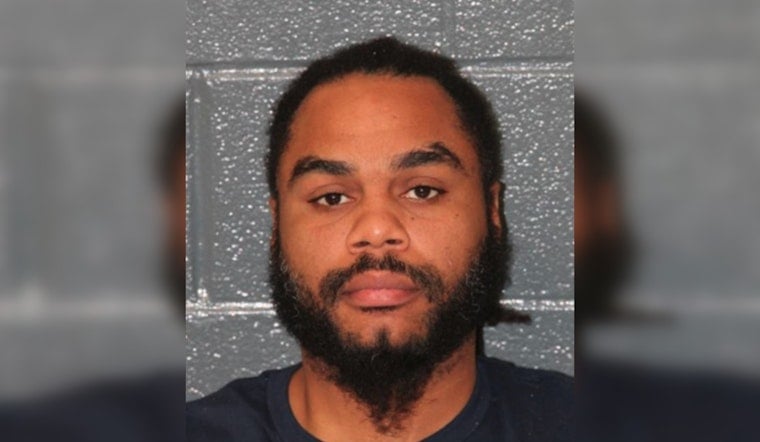
A Charlotte man who was shot during a struggle with police outside a North Tryon restaurant nearly two years ago has now been found guilty by a federal jury of illegally possessing a firearm as a convicted felon. Marcus Jamal Shankle, 36, faces up to 15 years in federal prison after the two-day trial concluded Friday, and a sentencing date has not yet been set.
The case traces back to October 3, 2024, when Charlotte-Mecklenburg police confronted Shankle as he was leaving the Chicken Box Café on West Sugar Creek Road, according to Queen City News. CMPD's North Tryon Crime Reduction Unit had begun surveilling Shankle after a 911 caller reported him brandishing a handgun on Prospect Drive, tracking his black Lincoln sedan to the restaurant, according to court records filed in the U.S. District Court for the Western District of North Carolina.
Officers disarmed Shankle during the encounter, but he then grabbed a second gun and tried to pull a handgun from his waistband, officers said, per the same account. A struggle ensued, and Shankle was shot during the confrontation with officers.
Two Guns, One Stolen, Recovered at the Scene
Prosecutors said investigators recovered two firearms from the scene: a Ruger .40-caliber pistol and a stolen KelTec .380-caliber pistol. The stolen weapon later formed the basis of a separate state charge against Shankle for possession of a stolen firearm.
CMPD identified the officer who fired the shot as Justin Blum, a North Tryon Division officer who joined the force in October 2015, according to a statement from the City of Charlotte. Blum was placed on standard paid administrative leave following the shooting, and both the North Carolina State Bureau of Investigation and CMPD's Internal Affairs Bureau conducted parallel reviews of his use of force, per standard protocol for officer-involved shootings.
CMPD detectives also obtained state warrants charging Shankle with four counts of assault on a law enforcement officer with a firearm, felony carrying a concealed gun, resisting a public officer, and possession of a stolen firearm. Whether prosecutors will still pursue those state charges following the federal conviction remains an open question.
Dismissed Murder Charges and a Federal Record
Shankle's history with law enforcement predates the 2024 shooting. He had previously been charged with murder and attempted murder in connection with an April 2023 Charlotte shooting that killed 26-year-old Lemuel Carr, though Mecklenburg County prosecutors later dismissed those charges for insufficient evidence, according to WCNC. That history had led local authorities to designate him a known violent criminal offender.
His federal record includes a prior conviction for distribution of cocaine base, for which he served prison time, and a subsequent 20-month sentence for violating supervised release after his 2017 release from custody, WCNC reports. Those prior felony drug convictions are what made him prohibited from possessing firearms under federal law and put him in the crosshairs of CMPD's surveillance operation in the first place.
Life-Threatening Injuries and Continuous Detention
Shankle suffered life-threatening injuries in the shooting and was hospitalized before later being ordered held in federal pretrial detention, with a magistrate judge citing his criminal history and risk to public safety, according to court filings reviewed by Midpage. He remained incarcerated continuously from his arrest until his conviction Friday.
U.S. District Judge Matthew E. Orso presided over the trial in Charlotte, where federal prosecutors laid out the evidence that led to Shankle's conviction, according to the U.S. Attorney's Office for the Western District of North Carolina. The prosecution was brought under Operation Take Back America, a Department of Justice initiative in which federal prosecutors work alongside local police and the ATF to bring federal charges against repeat offenders involved in violent crime and illegal gun possession.
Steeper Penalties Under Federal Gun Law
Shankle's conviction falls under 18 U.S.C. § 922(g), the federal statute barring convicted felons from possessing firearms. The maximum sentence for that offense rose from 10 years to 15 years after Congress passed the Bipartisan Safer Communities Act in 2022, according to the Federal Register, meaning Shankle now faces significantly more prison time than he would have under the older statutory cap.
No sentencing date has yet been scheduled for Shankle, and it remains unclear exactly how long a sentence Judge Orso will ultimately hand down.





