

























































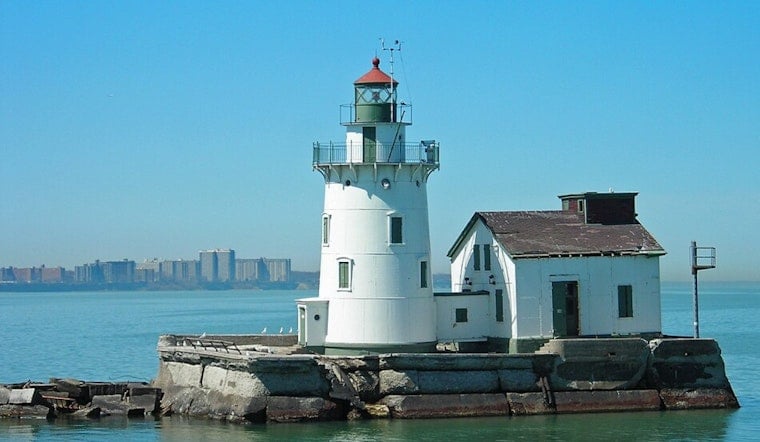
Half a mile out into Lake Erie, past the mouth of the Cuyahoga River, sits a 67-foot cast-iron tower that has spent most of the last eight decades locked away from the public. The Cleveland Harbor West Pierhead Lighthouse is once again up for grabs, and this time a Lakewood pharmacist named Geoff Brediger wants to be the one who gets it. Brediger, 48, founded a nonprofit called the Cleveland Light Keepers Collective specifically to make a run at the historic beacon, and he is not alone — five other groups have also thrown their names into the ring.
Brediger got a firsthand look inside the lighthouse this summer, one of the rare visits the public has been allowed since World War II, according to News 5 Cleveland. Reaching the tower requires either a slick platform leading to steps or a ladder bolted to the wall, and once inside, visitors find gutted rooms with rusting metal and rotting wood, cliff swallows nesting by the dozen under the upper deck, and a fog house that once held the tower's large warning equipment. There is no running water, no heat, and no electricity beyond a solar-powered LED light upstairs that flashes red to guide smaller boats as a backup signal. Still, Brediger told the station the place feels like something else entirely: “It's magical.”
A Federal Program Built to Save Maritime History
The lighthouse's renewed availability traces back to April, when the U.S. General Services Administration published a Notice of Availability for the property, restarting the transfer process under the National Historic Lighthouse Preservation Act. That 2000 law created a process for moving significant lighthouse properties out of federal hands, and per the Act, public agencies and non-profits get first crack at eligible lighthouses at no acquisition cost before the government can auction a property off to private bidders, according to the General Services Administration. GSA has confirmed six groups expressed interest in taking over the Cleveland tower, though the agency has not released the identities of those groups beyond the Light Keepers Collective's own public statements.
The federal lighthouse preservation program has found stewards for more than 150 lighthouses nationwide, including upwards of 50 in the Great Lakes region alone, per the same reporting. Nationally, conveyances under the Act have split roughly evenly between free non-profit stewardship transfers and private auction sales in the more than 100 disposals conducted since 2000, according to Soundings Online. A GSA spokesman described offshore lighthouse transactions like Cleveland's as inherently complex, and said the agency remains committed to finding a responsible caretaker for the structure.
A Failed 2023 Sale Looms Over the Effort
This is not the lighthouse's first trip through the disposal pipeline. It has been targeted for federal transfer for almost a decade, and in 2023 the GSA ran a public auction that opened at $25,000 and drew nine bidders before closing at $425,000, a bid placed by jewelry designer Heather Moore and car dealer Jim Brown. That sale ultimately fell through — a GSA spokesman said the high bidder decided not to proceed, per the station's account — leaving the tower back in limbo. Brediger himself took part in that 2023 auction and withdrew when the price climbed too high, a loss he has clearly not shaken off.
Whoever eventually wins the lighthouse will face steep obligations. The 2023 purchase agreement required a 25-year lease with the U.S. Army Corps of Engineers and government-mandated liability insurance coverage, and any future owner must preserve U.S. Coast Guard access to maintain the light itself, which remains an active navigational aid despite the tower having sat vacant for decades. Brediger is looking to Lake Erie's other surviving lighthouse keepers for a sense of what that commitment actually costs.
Lessons From Ashtabula's Restoration
About 50 miles east, the Ashtabula Lighthouse Restoration & Preservation Society has already lived through what Brediger's group hopes to take on. The nonprofit, led by 73-year-old Joe Santiana, acquired the Ashtabula Harbor Light in 2007 — the last manned beacon on Lake Erie, staffed by keepers until 1973 — and has since spent roughly $350,000 restoring it. The group now pays $5,000 a year for liability insurance and owns its own boat to ferry visitors out, since the lighthouse, like Cleveland's, is only reachable by water. Installing and removing the seasonal dock each year takes several divers, and at least ten other volunteers, and the society leans on memberships and donations to keep the operation running.
Brediger is trying to build a similar support structure before his group even has the keys. He is assembling a coalition of skilled tradesmen, historians, boaters and fundraisers, and says he is seeking guidance from community groups and private lighthouse owners who have gone through this before. The Cleveland Light Keepers Collective submitted its letter of interest by the May 26 deadline and, within weeks of pulling its team together, formally launched as a nonprofit. The group's annual fish-fry fundraiser is set for August 22.
What Cleveland Could Get Back
Built between 1910 and 1911 as a four-story, sparkplug-style cast-iron tower connected to a fog signal building expanded in 1916, the lighthouse originally housed a bedroom on its second floor and a kitchen on the first — living quarters for keepers in an era before automation, per Lighthouse Friends. Automation came in 1965, and the tower's original fourth-order Fresnel lens was removed in 1995 and now sits on public display at the Great Lakes Science Center, directly across the harbor from where it once flashed. The lighthouse earned a spot on the National Register of Historic Places in 1983 and carries a City of Cleveland landmark designation as well.
Brediger envisions the lighthouse hosting fishing, arts festivals, and morning yoga if his group's application succeeds — a public asset for a city that, in his telling, could rally around the project as a whole. It sits at the entrance to a harbor that still matters commercially: the Port of Cleveland ranks as the third-largest bulk freight port on the Great Lakes, moving millions of tons of cargo through the Cuyahoga River mouth each year. From the tower's upper deck, according to the station's report, visitors can take in views of Cleveland's skyline and miles of Lake Erie shoreline.
Prospective owners, including Brediger's group, are now preparing detailed applications due to the National Park Service by mid-September — the deadline that will determine whether the lighthouse finds a long-term community steward or heads back toward the auction block that already claimed one buyer in 2023. Original blueprints for the tower are held at the National Archives in Maryland, a paper trail for a structure whose future, for now, remains as unsettled as the lake around it.





