

























































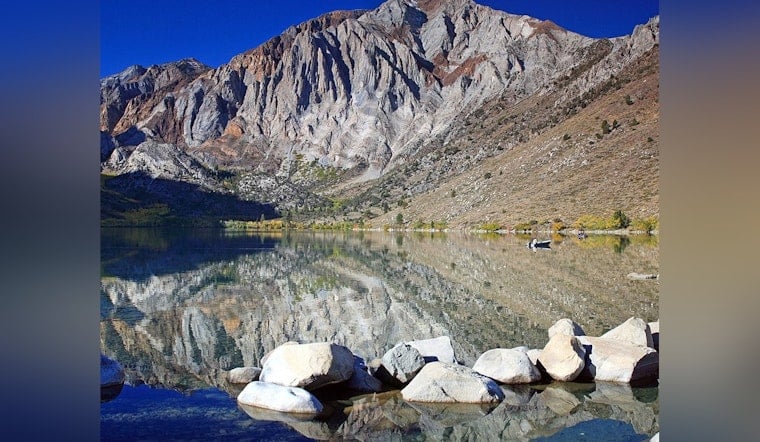
A climber who got off route on Laurel Mountain's Mendenhall Couloir ended up clinging to a ledge just 6 inches wide, with thousands of feet of open air below him, for roughly 8 hours before volunteer rescuers reached him overnight. Rob Martin had wandered into the wrong gully while ascending the route on August 22, and by the time searchers found him, he was stopped in place, repeatedly shifting his weight between his feet just to stay balanced on the narrow perch.
The ordeal began at 1:20 p.m. that Saturday, when Martin's Garmin InReach satellite device sent an emergency signal that prompted the Mono County Sheriff's Office to page out its volunteer search and rescue team, according to the Mono County Sheriff Search and Rescue Team. As reported by the New York Post, rescuers began searching after being alerted to the stranded climber but could not locate him during their initial push, spending roughly two hours combing the mountain before they finally heard a voice calling from a distance.
Once rescuers approached Martin on foot in the dark, they found him stopped on the 6-inch ledge with no viable way to continue climbing up or down. The Mono County Search and Rescue Team has explained that off-route travel on Laurel Mountain can lead climbers into increasingly vertical, unprotectable 5th-class terrain, and the section Martin had traversed had no route markers to guide him back. Rescue team volunteers reported that a fall would almost certainly have been fatal given the thousands of feet of vertical exposure below him, and the rescue operation determined a fatal fall was becoming increasingly possible the longer Martin remained stranded overnight.
Wind Grounds Helicopter, Forcing an All-Ground Night Rescue
A California Highway Patrol helicopter, designated H42, responded from Fresno to evaluate an air extraction, but powerful winds gusting up to 30 knots along Laurel Mountain ruled out any helicopter hoist. That forced rescuers into an all-ground operation, driving a 6x6 off-highway vehicle nicknamed Ranger Two up Laurel Lakes Road before hauling gear 1,200 vertical feet down into the chute, per the same account from the rescue team. Technical rescuers then deployed 1,200 feet of rope and a rescue bolting kit to lower a team member down to Martin, working in total darkness with headlamps on loose slate and limestone.
A separate communications team with high-powered optics was posted at the Convict Lake Day Use Area, which sits directly below Laurel Mountain's east face, to keep continuous visual contact with Martin and relay radio communication across the mountain. A rescuer eventually secured Martin to a rope system lowered from above, which the rescue team says eliminated the immediate risk that he could fall. The rescue operation wrapped up in the early hours of Sunday morning, lasting about 15 hours in total.
Rescuer Recalls a Climber Who 'Did Not Give Up'
Mitchell Quiring, one of the rescuers involved, described the nighttime movement across the mountain as dangerous and scary, noting that terrain navigable by day becomes unnavigable at night, the New York Post reported. Quiring said Martin did not give up during the rescue, and that the outcome could have been very different had Martin not pushed through the adversity of the night. Rescuers believe Martin may have experienced leg cramps as he waited, and Martin himself later said his hands were cramping too.
Speaking to NBC News, Martin thanked his rescuers and said his feet were the hardest part of the ordeal, since they occupied only about half of the ledge's width. He described experiencing scary and lonely thoughts during the hours he spent stranded on the cliff. Martin said Mitch and his team saved his life, adding that he would not be alive without his rescuers and their sense of service.
A Route With a History of Danger
The Mendenhall Couloir, also called the Northeast Gully, climbs 3,000 vertical feet up Laurel Mountain to a summit elevation of 11,818 feet, and holds a place in Sierra mountaineering history as the site of the first roped belayed climb in the High Sierra, completed by John Mendenhall and James Van Patten in September 1930, according to Mountain Project. The central gully is known for smooth, water-polished rock, but it's bordered by loose metamorphic rock that turns treacherous the moment a climber strays off route.
This isn't the route's first brush with disaster. In July 2020, Mono County Search and Rescue carried out another major overnight technical rescue in the same couloir after a 34-year-old Oakland climber was struck by falling rock, fell 20 to 30 feet, and suffered an open leg fracture and head trauma, per the rescue team's own mission records. Under the Yosemite Decimal System used across North America, 5th-class terrain describes exactly this kind of steep, technical rock climbing, where a fall without protective ropes and anchors carries a high probability of severe injury or death.
An All-Volunteer Team Stretched by a Busy Summer
Martin's rescue was logged as Operation #43 for Mono County Search and Rescue in 2026, a marker of just how many backcountry emergency calls the volunteer team fields during peak summer tourist season in the Eastern Sierra. The team operates as an all-volunteer 501(c)(3) nonprofit under the authority of the Mono County Sheriff's Office, providing rescue services free of charge while relying on public donations and volunteer-owned gear to fund exactly the kind of heavy rigging and 1,200-foot ropes used to reach Martin.
Mono County has also become something of a proving ground for high-altitude rescue work statewide. In January, the California Governor's Office of Emergency Services selected Mammoth Lakes, within the county, to host its annual statewide Winter Search and Rescue Exercise for agency coordinators, underscoring the region's role in training rescuers for extreme mountain environments across California.





