

























































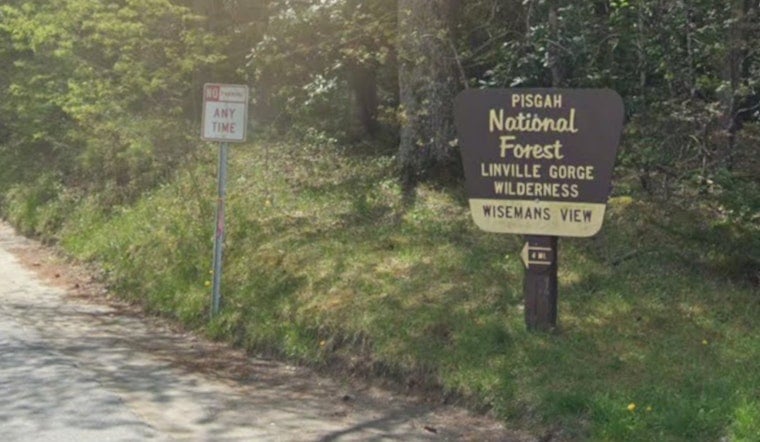
A climber reportedly suffered multiple fractures after a fall deep inside Linville Gorge yesterday, setting off a multi-agency rescue effort that paired Charlotte firefighters with a state National Guard helicopter crew. Rescuers warned the remote terrain would likely force an extended carryout before the injured climber could reach medical care.
Three members of the Charlotte Fire Department assigned to North Carolina Task Force 3 responded to the gorge for the rescue, according to the Charlotte Fire Dept. The agency said the crew was approximately 25 minutes from the rescue site as the mission got underway, and that an NCHART mission had been approved for the fallen climber's extraction. Charlotte Fire said it would share more information as it became available.
NCHART MISSION | LINVILLE GORGE
— Charlotte Fire Dept (@CharlotteFD) August 30, 2026
Three Charlotte Fire members assigned to North Carolina Task Force 3 are responding to Linville Gorge for the rescue of a fallen climber who reportedly suffered multiple fractures.
With an extended carryout expected due to the remote terrain, a… pic.twitter.com/QEwee1Y2Ki
NCTF-3 is the Charlotte Fire Department's own urban search and rescue team, built for high-angle, swiftwater, and disaster response missions that can be deployed anywhere in the state, according to the City of Charlotte. The team's involvement in Sunday's rescue reflects how specialized personnel based in Charlotte routinely travel across North Carolina for technical emergencies far outside the city limits.
A Helicopter Built for This Terrain
The rescue crew departed aboard Kill Devil 244, a UH-60 Blackhawk helicopter flown out of Salisbury as part of the NCHART mission. The aircraft belongs to Company C, 1st Battalion, 131st Aviation Regiment of the North Carolina Army National Guard, a unit that has flown under the Kill Devil callsign since 1994 in honor of the Wright brothers' first flight site, according to the Salisbury Post. The unit operates out of the Army Aviation Support Facility in Rowan County.
NCHART itself was formally established in 2004 to pair civilian rescue technicians with aircrews from the North Carolina State Highway Patrol and the National Guard, per the North Carolina Department of Public Safety. County emergency management agencies request these aerial hoist extractions by submitting mission requests through the State Emergency Operations Center in Raleigh, according to the National Wildfire Coordinating Group, meaning Sunday's request would have moved from local 911 dispatch up through state channels before Kill Devil 244 ever left the ground.
Why the Gorge Makes Rescues So Difficult
Linville Gorge plunges as much as 2,000 feet deep over nearly 12 miles along the Linville River, earning its 12,000-acre wilderness the nickname the Grand Canyon of the East, according to Islands. Its steep rock walls make ground evacuations uniquely difficult, which is why the rescue operation anticipated an extended carryout due to the remote terrain.
Complicating matters further, Linville Gorge is a federally designated wilderness area under the Wilderness Act of 1964, which bars motorized equipment and power tools inside its boundaries, per the Carolina Climbers Coalition. That restriction forces rescue crews to rely on manual rope rigging and physical carryouts rather than ATVs or powered winches to move an injured climber out of the gorge, a challenge managed by the U.S. Forest Service's Grandfather Ranger District.
The gorge is also a major destination for traditional multi-pitch rock climbing, with cliffs like Table Rock, Shortoff Mountain, and the Chimneys drawing climbers who must place their own gear rather than clip into permanent bolts. Loose handholds, high winds, and route-finding errors have historically caused severe falls in the area requiring technical hoists, according to American Alpine Club Publications. It was not immediately reported which route or cliff Sunday's climber had been on when the fall occurred.
Ground Teams and Aerial Crews Working Together
Rescues inside Linville Gorge typically depend on joint operations between volunteer ground search-and-rescue squads, such as Burke Rescue Inc., and state aerial hoist units, which together locate, stabilize, and extract victims. Ground responders often hike several miles into the wilderness carrying stokes baskets and medical equipment before a helicopter hoist is even possible.
Technicians who perform those hoists must first pass a demanding NCHART certification process that includes a 300-meter swim, a helicopter dunker escape drill, a 100-meter victim tow, and advanced mechanical-advantage rope rigging exercises, according to NC Emergency Management. Candidates must also complete annual indoctrination evaluations to keep their certification active, underscoring how specialized the skill set is for missions like Sunday's.
As of Sunday evening, the rescue operation remained active, with the injured climber's condition beyond the reported multiple fractures not yet detailed and weather conditions at the time of the hoist not specified. Access to the surrounding mountain corridor has also been shaped by ongoing infrastructure work; full Blue Ridge Parkway repairs near the gorge are still targeted for completion by the end of 2026.





