

























































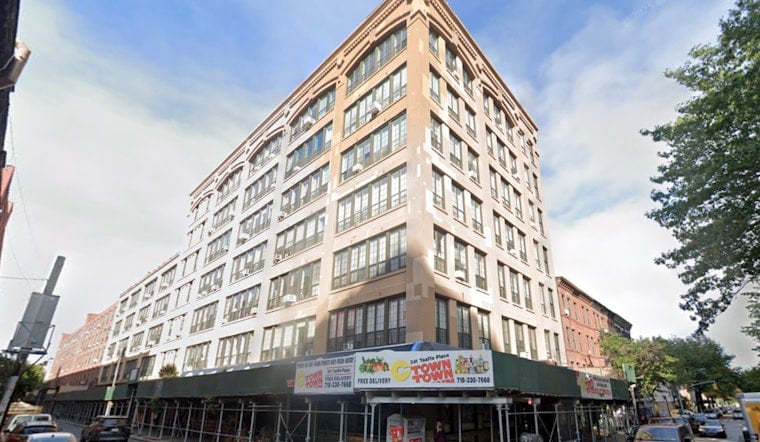
A burst pipe sent water pouring through multiple floors of a Clinton Hill apartment building for nearly eight hours on Sunday, August 2, damaging dozens of units and leaving residents without a place to sleep in the building ever since. Tenants at 241 Taaffe Place say hallways, stairwells, apartments, walls, ceilings and floors were all soaked, along with personal belongings that in many cases can't be salvaged.
Ana Paula Cervera, one of the affected residents, described the scene to News12 Brooklyn, saying “water started raining throughout the apartment and flowed like a river.” Cervera said her unit is now “toxic and not livable.” The flooding left the pre-war, seven-story building — which contains 91 rental units and dates back to 1935, according to Corcoran — with water stains, peeling paint, buckling floors and ruined belongings throughout common areas and individual apartments.
Neighbor Suzanne O'Connor said the trouble didn't start on Sunday. She reported that water pipes had already spouted dirty water in the basement near the laundry room the day before the pipe burst, and that more than six inches of rust-colored water eventually filled at least 20 containers tenants scrambled to place around the building. O'Connor said water first poured under her door, and the stairwell “looked like a waterfall.”
Tenants Scrambled With Mops and Buckets
With no immediate fix in sight, residents grabbed mops, buckets, towels, brooms and anything else they could find to try to contain the rising water themselves. O'Connor said the building's plumbing is old, noting that the pipes under her own sink have already been replaced twice because they were rotted through. She also said management has repeatedly shut off water building-wide for days at a time to make repairs.
The stakes are higher for some residents than others. O'Connor said she has a daughter with asthma and an immunocompromised blood disorder, and the family currently has no air-quality readings for the apartment to know whether it's safe to return. That absence of testing matters: the New York City Department of Health and Mental Hygiene has said standing water and wet building materials need to be fully dried within 24 to 48 hours to head off mold growth, according to state health guidance — a window an eight-hour, multi-floor flood can blow past quickly.
What The Building's Ownership Has Offered
Building ownership has said it is addressing and remediating the incident while the cause of the pipe failure is investigated, and has offered residents a one-month rent credit. Ownership says it plans to swiftly clean up and fully restore the affected units. Tenants, meanwhile, have asked for more communication from management throughout the repair process, and an insurance company is investigating the exact cause of the water incident.
Landlords are generally responsible for repairing this kind of building damage, and the legal exposure here goes beyond good customer service. Under the city's Housing Maintenance Code, flooding severe enough to pose an immediate health hazard is classified as a Class C immediately hazardous violation, which requires owners to begin corrections within 24 hours of notice, per the Legal Aid Society. If mold turns up across more than 10 square feet in a building this size, Local Law 55 — the Asthma-Free Housing Act — requires the owner to bring in an independent, state-licensed mold assessor and a separate licensed remediator, according to the NYC Department of Housing Preservation and Development.
Legal Options If Repairs Stall
A one-month rent credit is far from the ceiling of what tenants could pursue. New York's implied warranty of habitability, under Real Property Law Section 235-b, gives every tenant an unwaivable right to seek a retroactive rent abatement when flooding renders an apartment unlivable, according to the New York State Attorney General's office. Rent-stabilized tenants also have an administrative path: filing Form RA-81 with New York State Homes and Community Renewal for a rent reduction tied to a loss of essential services, which freezes future increases until repairs are verified and the unit passes re-inspection.
If management doesn't move fast enough, tenants can file what's known as an HP Proceeding in Housing Court to force an expedited repair order, a mechanism that triggers court-scheduled inspections by the city's Department of Housing Preservation and Development and can carry civil fines for owners who don't comply. And if the agency finds Class C hazards going unaddressed, it can send in its own contractors through the Emergency Repair Program and bill the owner via a property tax lien.
For displaced residents, standard renters' insurance may offer some relief. HO-4 renters policies typically cover personal belongings damaged by internal pipe bursts and include Loss of Use coverage for temporary lodging while a unit is uninhabitable, though such policies generally exclude damage from external natural flooding, according to Allstate Insurance. Whether that distinction applies here may hinge on what investigators determine caused the pipe to fail in the first place — a question that, for now, remains open.



