

























































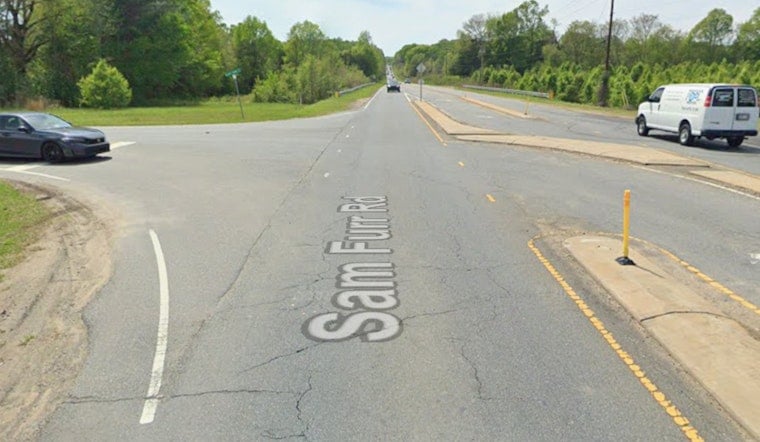
Cornelius commissioners voted 3-2 on Monday to approve a rezoning that clears the way for a $20 million inn styled after the English countryside, on 6.28 acres of land at the intersection of Sam Furr and Mayes roads that had been designated for rural, low-density use. The vote caps months of contentious debate over a project developer Jake Palillo says will bring a 40-room hotel, seven rental cottages, and a spa to a stretch of Cornelius long dominated by single-family homes and open land.
Commissioners Susan Johnson, Robert Carney, and Scott Higgins voted in favor of the rezoning, while Colin Furcht and Mike Osborne voted against it, according to Cornelius Today. The project, which the Charlotte Observer reports will be called the Cornelius Inn, is designed with Cotswold-style architecture, light-colored brick, and stone accents meant to evoke a European country inn rather than a typical chain hotel. Interiors are expected to carry what the Observer describes as a Ralph Lauren-type look, with cottages ranging from 900 to 1,200 square feet and each containing a single bedroom.
A Rural Preservation Parcel Rezoned for Lodging
Before the board's action, the 6.3-acre parcel carried a Rural Preservation designation under the Cornelius Land Development Code, a classification that caps residential density at one dwelling unit per five acres and explicitly bars commercial lodging uses like hotels and spas, according to the Town of Cornelius. Getting the inn built required commissioners to approve a conditional rezoning that departed from that baseline framework, which is part of why opponents argued the decision broke faith with the town's long-term planning guidelines.
Cornelius planning staff had recommended approval with conditions the month prior, concluding that a low-intensity, residentially scaled inn and spa would serve as an appropriate transition between the high-intensity commercial corridor along Sam Furr Road and the existing single-family homes on Mayes Road, per Cornelius Today's report. The town's planning board had earlier recommended the rezoning by a 5-3 vote, with supporters citing the project's quality and noting that only one Cornelius resident spoke against it at that July meeting. Opponents on the planning board countered that the hotel would clash with the character envisioned in the town's zoning plan.
A Developer's Pivoting Plans and a Troubled History
Palillo's path to the inn proposal was not a straight line. In October 2025, he had presented Cornelius's pre-development review committee with plans for an entirely different project on the same site: a 16-lot single-family subdivision, according to Lake Norman Publications. By early 2026 that plan had given way to the inn concept entirely, a rapid shift in scope that fed neighbor arguments that the project's direction couldn't be trusted.
Palillo's name also carries baggage from a prior fight along the same corridor. In September 2023, he withdrew plans for an $800 million Lagoona Bay resort in neighboring Huntersville — a project that would have included a 10-acre crystal lagoon off Sam Furr Road — after the local planning board recommended denial, public backlash mounted, and he filed libel lawsuits against protesting residents, according to reporting cited in the dossier. That history has shaped how skeptically some residents view his latest project, even though the Cornelius Inn is a far smaller undertaking. Palillo has said there is a strong need for the inn in the area, and his family is expected to run it, with rooms priced around $300 a night once it opens.
Neighbors Push Back Across Town Lines
The site sits where the municipal boundaries of Cornelius, Davidson, and Huntersville converge, inside Cornelius's Extra-Territorial Jurisdiction — meaning many of the people most directly affected by the project, in neighboring Davidson and Huntersville, have no vote in Cornelius elections, per Lake Norman Publications. That governance gap helps explain why the bulk of public hearing opposition came from outside Cornelius proper. Adjacent Davidson neighborhood residents raised traffic and public safety concerns, per the Observer, and opposed the hotel outright.
An online petition against the project gathered more than 930 signatures ahead of the August 17 vote, with organizers citing severe traffic congestion on NC 73, potential stormwater runoff into the Rocky River watershed, and the loss of rural open space. Sam Furr Road already carries more than 20,000 vehicles a day near the site, and the state's transportation department is planning a multi-phase widening of a 14-mile stretch of the corridor from two to four lanes between Lincoln and Cabarrus counties, according to NCDOT — a project residents say underscores how strained the road network already is.
Supporters See Jobs, Tax Revenue, and a Missing Amenity
Commissioner Susan Johnson, who voted for the rezoning, said the project would bring jobs, tax revenue, and business for the town, according to the Observer. She said Cornelius needs quality hotels to match the caliber of its business community. Bill Russell, who leads the Lake Norman Chamber of Commerce, spoke in favor of the rezoning and said the inn would fill a community need while drawing customers to local businesses and restaurants, adding that Cornelius needs first-class accommodations to match its business community.
Commissioner Mike Osborne and Commissioner Colin Furcht voted against the rezoning plan, aligning with residents who argued the approval undercuts the town's own land-use plan. Palillo has estimated that building the inn, its seven cottages, and the spa facility will take at least two years after initial site plan permits are finalized. Separately, Cornelius already holds a 2009 conditional zoning on Holiday Lane near Interstate 77 that permits a five-story, 100-room hotel — a site where the town board recently denied a Novant Health proposal for an emergency department, according to Lake Norman Publications, illustrating that this is not the town's only unresolved commercial lodging question along its busiest corridors.



