

























































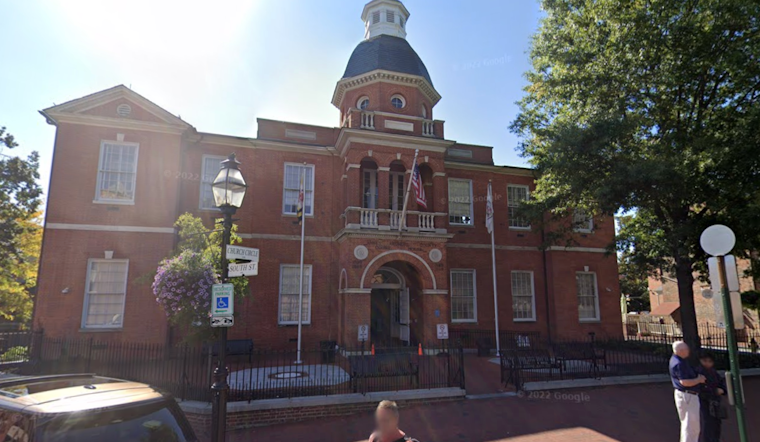
A 56-year-old Crofton woman was sentenced Tuesday for running two separate felony theft schemes that together drained more than $185,000 from a small Anne Arundel County contractor and a state auto insurance fund. Carolyn Rae Aldridge was sentenced by Associate Judge Stacy W. McCormack of the Circuit Court for Anne Arundel County following her guilty plea in March, with one scheme netting her $173,004.43 and the other $12,291.85, for a combined loss of $185,296.28.
According to WBFF, Aldridge worked as office manager for ABC Builders, an Anne Arundel County-based small business engaged in home improvement and general contracting, when she began stealing checks from the company in August 2017. Over more than three years, she diverted 96 checks meant for the business into her own personal bank account, causing a total loss of $173,004.43 to the company, per the same report.
While that scheme was still running, Aldridge took on a part-time contractual position in the fiscal department of the Maryland Automobile Insurance Fund, or MAIF, in January 2020. Court documents cited by the station indicate she used that access to intercept 13 checks belonging to the agency and deposit them into her own account as well, resulting in a $12,291.85 loss to MAIF. For roughly a year, from January 2020 to January 2021, Aldridge was reportedly running both theft schemes at the exact same time, according to the Office of the Attorney General of Maryland.
How the Sentence and Restitution Break Down
For the ABC Builders scheme, Aldridge was sentenced to five years of incarceration with all but 173 days suspended, and she remains under court order to pay back the full $173,004.43 owed to the company. For the MAIF scheme, she received a separate five-year sentence that was fully suspended after she paid the $12,291.85 owed to the fund upfront at Tuesday's sentencing hearing, satisfying that restitution obligation in full. She will also serve five years of supervised probation once released.
An Anne Arundel County Grand Jury formally indicted Aldridge on two counts of felony theft scheme on June 27, 2025, roughly nine months before she pleaded guilty to both charges in March. The state's case against her drew on an investigation led by the Attorney General's Fraud and Corruption Unit, working alongside Maryland Insurance Administration Investigator William Wagner and former Forensic Auditor Suzzanne Jones, with Anne Arundel County State's Attorney Anne Colt Leitess also assisting the prosecution, the AG's office says.
Officials Frame Case Around Betrayed Trust
Maryland Attorney General Anthony Brown announced the sentencing himself, and following Aldridge's 2025 indictment, he had already stated that workplace embezzlement from both private small businesses and state-created entities undermines institutional integrity and public confidence. Under Maryland Criminal Law Code § 7-104, felony theft of property valued at $100,000 or more carries a statutory maximum penalty of up to 20 years in prison and a fine of up to $25,000, in addition to mandatory victim restitution, according to Seddiq Law. Maryland classifies any theft over $1,500 as a felony under that same statute.
MAIF, one of the two victims in the case, was established by the Maryland General Assembly in 1972 to serve as the state's independent insurer of last resort, providing auto coverage to drivers who cannot secure it in the private market. Hoodline previously covered the fund's former Annapolis headquarters after it changed hands in a real estate sale earlier this year.
Judge McCormack, who has served as an associate judge on the Circuit Court for Anne Arundel County since December 2015, also presides over the court's Adult Drug Treatment Court and previously worked as an assistant public defender in Maryland before her judicial appointment. It remains unclear exactly how Aldridge's overlapping check-diversion schemes went undetected for so long at both organizations, or the precise payment schedule she must follow to repay the remaining $173,004.43 owed to ABC Builders during her five years of probation.





