

























































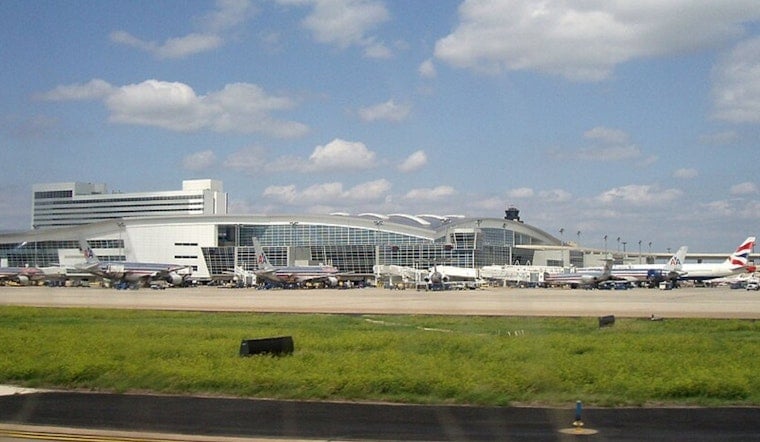
A 3-year-old German Shorthaired Pointer named Bolt, who spends his workdays sniffing out explosives at Dallas Fort Worth International Airport, has just been named the winner of the Transportation Security Administration's 2026 Cutest Canine Contest. The agency announced the results in a press release timed to International Dog Day, capping a nationwide vote that started with 85 nominated dogs and narrowed the field down to four finalists before Bolt came out on top.
Bolt's handler, Daphne Wang, described him as a dog who brings serious energy to a serious job. As reported by KTLA, Wang said Bolt is “quite the personality” and that working with him every day is an adventure. She also said Bolt works hard and plays even harder, and that he shows up to the job “1,000% excited” no matter the day.
According to Wang, that drive doesn't switch off once the shift ends. She said Bolt is always in working mode, even at home, and that he's a character and a hard-working dog who loves his job. Wang added that the national spotlight lets Bolt show the world his quirky personality, something that clearly resonated with voters across the country.
A Final Four Stacked With Working Dogs
Bolt's path to the title ran through three other finalists, each with their own airport pedigree. Ember, a Labrador Retriever from Orlando International Airport, was the lone female dog to reach the 2026 Final Four, having won the Southeast regional vote among TSA employees, per the agency's own account. Xaro, a 9-year-old German Shepherd from St. Louis Lambert International Airport, brought six years of experience as an explosives detection dog to the competition and was slated to retire by the end of 2026, according to TSA.
The fourth finalist, Epic, works at Pittsburgh International Airport, which had reason to feel confident heading into this year's vote. A Pittsburgh teammate, Labrador Retriever Steeler, won the 2025 title outright after beating out nearly 100 nominated dogs nationwide, as reported by CBS News at the time.
Pointer Power: A Breed on a Winning Streak
Bolt's win also extends a streak for his breed. He's the third German Shorthaired Pointer to take the national title in four years, following Barni of San Francisco International Airport in 2024 and Dina of Las Vegas's Harry Reid International Airport in 2023, according to a PR Newswire release documenting the contest's history. TSA has noted that German Shorthaired Pointers are widely used for passenger screening because of their high drive and friendly demeanor, traits that appear to translate well both on the job and in a public popularity vote.
The win comes with a tangible perk beyond bragging rights. Bolt's victory earns him the cover spot on TSA's 2027 Canine Calendar, a downloadable keepsake the agency releases to the public every December featuring its top working dogs.
The Serious Work Behind the Cute Photos
Behind the contest is a security apparatus that rarely gets this kind of public attention. TSA maintains more than 1,000 active explosives detection canine teams stationed at airports, mass transit hubs, maritime ports, and cargo facilities across the country, according to figures reported by Business Insider. All of those teams, dogs and handlers alike, go through specialized training lasting between 11 and 32 weeks at the TSA Canine Training Center at Joint Base San Antonio-Lackland in Texas.
Roughly 60% of the teams that graduate from that training center end up with state or local law enforcement agencies, while the remaining 40% are paired directly with TSA transportation security specialists like Wang and Bolt, per TSA's own figures. Passenger screening dogs such as Bolt are trained specifically to pick up explosive scent plumes drifting through moving crowds of travelers, rather than searching stationary bags or objects, according to research from the DHS Science and Technology Directorate.
The program tracing back to Bolt's job has deep roots. The federal explosives detection canine effort was established in 1972 under the Federal Aviation Administration following a bomb threat aboard a TWA flight, and it transferred to TSA's oversight in 2003 after the September 11 attacks, according to TSA's own historical account. More than five decades later, that legacy now includes a Dallas airport pointer with a knack for winning both security assignments and popularity contests.





.jpg)