

























































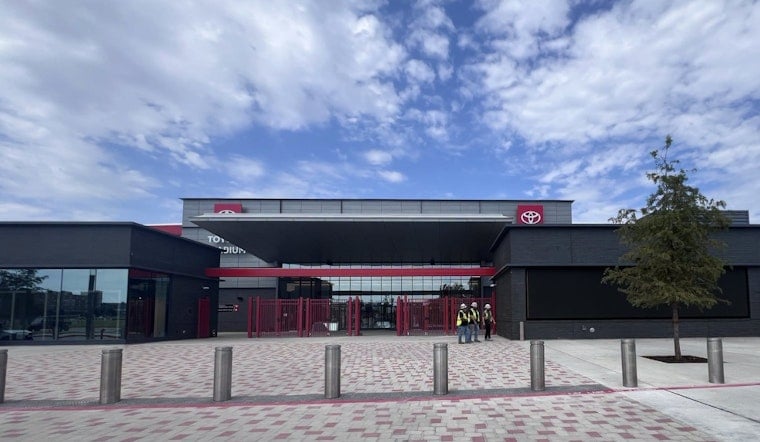
FC Dallas president Dan Hunt personally guided Frisco city and school officials through Toyota Stadium this week, showing off Phase One renovations that include a new entrance anchored by a video board, mesh seating, fresh wayfinding signage, and a shade canopy. The walkthrough came just before high school football returned to the stadium on Thursday, and ahead of FC Dallas's next home match next Saturday.
According to the City of Frisco TX - City Hall, Hunt's tour included Mayor Mark Hill, members of the Frisco City Council, the Frisco Independent School District Board of Trustees, the Frisco Community Development Corporation, and city staff. The group inspected progress on the stadium's east side renovations, part of a broader project that will eventually give Toyota Stadium a new club area with premium amenities. The tour offered officials a firsthand look at how their public investment is taking shape roughly two years into construction.
A $182 Million Bet on Frisco's Future With FC Dallas
The renovation traces back to September 2024, when the Frisco City Council approved a $182 million public-private partnership to redevelop Toyota Stadium and extend FC Dallas's lease in the city through 2057, according to the City of Frisco. The deal locks the club into Frisco for at least three more decades, with full project completion targeted for 2028.
Public entities are shouldering $117 million of the total cost, the city says, made up of $77 million from a Tax Increment Reinvestment Zone shared by Frisco and Frisco ISD, plus $40 million in Frisco Community Development Corporation sales tax bonds. Hunt Sports Group is covering the remaining $65 million and has agreed to absorb any cost overruns. The project's budget grew further in April, when the Frisco City Council unanimously approved an additional $9.26 million for seating bowl remediation and stadium Wi-Fi restoration, according to Community Impact. That add-on was split between $5.46 million in public funds and $3.81 million from the stadium's operating entity, with seating bowl repairs alone accounting for roughly $7.5 million of the increase.
Bigger Club Seats, Bigger Screen, Bigger Capacity
Once every phase wraps in 2028, Toyota Stadium's seating capacity will grow by 10% to 23,900, per FC Dallas. Club seating capacity is set to jump 175% and suite capacity by 58%, while a new 6,000-square-foot video board is expected to become the largest among soccer-specific stadiums in Major League Soccer. Those upgrades build on the venue's history: the stadium first opened as Pizza Hut Park on August 6, 2005, after an initial $80 million build, making it MLS's third-oldest soccer-specific venue, the club notes. FC Dallas played at the Cotton Bowl before the move to Frisco.
This isn't the stadium's first major overhaul. A previous $41.6 million renovation culminated in the 2018 opening of the National Soccer Hall of Fame inside the stadium's south end zone, according to Manhattan Construction Company, which added 61,400 square feet of conditioned space along with new locker rooms and made it the first major sports hall of fame built inside a stadium. Manhattan Construction Group, based in Naples, Florida, is again serving as general contractor on the current project, with Dallas-based HKS Architects handling design, according to Construction Dive. HKS also designed the stadium's original 2005 layout.
Construction Kept Running Through a World Cup Camp
Remarkably, Toyota Stadium has stayed fully operational through all of this work, hosting FC Dallas regular-season games and Frisco ISD high school football alongside the construction. It even served as the official training base camp for Sweden's men's national team during the 2026 FIFA World Cup in June and July, according to the Associated Press. During that stretch, Swedish players were reportedly startled by a controlled pull-down demolition of the stadium's old press box, which they initially mistook for storm damage; FC Dallas confirmed it was planned work in an active construction zone that did not affect pitch operations, per the same report.
The stadium overhaul fits into Frisco's larger identity as self-styled Sports City USA, a branding push tied to real revenue. The city's sports tourism economy generated a record $96.6 million in total economic impact and $13.1 million in hotel occupancy tax revenue in fiscal year 2024, driven by 259 athletic events and conventions, Hoodline has reported. Toyota Stadium's expanded amenities are designed to keep that momentum going as the venue competes for both league games and marquee international attention.
Frisco also renewed its corporate relationship with the stadium's naming-rights partner last year, a deal Hoodline covered in its renewed Toyota partnership story. With Phase One now visible to the officials who approved its funding, and high school football back on the pitch, the stadium's next milestone arrives Saturday, September 5, when FC Dallas hosts its next MLS home match under the partially transformed venue.





