

























































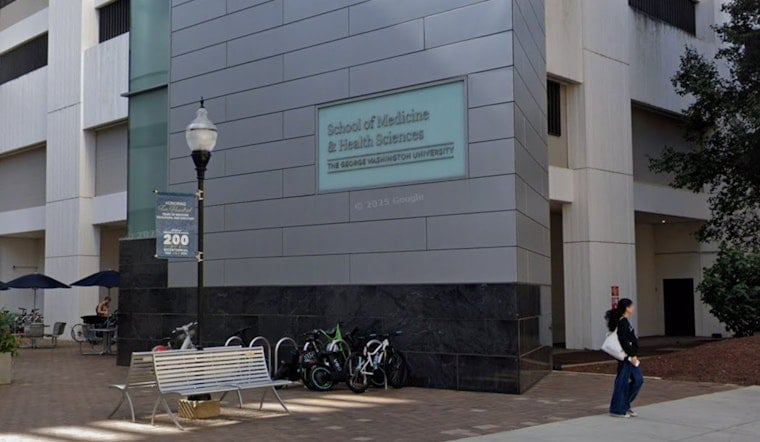
The Justice Department says George Washington University's School of Medicine and Health Sciences illegally used application essays to figure out applicants' race, then used that information to shape who got interviewed and admitted into its 2024 and 2025 incoming classes. Federal investigators concluded the medical school's admissions officers relied on essay questions specifically designed to elicit an applicant's race or ethnicity, even after the university had already banned self-reported racial check-boxes on applications.
According to WUSA9, the Justice Department announced that its Civil Rights Division found GW Med intentionally discriminated based on race in granting and denying admission. The finding, detailed in the department's findings letter, describes a workaround built specifically to get around the university's own guidance. After the Supreme Court's 2023 ruling in Students for Fair Admissions v. Harvard banned race discrimination in higher education, GW issued university-wide guidance prohibiting admissions officers from using self-reported racial check-boxes. Federal investigators say GW Med circumvented that guidance anyway, using secondary essay questions crafted to draw out an applicant's race or ethnicity so admissions officers could use it to select interview candidates.
MCAT Scores and Interview Ratings Under Scrutiny
The numbers cited in the findings letter are stark. The Justice Department reported that Black applicants admitted to GW Med's 2024 and 2025 incoming classes scored significantly lower on the Medical College Admission Test than admitted white or Asian applicants, while also receiving disproportionately higher interview scores than comparable Asian applicants, per the department. Investigators say GW Med admissions officers used those essays to select interview candidates, and that the school denied admission to white and Asian applicants in favor of Black and Hispanic applicants, per the Justice Department's account.
Assistant Attorney General Harmeet K. Dhillon framed the finding as a straightforward legal violation, saying admissions officers can no longer discriminate based on race in the name of diversity. Dhillon has argued that using diversity-focused essay questions to identify and grant preferences to specific racial groups violates Title VI of the Civil Rights Act of 1964 and Supreme Court precedent, according to the department's findings. Title VI itself prohibits discrimination based on race, color, or national origin by any entity receiving federal financial assistance, and, per the Congressional Research Service, non-compliant institutions can face administrative enforcement including the deferral, termination, or complete withholding of federal grants.
A Legal Line Drawn by the Supreme Court
The dispute turns partly on how far Chief Justice John Roberts' majority opinion in SFFA v. Harvard actually goes. The ruling allowed applicants to discuss how race shaped their individual lives, but only when tied to personal character or unique ability, according to Discourse Magazine. Roberts explicitly cautioned that application essays could not be used to re-establish unlawful race-conscious admissions regimes, which is the theory federal investigators are now applying directly to GW Med's essay prompts.
That legal theory is also shaped by a regulatory shift that took effect in December, when the Justice Department published a final rule amending its Title VI regulations to eliminate disparate-impact liability, restricting enforcement strictly to cases of proven intentional discrimination, as explained by HR Works. That change is why investigators focused so heavily on demonstrating intentional race-conscious screening at GW Med rather than pointing only to statistical outcomes.
Part of a Broader Federal Sweep
GW Med is far from the only school caught up in this. It joins a growing list of elite medical schools cited by the DOJ's Civil Rights Division in 2026, following formal findings against Yale School of Medicine and UCLA's David Geffen School of Medicine in May, UC Davis School of Medicine in June, and UC San Diego School of Medicine in July. The department has said prioritizing racial demographics over academic merit in medical admissions poses public health risks.
Just weeks earlier, Hoodline reported that the DOJ accused Duke Law of bias, citing the law school's use of personal essay questions and internal diversity tags as proxies to preserve race-conscious admissions outcomes. The George Washington University itself has acknowledged the scope of this campaign, noting in a January federal update that the Justice Department has been reviewing diversity policies and potential racial proxies across more than 50 colleges and medical schools nationwide, with joint reviews alongside the Department of Education's Office for Civil Rights launched at schools including Dartmouth and East Carolina University.
GW's Second Title VI Finding in a Year
This is not GW's first brush with a federal civil rights finding in the past year. The medical school probe follows an August 2025 determination that GWU showed deliberate indifference to campus antisemitism during the spring 2024 encampments, according to Higher Ed Dive. That earlier finding drew pushback from GWU faculty groups who argued the federal action chilled academic freedom. Two major Title VI violation findings within twelve months puts the university in a position where remediation failures could expose it to federal funding sanctions.
George Washington University has not provided a statement to WUSA9 regarding the medical school findings. The admissions probe also lands as GW Med's clinical system undergoes significant operational change: in March, hospital operator Universal Health Services moved to take control of and employ clinicians from the financially troubled GW Medical Faculty Associates, as Hoodline reported in its piece on the UHS takeover of GW doctors. That restructuring came after the physician group had accumulated substantial financial losses, prompting renegotiations between UHS and the university well before the federal admissions findings became public.





