

























































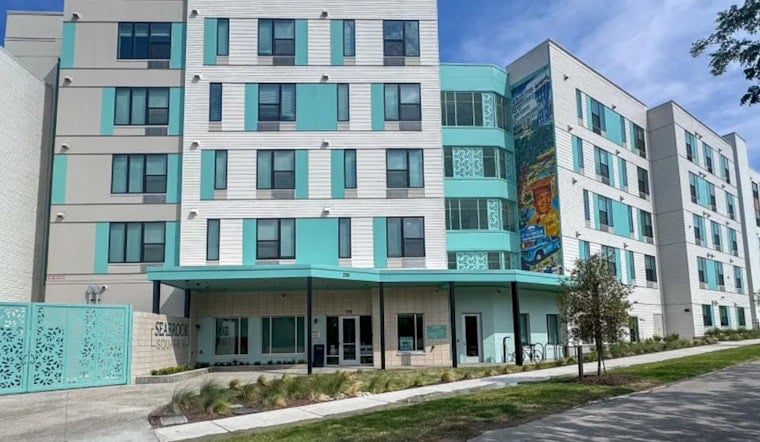
The first 14 residents have moved into Seabrook II, a new $21 million supportive housing complex near Manor Road and E.M. Franklin Road in East Austin that will eventually house 60 formerly homeless residents alongside on-site mental health and medical services. The building marks Integral Care's fourth supportive housing location, part of a growing local effort to pair permanent housing with the wraparound care that advocates say is necessary to break cycles of chronic homelessness.
According to the Austin American-Statesman, which first reported on the opening, Seabrook II provides single-resident housing units for people who have experienced homelessness, and residents sign 12-month leases they can renew. Those with income pay no more than 30% of it toward rent, while residents with no income pay nothing at all, the paper reports. Integral Care, which serves as Travis County's mental health authority, uses housing vouchers to cover rent for qualifying tenants and operates under what it calls a housing-first model.
A Complex Built Around Trauma-Informed Design
Seabrook II was designed with trauma-informed principles in mind, according to the Statesman, and includes features meant to support both privacy and community. The building has open-air vestibules with screened-in space on each floor, an outdoor living space between the apartment building and a garage, and a large community room. Residents also have access to free washers and dryers, computers, and a 24-hour front desk receptionist along with round-the-clock security.
On-site support extends beyond the physical building. Central Health provides on-site medical care once a week, and the complex includes a peer support specialist along with staff who help residents sign up for Medicare, Medicaid, Social Security, SNAP, and Central Health's medical access program, per the same account. The complex also offers art therapy, cooking classes, and recovery meetings — though residents are not required to use any of the support resources.
Feeding Residents Through Donated Supplies
Seabrook II includes a food pantry stocked by the Central Texas Food Bank and supplemented with grant-funded H-E-B products including milk, eggs, and meat, the newspaper reports. Kali Holyfield, quoted in the Statesman's coverage, said “the key to healing is connection” — a philosophy reflected in the building's communal spaces and shared resources. Residents are also allowed to bring pets, though Integral Care requires a plan for pet care in case a resident is hospitalized or dies.
Marlene Buchanan, also quoted in the report, said “if we can solve the housing, everything else will follow.” She added that Integral Care became a housing provider “out of necessity,” and noted that residents may reject support resources repeatedly before eventually accepting them. Unlike Integral Care's three other supportive housing sites, where residents typically stay two to five years and can remain longer depending on their health and needs, Seabrook II's lease structure was detailed by the Statesman without specifying a similarly extended timeline.
How the $21 Million Project Was Financed
Funding for Seabrook II came from a mix of sources, including designated housing funds from the City of Austin, Travis County, and the federal government, with some money originating from COVID-19 pandemic funding programs, according to the Statesman's reporting. That blended financing model mirrors other Integral Care properties: the Nellie was renovated for $14 million using federal funding, the Bungalows was renovated for $4 million using City of Austin funding, and the Terrace at Oak Springs cost $19 million. Integral Care now spends about $4 million annually on support services across its four properties, and the agency currently has no new funding available for additional properties, the paper reports.
Seabrook II sits adjacent to Seabrook Square I, which opened 204 affordable housing units for households earning up to 60% of the Area Median Income in July, according to the City of Austin. Together the two phases form a 264-unit development on Pershing Drive designed to serve a range of income levels, from working families to formerly unhoused residents with intensive needs. The site sits within East Austin's historic J.J. Seabrook neighborhood, named for Dr. John Jarvis “J.J.” Seabrook, a Black educator, pastor, and former president of Huston-Tillotson University, as reported by KVUE.
A Novel Funding Mechanism and a Growing Need
The City of Austin allocated $5.18 million to Seabrook Square II through its Downtown Density Bonus Program, making the complex the city's first capital project funded by trading increased height and density allowances on downtown high-rises for affordable housing revenue, according to Community Impact. The city also secured 60 local project-based housing vouchers to keep the efficiency units affordable to tenants earning 30% or less of the Area Median Income for at least 40 years, per Urbanize Austin. Formerly unhoused residents are matched to the units through Travis County's Coordinated Entry system, a 28-question evaluation administered by the Ending Community Homelessness Coalition, which also counted 3,865 unsheltered people in Travis County in 2025 and maintains the resident selection list, per the Statesman.
Nearly half of the people who experienced homelessness in Austin during 2025 reported becoming unhoused for the first time, according to the City of Austin, underscoring the urgency behind projects that pair housing with medical and mental health care. Integral Care, which now has 225 permanent supportive housing units across its four properties, appointed CEO Jeff Richardson in February 2024 to head the agency and oversee an expansion of its housing portfolio. Seabrook II's groundbreaking, previously covered by Hoodline, laid the foundation for the 60 units now slowly filling with residents starting new chapters after homelessness.





